
Health
Study Finds Calorie Restriction Can Boost Chemotherapy Effectiveness in Sarcoma Treatment


A new Portuguese-Brazilian study suggests that controlling calorie intake can improve the effectiveness of chemotherapy in treating sarcomas, a rare type of cancer, while also protecting healthy cells from treatment damage. The research, conducted by the RISE Health Research Unit in collaboration with the Federal University of Piauí in Brazil, was released on World Cancer Day, February 4, a day promoted by the International Union Against Cancer (UICC) to raise awareness of cancer prevention, early diagnosis, and access to treatments.
The study found that moderate calorie restriction, alone or in combination with chemotherapy drugs such as doxorubicin, significantly reduced tumour size and weight, increased tumour inhibition rates, and protected normal cells from chemotherapy-induced damage. Researchers reported that a 40 percent reduction in calorie intake induced metabolic stress in the tumour microenvironment, disrupting processes essential for cancer growth.
“From this experimental study, carried out on animal models, we observed that calorie restriction for short periods can be favourable to cancer treatment,” said Moisés Tolentino Bento da Silva of RISE Health, who led the research in Portugal. He explained that higher energy intake fuels cancer progression, so reducing calorie intake limits the energy supply to the tumour and enhances chemotherapy effectiveness.
The study also highlighted additional benefits of calorie restriction. It supports DNA repair in healthy tissues damaged by chemotherapy and reprogrammes lipid metabolism, lowering cholesterol and triglyceride levels that feed malignant cells. Researchers noted that these effects may also have broader implications for managing chronic conditions such as type II diabetes, cardiovascular disease, and neurodegenerative disorders.
Alongside dietary control, the study emphasized the importance of regular physical exercise during cancer treatment. “If cancer patients exercise adequately and regularly during chemotherapy, they will experience fewer side effects in various systems, such as the gastrointestinal tract,” Tolentino Bento da Silva said. “Physical exercise, together with a good diet, has great benefits for the patient’s quality of life, whether it is preventative, during treatment, or after oncological therapy.”
The research, published in the journal Cancers, provides new evidence that lifestyle interventions, including calorie management and physical activity, can complement traditional cancer therapies. While the study was conducted on animal models, the findings open pathways for clinical research and potential integration into patient care protocols.
As cancer treatment continues to evolve, experts suggest that non-pharmacological approaches such as diet and exercise may play an increasingly important role in supporting patients, improving treatment outcomes, and enhancing overall well-being during chemotherapy.












Portuguese teenagers are reporting lower levels of alcohol and drug use and fewer problems linked to addictive behaviours, but risks are becoming increasingly concentrated among young people facing multiple personal and social difficulties, according to a new study.
The findings come from the 2024 Study on Alcohol, Tobacco, Drugs and Other Addictive Behaviours (ECATD-CAD), conducted by the Institute for Addictive Behaviours and Dependencies (ICAD). The research examines addictive behaviours among pupils aged 13 to 18 attending state schools across Portugal.
Compared with the previous study in 2019, the latest results show a consistent decline in reported problems, including violence, accidents, hospitalisations, risky sexual behaviour and other incidents with potentially serious consequences.
Researchers linked the broader improvement to several protective factors. Students reported better academic performance, closer parental supervision and fewer nights out, suggesting that changes in family and school environments may be helping reduce risky behaviour.
However, ICAD warned that the overall decline does not mean the problem has disappeared. The most serious behaviours are increasingly concentrated in a relatively small group of adolescents who face greater individual and social vulnerabilities.
Recent alcohol consumption and, particularly, illicit drug use remain strongly associated with problematic situations. Young people who use psychoactive substances report higher rates of risky sexual behaviour, violence between individuals, accidents and trouble with the police.
The report noted that these problems do not necessarily occur immediately after substance use, but the association remains significant.
Combining alcohol with illicit drugs appears to carry additional risks. Adolescents who reported recent use of both substances experienced higher levels of accidents, police-related problems, cyberbullying and risky sexual behaviour than those who consumed alcohol alone.
Alcohol use also raises concerns about why some teenagers drink. While pleasure, entertainment and socialising remain the main motivations, a significant proportion said they consumed alcohol to forget their problems. ICAD identified this as a warning sign associated with potentially harmful drinking patterns and dependence.
Cannabis use presented a mixed picture. Although most users showed no indicators of dependency risk, the proportion classified as being at high risk increased, alongside growth in the group with no identified risk.
Social media remained the main concern among behaviours not involving substances. A significant number of young people acknowledged spending excessive time on these platforms. Indicators of problematic electronic gaming remained broadly stable, while gambling for money became more prevalent among adolescents, despite a slight decline in some indicators of problematic gambling.
The study also identified differences between boys and girls. Boys were more likely to report problems with the police, risky gaming and gambling. Girls reported higher levels of problematic social media use and were more likely to use alcohol to cope with emotional difficulties.
Family circumstances and wellbeing were also important. Low academic achievement, limited parental supervision, frequent nights out and poorer physical and emotional health were associated with greater risk. Better school performance, stronger parental involvement and improved wellbeing appeared protective.
Regional differences were also evident. Alentejo recorded the highest concentration of unfavourable indicators, followed by the Azores. Lisbon, which showed the greatest vulnerability in the 2019 study, no longer held that position.
ICAD’s findings point to the need for targeted support for vulnerable adolescents, even as overall patterns of substance use and related problems improve.

The death of a scientist in Russia’s Siberian region of Irkutsk has revived concerns about plague, but health authorities say there is currently no evidence of an outbreak or sustained transmission in Europe.
The woman died from pneumonia of unknown origin, prompting speculation that she could have contracted pneumonic plague. Russian authorities have said no plague cases have been confirmed in the region, while tests conducted on people who had contact with the woman were negative.
The World Health Organization has asked Russia for additional information about the incident and offered assistance to local health authorities.
Plague is caused by the bacterium Yersinia pestis, which remains present in wild animal populations in parts of the world. It is commonly associated with rodents and the fleas that live on them. People can become infected through bites from infected fleas, contact with tissues or bodily fluids from infected animals, or respiratory particles from people suffering from pneumonic plague.
For Spain and most of Europe, however, the current risk is considered very low. The European Centre for Disease Prevention and Control says routine transmission has not been recorded in Europe for more than five decades.
That does not mean the bacterium has disappeared. Its continued presence in animal reservoirs means isolated human infections remain possible, particularly in areas where infected wildlife and fleas are found.
Spain has maintained epidemiological surveillance despite the absence of locally acquired cases for decades. In April 2026, its Public Health Commission updated the national plague protocol, including case definitions, epidemiological information and procedures for investigating suspected infections.
European authorities have also been monitoring the Siberian incident. The European Union discussed the case at a Health Security Committee meeting on October 7, while the ECDC said there was no evidence of secondary cases or sustained person-to-person transmission.
The WHO has assessed the risk to the European region as very low.
Plague continues to occur in parts of Africa, Asia and the Americas. According to the WHO, most reported human cases between 2019 and 2025 were concentrated in Madagascar and the Democratic Republic of the Congo. Madagascar records bubonic plague cases during its annual epidemic season, generally from September to April. In the United States, about seven human cases are reported each year, mainly in rural areas of western states.
The disease can occur in bubonic, pneumonic or septicaemic forms. Bubonic plague usually causes fever and painful swollen lymph nodes after an infected flea bite. Pneumonic plague affects the lungs and can spread between people through respiratory particles. Septicaemic plague occurs when the infection enters the bloodstream.
Modern antibiotics can successfully treat plague, but early diagnosis is critical. Health surveillance, rapid identification and treatment remain important in preventing isolated infections from developing into wider outbreaks.
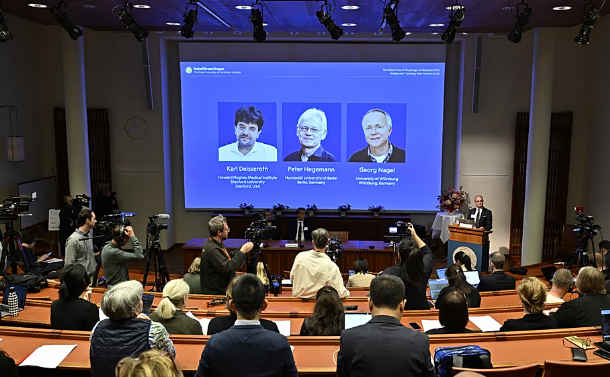
Scientists Karl Deisseroth, Peter Hegemann and Georg Nagel have been awarded the 2026 Nobel Prize in Physiology or Medicine for their work on light-gated ion channels and optogenetics, a technique that has transformed the study of the brain.
The Nobel Assembly at Karolinska Institutet announced the award on Monday, describing the work as laying the foundation for a new era in neuroscience.
Optogenetics allows researchers to control selected cells using light, effectively providing a remote switch that can turn specific cells on or off. The technique has enabled scientists to investigate how individual neurons and neural circuits influence behaviour in living animals.
The origins of the discovery date back to Hegemann’s research more than three decades ago. While studying the single-celled alga Chlamydomonas, which moves towards light, he sought to understand how the organism detects changes in illumination.
Hegemann focused on the alga’s eyespot, a small light-sensing structure on its surface. His research and subsequent experiments identified light-sensitive proteins known as channelrhodopsins.
Hegemann later worked with Nagel at the Max Planck Institute for Biophysics in Frankfurt. The researchers inserted genes from the algae into frog egg cells and human kidney cells, demonstrating that channelrhodopsin functions as a light-controlled ion channel.
When exposed to blue light, the channel can open within about 0.2 milliseconds. Positively charged ions then enter the cell, generating an electrical signal.
Deisseroth later adapted the discovery for neuroscience. He introduced the channelrhodopsin gene into rat nerve cells and showed that blue light could activate the cells and trigger nerve signals.
He subsequently used the technique in the brains of living mice, demonstrating that researchers could control specific groups of neurons with light. Experiments showed that stimulating selected neural circuits could produce physical responses, including movements of a mouse’s whiskers, or cause sleeping animals to wake.
The method was named optogenetics in 2006 and has since become an important research tool in neuroscience.
Researchers now use it to establish direct links between neural activity and behaviour. By activating or silencing particular groups of cells, scientists can study circuits associated with fear, anxiety, reward, pain, thirst, attention and aggression.
The technique has also been used in research into conditions including depression, schizophrenia, anxiety, Alzheimer’s disease, Parkinson’s disease and epilepsy.
Per Svenningsson, chair of the Nobel Committee for Physiology or Medicine, said the discovery provides opportunities to map the brain in ways researchers could previously only imagine.
Optogenetics has also moved beyond laboratory research. Scientists are testing its potential as a treatment for retinitis pigmentosa, a genetic disorder that causes blindness through the loss of light-sensitive retinal cells.
In experimental treatments, researchers introduce genes encoding light-sensitive proteins into surviving retinal cells. In some trials, patients using specialised light-emitting goggles have been able to regain partial vision and detect high-contrast objects.
The Nobel award recognises a discovery that has given researchers an unprecedented way to investigate the relationship between brain cells, neural circuits and behaviour.

France Considers Exit Tax on Crypto Gains and €10,000 Fine for Undeclared Wallets

Portuguese Teenagers Report Lower Drug and Alcohol Use, but High-Risk Behaviour Persists

Lancet Study Warns AI Misuse and Nuclear War Could Threaten Humanity by 2100

Spanish Police Clear Ceuta’s Last Migrant Camp Ahead of Royal Visit

Macron to Push ‘Made in Europe’ Agenda at Final Paris Motor Show Visit

Scientists Warn of Possible Major Rockslide at Germany-Austria Border Mountain

EU May Need to Cut Gas Consumption by 7% This Winter as Reserves Hit Record Low

Russian Escalation Raises Questions Over EU’s €90 Billion Ukraine Support Plan

Teacher Salaries Across Europe: Germany Leads as Major Pay Gaps Persist

Etihad Airways and flydubai Cancel Saudi Flights After Riyadh Airport Attacks

Meta Acquires Tilda Swinton VR Doc ‘Impulse: Playing With Reality’

China’s Historic Olympic Victory Sparks National Pride Amid Controversy

Saudi Arabia’s Model for Sustainable Aviation Practices

Recent Developments in Small Business Taxes

Effective Drain Cleaning: A Key to a Healthy Plumbing System

Who was Ebrahim Raisi and his status in Iranian Politics?

Keely Hodgkinson Wins Britain’s First Athletics Gold at Paris Olympics in 800m

Carrectly: Revolutionizing Car Care in Chicago

Nobel Laureate Muhammad Yunus Proposed as Head of Bangladesh’s Interim Government Following Hasina’s Resignation

Chinese Hackers Infiltrate Major U.S. Telecom Firms in Possible National Security Breach

Sony WF-10XM4: Headphones Are Our Absolute Favorite

10 Places You Can’t Miss If It’s Your First Time in European

New Census Data Will Shake Up Alabama Politics

16 Top of Our Favorite Outdoor Clothing Brands

Fashionable Summer Accessories to Dress Up Your Travel Look

How Sleeping Less than 7 Hours a Night Can Lead to Weight Gain
-
 Entertainment2 years ago
Meta Acquires Tilda Swinton VR Doc ‘Impulse: Playing With Reality’
-
 Sports2 years ago
China’s Historic Olympic Victory Sparks National Pride Amid Controversy
-
 Business2 years ago
Saudi Arabia’s Model for Sustainable Aviation Practices
-
 Business2 years ago
Recent Developments in Small Business Taxes
-
 Home Improvement2 years ago
Effective Drain Cleaning: A Key to a Healthy Plumbing System
-
 Politics2 years ago
Who was Ebrahim Raisi and his status in Iranian Politics?
-
 Sports2 years ago
Keely Hodgkinson Wins Britain’s First Athletics Gold at Paris Olympics in 800m
-
 Business2 years ago
Carrectly: Revolutionizing Car Care in Chicago