
Sports
Keely Hodgkinson Wins Britain’s First Athletics Gold at Paris Olympics in 800m


Paris – In a sensational display of speed and determination, Keely Hodgkinson has clinched Great Britain’s first athletics gold medal at the Paris Olympics, winning the 800m final. The 22-year-old runner delivered an outstanding performance, crossing the finish line in a remarkable time of 1:57.62, securing her place in British sporting history.
Hodgkinson’s victory is a landmark achievement, as it marks the first time a British woman has won Olympic gold in the 800m since Kelly Holmes’ triumph in Athens 2004. The race at the Stade de France was fiercely competitive, but Hodgkinson maintained her composure and executed her strategy flawlessly. As the pack surged forward in the final lap, she made her decisive move, pulling ahead with a powerful burst of speed that left her competitors trailing.
This gold medal is a testament to Hodgkinson’s hard work and perseverance. The young athlete from Wigan has been a rising star in British athletics, and her victory in Paris solidifies her status as one of the sport’s brightest talents. Her journey to the top has been marked by steady progress and a series of impressive performances, culminating in this Olympic triumph.
Speaking after the race, Hodgkinson expressed her joy and gratitude, dedicating the win to her coaches, family, and supporters. “It’s a dream come true,” she said. “I’ve worked so hard for this moment, and to win gold for my country is just incredible.”
The win has sparked celebrations across the UK, with fans and fellow athletes hailing Hodgkinson’s achievement. As the first athletics gold for Team GB at these Games, her victory has set a high standard for the rest of the British track and field contingent.
Keely Hodgkinson’s gold medal in the 800m not only adds to Britain’s illustrious Olympic legacy but also promises a bright future for the young star in the world of athletics.








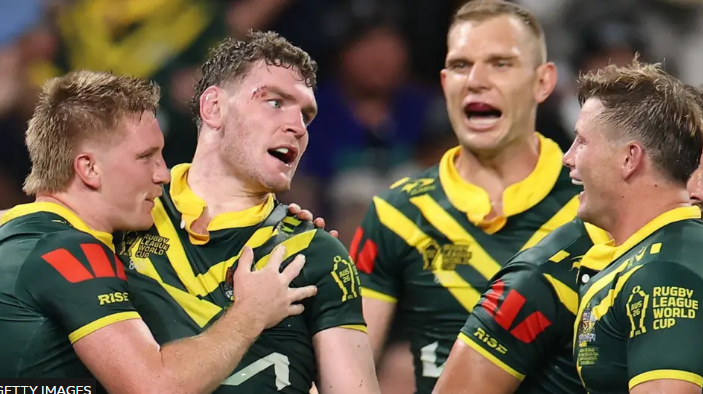
Australia confirmed their status as the leading force in international rugby league with a commanding 32-12 victory over New Zealand in the World Cup final, securing their fourth consecutive title and extending their record to 13 tournament triumphs.
The Kangaroos produced a dominant first-half performance to establish a 24-6 lead and put themselves firmly on course for victory in front of a sell-out crowd of 52,500. The result continued Australia’s remarkable run of 23 consecutive World Cup match wins since their defeat to New Zealand in the 2008 final.
The victory was particularly significant after Australia had struggled to convince earlier in the tournament. They had been pushed hard by New Zealand in their opening meeting on October 15, eventually winning 24-22 despite being outplayed for long periods.
Five weeks later, Kevin Walters’ side delivered a far more convincing performance, showing the strength and experience that have made them the team to beat.
Australia took control almost immediately after New Zealand winger Jamayne Isaako made an error from the opening kick-off. Liam Martin capitalised, powering over for the opening try after just 84 seconds.
New Zealand briefly responded through Casey McLean, the youngest player in the final, who crossed to bring the scores level. However, the Kiwis struggled to maintain possession and repeatedly gave Australia opportunities to attack.
Reece Walsh and Bradman Best combined to create the next opening, allowing winger Jack Bostock to score his eighth try of the tournament. Best then added a try of his own before Martin crossed for his second, giving Australia a commanding advantage at half-time.
New Zealand’s difficulties continued after the break when hooker Erin Clark lost possession in a tackle just 36 seconds into the second half.
Australia quickly turned the mistake into another score. Walsh produced impressive footwork to evade two defenders before releasing an acrobatic pass to Tom Trbojevic, who finished in the right corner.
The contest had been billed partly as a battle between Walsh and New Zealand full-back Kalyn Ponga, who had received the Golden Boot award on Thursday. However, Ponga struggled to influence the match and later sent a pass into touch while his side were in a promising attacking position.
New Zealand continued to compete despite the growing deficit, with Isaiah Papali’i scoring a try that briefly lifted their hopes.
But Australia had the final say. Bostock crossed for his second try, completing another impressive performance from the 23-year-old winger, who had been recovering from knee reconstruction surgery a year earlier.
The final whistle confirmed Australia’s latest championship and extended their record as the most successful nation in Rugby League World Cup history.

Costa Concordia Captain Francesco Schettino Released From Prison on Probation

Chronic Loneliness Linked to 38% Higher Dementia Risk, Study Finds

Denmark Has Europe’s Widest Urban-Rural House Price Gap, OECD Data Shows

Trump Administration Fires US National Cyber Director Sean Cairncross

JPMorgan Chase, Visa and Mastercard Customer Data Exposed in Third-Party Cyberattack

Canada and China Agree to Ease Tariffs on Pork, Seafood and Metals

Germany Ranks Last in Business Start-up Bureaucracy Study, Requiring Nearly 4,000 Hours

UK Inflation Rises to 3.6% in October as Record Diesel Prices Push Up Costs

EU Accuses Temu of Failing to Prevent Illegal Products, Risking Heavy Fine

Measles Cases Decline Across Europe in 2026, but Outbreaks Persist in Several Countries

China’s Historic Olympic Victory Sparks National Pride Amid Controversy

Meta Acquires Tilda Swinton VR Doc ‘Impulse: Playing With Reality’

Saudi Arabia’s Model for Sustainable Aviation Practices

Recent Developments in Small Business Taxes

Effective Drain Cleaning: A Key to a Healthy Plumbing System

Who was Ebrahim Raisi and his status in Iranian Politics?

Keely Hodgkinson Wins Britain’s First Athletics Gold at Paris Olympics in 800m

Carrectly: Revolutionizing Car Care in Chicago

Nobel Laureate Muhammad Yunus Proposed as Head of Bangladesh’s Interim Government Following Hasina’s Resignation

Chinese Hackers Infiltrate Major U.S. Telecom Firms in Possible National Security Breach

Sony WF-10XM4: Headphones Are Our Absolute Favorite

10 Places You Can’t Miss If It’s Your First Time in European

New Census Data Will Shake Up Alabama Politics

16 Top of Our Favorite Outdoor Clothing Brands

Fashionable Summer Accessories to Dress Up Your Travel Look

How Sleeping Less than 7 Hours a Night Can Lead to Weight Gain
-
 Sports2 years ago
China’s Historic Olympic Victory Sparks National Pride Amid Controversy
-
 Entertainment2 years ago
Meta Acquires Tilda Swinton VR Doc ‘Impulse: Playing With Reality’
-
 Business2 years ago
Saudi Arabia’s Model for Sustainable Aviation Practices
-
 Business2 years ago
Recent Developments in Small Business Taxes
-
 Home Improvement2 years ago
Effective Drain Cleaning: A Key to a Healthy Plumbing System
-
 Politics2 years ago
Who was Ebrahim Raisi and his status in Iranian Politics?
-
 Business2 years ago
Carrectly: Revolutionizing Car Care in Chicago
-
 News2 years ago
Nobel Laureate Muhammad Yunus Proposed as Head of Bangladesh’s Interim Government Following Hasina’s Resignation