Connect with us

Business

Record-Breaking Bluefin Tuna Sells for €2.78 Million at Tokyo New Year Auction

Published

on

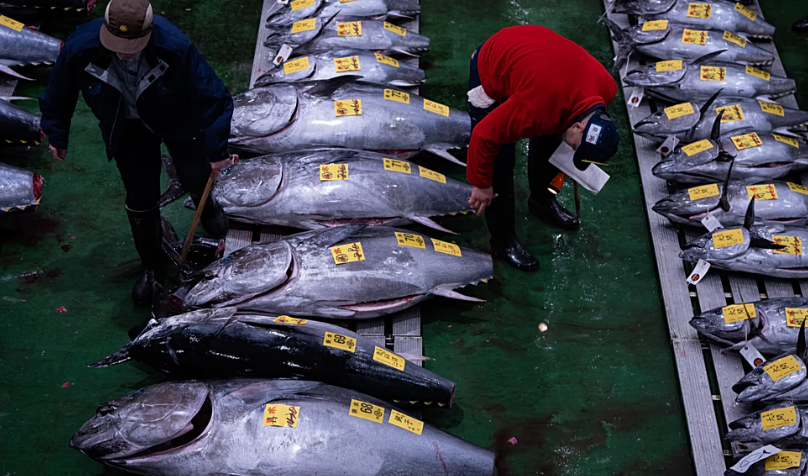
A 243-kilogram bluefin tuna sold for a staggering 510 million yen (€2.78 million) at the first auction of 2026 at Tokyo’s Toyosu fish market, setting a new record for the prized species.

The winning bidder was Kiyomura Corp., owned by Kiyoshi Kimura, who also runs the popular Sushi Zanmai chain. Kimura has frequently claimed top tuna at the market’s annual New Year auctions, but this year’s sale surpassed his previous record of 334 million yen (€1.82 million) set in 2019.

Kimura told reporters he had hoped to pay a little less but was outbid as the price quickly soared. “The price shot up before you knew it,” he said, adding that he purchased the tuna partly for good luck. “But when I see a good-looking tuna, I cannot resist. I haven’t sampled it yet, but it’s got to be delicious.”

The auction began in the predawn hours, with rows of torpedo-shaped tuna laid out with their tails removed, allowing bidders to inspect the meat’s color, texture, and fattiness. The record-setting fish was caught off the coast of Oma in northern Japan, a region renowned for producing some of the country’s finest tuna. At 2.1 million yen (€11,500) per kilogram, the sale highlights both the rarity and quality of Oma tuna, which is prized for sushi and sashimi.

The New Year auction is a high-profile event in Japan, drawing attention from buyers nationwide. While hundreds of tuna are sold daily at Toyosu, prices typically spike during the celebratory first auction of the year, with top specimens fetching sums that far exceed standard market rates.

See also  EU Electric Car Registrations Surge as Germany and Poland Lead Strong Growth

Pacific bluefin tuna, the species of this record-breaking catch, was previously considered threatened due to overfishing and climate change. Conservation efforts in recent years, however, have allowed stocks to recover, enabling the continuation of Japan’s tuna industry while protecting the species for future generations.

The high-profile sale reflects both the cultural importance of tuna in Japan and the market’s growing international prestige. Kimura’s purchase ensures that the fish will be featured in Sushi Zanmai restaurants, continuing a tradition of showcasing top-quality tuna to diners in Tokyo and beyond.

For Japan, the New Year tuna auction is not only a commercial event but also a symbol of prosperity and good fortune. Winning bidders, like Kimura, often view the purchase as a way to start the year with optimism, bringing attention to the skill of fishermen and the quality of Japan’s seafood.

Business

Corruption in Western Europe Remains Under the Radar Despite Public Perception

Published

on

Petty bribery may be rarer in Western Europe, but influence, lobbying, and regulatory capture continue to wield significant power, often going under the radar, experts say. While public discourse frequently frames corruption as a problem concentrated in Eastern Europe or developing countries, research increasingly challenges this view, highlighting systemic risks across the continent.

“In the academic and scholarly debate, the assumption that corruption is exclusive to Eastern European or developing countries is long gone,” Mihály Fazekas, director of the Government Transparency Institute and professor at Central European University, told Euronews.

Concerns over corruption have become particularly sensitive in the context of Ukraine. As Kyiv seeks continued financial and military backing from EU partners, some politicians in Western Europe have raised corruption-related objections. Hungarian Foreign Minister Péter Szijjártó has called for EU support to Ukraine to be halted, citing reports of fund misuse and accusing Kyiv of operating a “war mafia” that diverts Western funds.

Political narratives in parts of Western Europe often depict corruption as limited or exceptional, even as high-profile cases surface in countries like France, Germany, and the UK. However, public opinion appears more sceptical. Surveys indicate that while corruption is viewed as less prevalent in Denmark or Sweden, citizens in many core EU states see it as a significant concern. The European Commission’s 2024 Eurobarometer found that 61% of Europeans consider corruption unacceptable, and 68% believe it is widespread in their own country. About 27% reported feeling personally affected in daily life.

Experts note that the forms of corruption differ. In Western Europe, it often involves political financing, lobbying, procurement practices, and regulatory capture, rather than the visible bribery sometimes associated with Eastern Europe. Informal networks exist in both regions but operate differently. In Eastern Europe, gaps in institutional oversight after transitions from centralized governance have allowed informal networks to influence state institutions directly. In Western Europe, similar networks operate through law firms, consultancies, and structured political finance channels.

See also  UK Bank Shares Slide Amid Talk of New Sector Tax

The Corporate Europe Observatory estimated that at least 62 corporations and trade associations spent a combined €343 million on EU lobbying in 2024, a rise of roughly a third since 2020. Petty bribery, by contrast, is far less common in Western Europe, contributing to a perception that the region is relatively “clean,” even as high-level corruption continues largely unnoticed.

Recent cases illustrate these differences. Former EU foreign policy chief Federica Mogherini was arrested over alleged procurement fraud, while French politician Marine Le Pen was convicted of embezzling EU parliamentary funds, receiving a four-year prison sentence and a five-year ban from public office. Both cases have generated debate over political motives versus enforcement.

Fazekas said the challenge lies in distinguishing rhetoric from action. “Corruption is implicitly hidden, and it’s not always obvious who is serious about fighting it. The major challenge is seeing concrete actions as opposed to just rhetoric,” he said.

The ongoing contrast between public perception and structural realities suggests that corruption in Western Europe remains influential, even when it is less visible, and continues to shape debates on governance, oversight, and international aid.

Continue Reading

Business

Crypto Ownership Rises Across Europe Despite Volatile 2025

Published

on

Crypto assets faced a turbulent year in 2025, with a sharp market sell-off in October triggered by US President Donald Trump’s threat of new tariffs on China. Despite volatility, European interest in cryptocurrencies continues to grow, with ownership rates rising across the continent.

According to the ‘Web3 Industry in France and Europe’ report by Adan, more than 90 percent of adults in major European economies are aware of crypto assets. Data from the European Central Bank shows that nine percent of eurozone adults held crypto in 2024, up from four percent in 2022. Ownership varies across countries, ranging from six percent in the Netherlands and Germany to 15 percent in Slovenia. Greece, Ireland, Croatia, Cyprus, Lithuania, and Austria follow closely, reflecting modest differences among nations.

James Sullivan, chief risk and compliance officer at BCB Group, said ownership patterns are shaped by digital adoption, investor risk appetite, and local market conditions. “Countries with strong financial innovation and a younger, predominantly male investor base tend to lead,” he told Euronews Business. Regulatory and economic factors also play a role. In markets with limited traditional investment options, crypto is often used speculatively, while awareness campaigns, like those in Italy, can boost adoption.

The UK, though not part of the eurozone, shows strong crypto activity, ranking third globally in transaction volumes behind the US and India as of 2024.

Across the eurozone, ownership more than doubled between 2022 and 2024. Greece and Lithuania recorded the largest increases, rising by ten percentage points, while Cyprus, Belgium, Ireland, Austria, Slovakia, Slovenia, Portugal, and Italy also saw gains of seven points or more. The Netherlands remained stable, while data for Croatia in 2022 is unavailable. Sullivan said this trend reflects growing consumer confidence, supported by global market momentum and the European Union’s Markets in Crypto-Assets (MiCA) regulation.

See also  British Steel Faces Closure of Blast Furnaces, Putting 2,000 Jobs at Risk

MiCA establishes uniform rules for crypto assets, providing regulatory clarity and consumer protection. Sullivan said the framework signals mainstream recognition of crypto, encouraging cautious investors to enter the market.

Investment remains the primary use for crypto. In the eurozone, 64 percent of holders use it for investment, while 16 percent use it for payments, and 19 percent for both. The Netherlands and Germany show the highest focus on investment despite lower overall ownership, while France has the largest share of users leveraging crypto for payments at 25 percent.

Sullivan noted that most European consumers still use crypto primarily for speculation rather than daily transactions. While stablecoins could offer practical payment solutions, their adoption remains limited compared with traditional methods such as cards and cash. He added that the long-term success of crypto as a transactional tool will depend on MiCA’s effectiveness in regulating euro-denominated stablecoins and integrating them into existing payment systems.

Despite 2025’s volatility, the rise in ownership indicates that European retail interest in crypto remains strong, with regulation and market momentum supporting continued growth.

Continue Reading

Business

Crypto Ownership Rising Across Europe Despite Market Volatility

Published

on

Cryptocurrencies have experienced a turbulent 2025, including a sharp sell-off in October following US President Donald Trump’s threat of new tariffs on China. Despite these fluctuations, crypto ownership continues to grow across Europe, according to recent reports.

The ‘Web3 Industry in France and Europe’ report by Adan, using data from early 2025, found that more than 90 percent of adults in major European economies are aware of crypto-assets. Ownership of these digital assets, though still limited, has been steadily increasing.

Data from a European Central Bank survey shows that in 2024, nine percent of adults in the eurozone held crypto-assets. Ownership varies across countries, ranging from six percent in the Netherlands and Germany to 15 percent in Slovenia. Other nations with above-average adoption include Greece, Ireland, Croatia, Cyprus, Lithuania, and Austria.

Experts attribute these differences to factors such as digital adoption, risk appetite, and local market conditions. James Sullivan, chief risk and compliance officer at BCB Group, told Euronews Business that countries with younger, more digitally-savvy investors and higher levels of financial innovation tend to have higher ownership rates. Local regulatory frameworks and economic conditions also play a role. In markets with limited traditional investment options, crypto may be used more speculatively, while awareness campaigns, like those conducted in Italy, boost adoption.

The UK, though not part of the eurozone, ranks third globally in transaction volumes behind the US and India, reflecting continued strong consumer activity.

Ownership of crypto-assets across the eurozone more than doubled between 2022 and 2024, rising from four percent to nine percent. Greece and Lithuania saw the largest increases, each climbing by ten percentage points, while Cyprus, Belgium, Ireland, Austria, Slovakia, Slovenia, Portugal, and Italy saw gains of seven points or more. The Netherlands was the only country where the rate remained unchanged.

See also  UniCredit Set for Record Payout as Profits Surge Past €10 Billion Forecast

Sullivan highlighted that growing European interest in crypto reflects renewed confidence following previous market downturns. The introduction of the Markets in Crypto-Assets (MiCA) regulation, which sets uniform EU rules for previously unregulated crypto assets, has contributed to trust and encouraged new investors.

The majority of crypto holders use these assets primarily as an investment. In the eurozone, 64 percent of users cited investment as their main purpose, 16 percent for payments, and 19 percent for both. The Netherlands and Germany, despite relatively low ownership rates, had the highest shares of investment-focused users at 90 and 82 percent, respectively. France reported the highest use for payments at 25 percent.

Sullivan noted that while cryptocurrencies, particularly stablecoins, have transactional potential, day-to-day use remains limited. He said broader adoption for payments will depend on MiCA’s success in regulating stablecoins and integrating them into existing payment systems, a key focus for the European Central Bank.

Continue Reading

Trending