
Tech
Global Rights Groups Call for AI Companies to Be Held Responsible for Children’s Safety










Anthropic has reported new cases in which its artificial intelligence models were targeted for cyberattacks, surveillance, propaganda campaigns and potentially dangerous biological research, highlighting growing concerns about the misuse of increasingly capable AI systems.
The company said on Thursday that it had blocked attempts by malicious actors to use its models for harmful activities. Anthropic said advances in AI mean sophisticated cyberattacks can increasingly be carried out with less technical expertise, allowing individuals and small groups to create threats that would have been difficult to execute only a year earlier.
The findings were published in Anthropic’s third report on AI misuse since March 2025. The company said the cases were among the most significant and unusual examples of malicious activity it had identified.
The report included examples of malicious code and prompts detected by Anthropic. The company urged governments and other AI developers to monitor their own systems for similar patterns.
Among the cases was an attempt to use Claude to assist with a grant application involving gain-of-function research on chikungunya virus. The research sought to examine mutations affecting the virus’s transmissibility and ability to evade the immune system.
Anthropic said such research can have legitimate medical purposes, including the development of vaccines and treatments, but could also potentially be used to increase the danger posed by a pathogen.
The company said its older models were considered less capable of meaningfully assisting sophisticated users with dangerous biological research. However, it said the capabilities of newer systems have changed the assessment and made stronger safeguards necessary.
Anthropic has therefore introduced tighter restrictions covering a wider range of biological research queries involving dual-use applications in its newer models.
The company said the incidents identified between December 2025 and August 2026 involved actors including spyware vendors, politically motivated individuals and state-sponsored groups. It also identified nine operations involving hundreds of fake social media accounts created to appear as ordinary users while promoting coordinated political messages.
The campaigns originated in countries including Russia, Iran and Turkey, as well as parts of the Gulf, South Asia, Africa and Europe.
Anthropic said AI systems could provide an early warning because the activity may become visible while an influence campaign is still being developed rather than after material has spread widely online.
The report was released two days after Anthropic researcher Jacob Coxon announced his resignation over concerns about the direction of AI development. Coxon accused Anthropic and rival OpenAI of moving rapidly toward self-improving AI systems while failing to adequately address potential risks.
Anthropic said all malicious activities described in its report had been blocked. It said information from the cases had been shared with government authorities and industry partners and used to improve its safeguards.
The company said increasingly capable AI systems require stronger protections from developers, governments and wider society to prevent emerging threats from causing harm.

Apple has unveiled its latest iPhone range, including the company’s first foldable smartphone, as new chief executive John Ternus made his first major product presentation since taking over from Tim Cook.
Ternus, who became Apple’s CEO on September 1, introduced the new products at the company’s headquarters in Cupertino, California. After presenting updates to the iPhone, Apple Watch and AirPods, he surprised the audience at the Steve Jobs Theater by saying, “actually there is one more thing,” echoing the famous phrase associated with Apple’s late co-founder Steve Jobs.
The announcement was the foldable iPhone Duo, which Apple says has the largest display ever fitted to an iPhone while remaining pocket-sized.
The device opens to a 7.6-inch display, about 80% larger than the screen on the new iPhone 18 Pro. It also supports the Apple Pencil, a feature previously associated with the iPad range.
Duo allows users to divide the screen between two different applications or operate two windows of the same website, which could be useful for tasks such as comparing products online. The device will start at $1,999, making it the most expensive iPhone Apple has released.
Ben Wood, chief analyst at CCS Insight, said the device was likely to dominate attention at the event because it introduces a new design to the iPhone family and takes Apple into the foldable smartphone market.
However, Wood noted that foldable devices remain a small part of the global smartphone market, accounting for less than 5% of sales.
Apple also introduced the iPhone 18 Pro and iPhone 18 Pro Max, priced from $1,199 and $1,299 respectively. Preorders will open on September 12, with the phones going on sale on September 18. The Duo will arrive later, with availability scheduled for October 23.
The new Pro models feature improved battery life, cameras and performance. Apple said the Pro Max can provide up to 45 hours of video playback and supports faster charging.
Camera upgrades include new cinematic effects, expanded manual controls and smart focus tracking, designed to keep a moving subject in focus.
Apple also highlighted new Siri capabilities powered by artificial intelligence, while stressing privacy and security as it attempts to narrow the gap with rivals in AI.
Samsung, Motorola and Google have already launched foldable smartphones, but Apple has taken a slower approach to the technology.
Forrester analyst Dipanjan Chatterjee said Apple’s strategy was to enter the category after competitors had helped establish its potential, while allowing the company to shape the market with its own product.
The launch also gave Ternus an opportunity to begin defining his leadership of Apple, following Cook’s long tenure. Analysts said the company’s established hardware, software and services business would remain central to its future as the leadership transition gets under way.
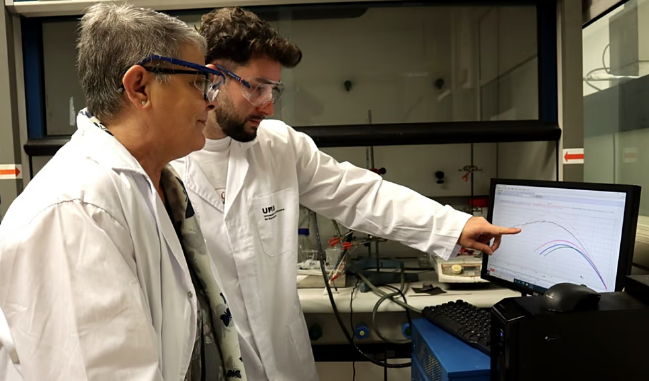
Researchers in Spain have developed a new design for zinc-air batteries that can increase their power output by up to 80% without changing the chemistry at the heart of the technology.
The work was carried out by scientists at the Institute of Materials Science of Barcelona (ICMAB-CSIC), in collaboration with the Catalan Institute of Nanoscience and Nanotechnology (ICN2) and the National University of La Plata in Argentina.
The researchers introduced conductive elements inside the battery that function as wireless bipolar electrodes. The elements are not connected to the battery’s existing electrodes or external electrical circuit, but can improve the movement of charge and reduce internal resistance.
The findings, published in the journal Energy Storage Materials, challenge conventional assumptions about how batteries should be designed.
Batteries generate electricity through the energy difference between their two electrodes, while an electrolyte allows ions to move between them. Conventional battery designs generally require the electrolyte to prevent electrons from passing directly between the electrodes in order to avoid a short circuit.
The research team, led by Nieves Casañ-Pastor of ICMAB-CSIC, found that isolated conductive metal pieces can be placed between the electrodes under specific conditions without causing a short circuit.
The researchers said the electric field created between the electrodes while the battery is operating polarises the conductive elements. Opposite charges accumulate at either end of the pieces, creating additional pathways for charge transport.
This process reduces the battery’s internal resistance and allows energy to be delivered more quickly.
“What is remarkable is that these conductors are not wired to anything: they are simply inserted into the system and they produce beneficial effects,” Casañ-Pastor said.
The research forms part of the doctoral work of Marc Mosqueda and focuses on the potential of zinc-air batteries, which use materials that are relatively abundant, inexpensive and considered safer than some alternatives.
Zinc-air batteries have attracted interest for energy storage because of these characteristics, but their performance has been constrained by the slow oxygen reaction involved in their operation.
The new architecture addresses part of this limitation by using wireless bipolar electrodes to improve charge transport and reduce internal resistance. Tests showed that the approach could raise power output by as much as 80%.
The researchers said the design principle could extend beyond zinc-air batteries and potentially be used in other energy storage technologies.
Casañ-Pastor’s group has already observed similar effects in other battery systems and plans to continue studying wireless bipolar electrodes.
The findings could offer a new approach to battery design by showing that carefully positioned conductive components do not necessarily need to be physically connected to a circuit to improve performance.

Two Azerbaijani Sailors Killed in Drone Strike on Tugboat Near Odesa

Anthropic Reports AI Misuse in Cyberattacks, Propaganda and Biological Research

Study Links Nighttime Light Exposure to Changes in Heart Structure

Apple Unveils Foldable iPhone Duo as John Ternus Takes Charge

Mental Health Support Before Major Surgery May Improve Recovery, Study Finds

Spanish Researchers Develop Zinc-Air Battery Design That Raises Power Output by 80%

Google Plans €13 Billion Investment in Finland Data Centres

ECB Expected to Raise Rates as Energy-Driven Inflation Complicates Decision

Thailand Investigates Bangkok Clinic After British Influencer Dies Following Cosmetic Procedure

China Export Growth Accelerates to 25% in August on Strong Tech Demand

Meta Acquires Tilda Swinton VR Doc ‘Impulse: Playing With Reality’

China’s Historic Olympic Victory Sparks National Pride Amid Controversy

Saudi Arabia’s Model for Sustainable Aviation Practices

Recent Developments in Small Business Taxes

Effective Drain Cleaning: A Key to a Healthy Plumbing System

Who was Ebrahim Raisi and his status in Iranian Politics?

Keely Hodgkinson Wins Britain’s First Athletics Gold at Paris Olympics in 800m

Carrectly: Revolutionizing Car Care in Chicago

Nobel Laureate Muhammad Yunus Proposed as Head of Bangladesh’s Interim Government Following Hasina’s Resignation

Chinese Hackers Infiltrate Major U.S. Telecom Firms in Possible National Security Breach

Sony WF-10XM4: Headphones Are Our Absolute Favorite

10 Places You Can’t Miss If It’s Your First Time in European

New Census Data Will Shake Up Alabama Politics

16 Top of Our Favorite Outdoor Clothing Brands

Fashionable Summer Accessories to Dress Up Your Travel Look

How Sleeping Less than 7 Hours a Night Can Lead to Weight Gain
-
 Entertainment2 years ago
Meta Acquires Tilda Swinton VR Doc ‘Impulse: Playing With Reality’
-
 Sports2 years ago
China’s Historic Olympic Victory Sparks National Pride Amid Controversy
-
 Business2 years ago
Saudi Arabia’s Model for Sustainable Aviation Practices
-
 Business2 years ago
Recent Developments in Small Business Taxes
-
 Home Improvement2 years ago
Effective Drain Cleaning: A Key to a Healthy Plumbing System
-
 Politics2 years ago
Who was Ebrahim Raisi and his status in Iranian Politics?
-
 Sports2 years ago
Keely Hodgkinson Wins Britain’s First Athletics Gold at Paris Olympics in 800m
-
 Business2 years ago
Carrectly: Revolutionizing Car Care in Chicago