Connect with us

News

Commonwealth Leaders Call for Reparations Talks, Address Climate Threats at Samoa Summit

Published

on

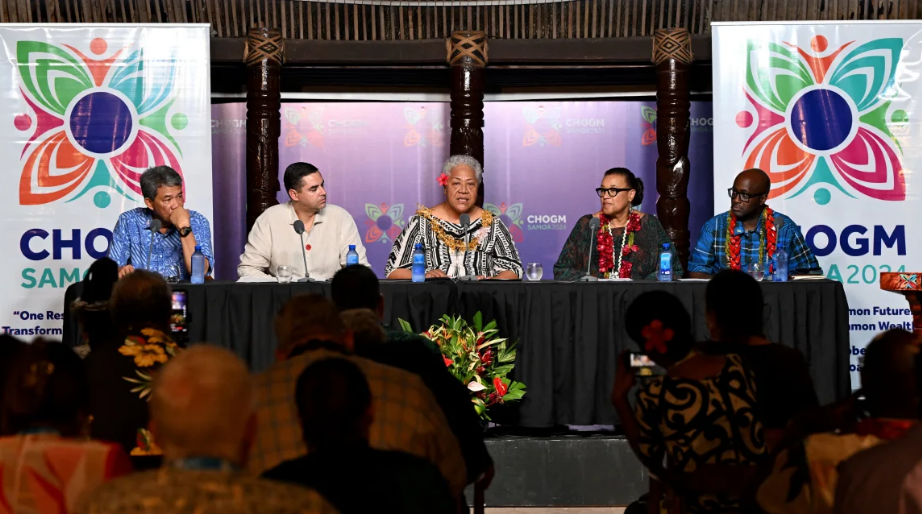
At the close of a week-long Commonwealth summit in Samoa, leaders from the 56-member group on Saturday urged Britain to engage in discussions on reparations for its role in the transatlantic slave trade. The call comes amid a renewed global push to address the historical legacies of slavery and the economic and social inequalities that persist today.

The summit, held in the Pacific nation, highlighted the issues of slavery and climate change, both central themes for the Commonwealth Heads of Government Meeting. Most member states share historical ties to Britain’s colonial empire, and the topic of reparations has gained particular momentum among Caribbean and African nations.

In a joint statement, Commonwealth leaders expressed that “the time has come for a meaningful, truthful and respectful conversation towards forging a common future based on equity.” This statement was seen as a significant moment in the ongoing calls for reparative justice, as it marked a collective acknowledgment of the need to address colonial-era wrongs.

British Prime Minister Keir Starmer, however, underscored that discussions around reparations were not about financial compensation. “In the two days we’ve been here, none of the discussions have been about money. Our position is very, very clear in relation to that,” he stated at a press conference following the summit.

The reparations discussion also touched on “blackbirding”—the practice in which people from Pacific Islands and other regions were coerced, deceived, or forcibly taken to work on plantations. Commonwealth members in favor of reparations argue that the legacies of slavery and exploitative practices like blackbirding have contributed to enduring inequalities. Opponents, meanwhile, question the feasibility of holding countries accountable for historical actions.

See also  Putin Hosts BRICS Summit Amid Rising Global Tensions

Professor Kingsley Abbott, director of the Institute of Commonwealth Studies at the University of London, characterized the joint statement as a potential breakthrough. “The commitment to conversations on reparatory justice wedges open the door for dialogue, and now the hard work really begins,” said Abbott, who attended the summit.

The leaders also addressed the climate crisis, with a particular focus on the impacts of rising sea levels on small island nations. In a historic move, the summit produced the Commonwealth’s first Oceans Declaration, which supports the establishment of fixed maritime boundaries for island nations threatened by climate change. This landmark agreement holds that even if rising seas submerge territories, nations should retain their maritime zones, securing economic rights to vast ocean resources.

This provision is particularly crucial for low-lying islands like Tuvalu, as it ensures these nations can continue to benefit from their fishing waters and other marine resources even if forced to relocate due to climate impacts. The declaration strengthens international support for the recognition of the perpetual statehood of vulnerable island states, advancing the legal framework to safeguard their territorial integrity despite the effects of climate change.

With over half of the Commonwealth’s members comprising small nations, many of which face severe climate-related threats, the commitment to fixed maritime boundaries represents a significant step toward securing economic futures and environmental justice for these states.

News

Spain and Portugal Hit by New Storms, Death Toll Rises

Published

on

Spain and Portugal endured fresh storms and torrential rain on Saturday, claiming another life just days after Storm Leonardo caused deadly flooding and widespread damage.

One person was killed in Portugal as heavy rainfall from Storm Marta swept across the Iberian Peninsula. Authorities reported that a 46-year-old member of the emergency services drowned in a river at Campo Maior, in the central Portalegre district, while attempting to cross a flooded area.

The extreme weather forced three municipalities in Portugal to postpone a presidential vote scheduled for Sunday by a week. Storms in recent weeks have already taken a heavy toll: Storm Kristin killed at least five people in Portugal last week, while Storm Leonardo claimed another victim on Wednesday.

Officials warned that the risk of flooding from the Tagus River in the central Santarém region remained at its highest level. Further south, in Alcácer do Sal, floodwaters from the Sado River had receded to the banks, though the city had previously been submerged, forcing residents to evacuate. Alcácer do Sal lies about 90 kilometres south of Lisbon.

In Spain, Storm Marta prompted the closure of dozens of roads as it moved northeast. In Ávila, a snow plough driver died on Saturday after the vehicle plunged down a 20-metre slope at the El Pico pass. According to the Directorate General of Traffic (DGT), more than 100 roads were closed in the early morning, mostly due to flooding, snow, or ice.

The province of Cadiz was the hardest hit, with several roads rendered impassable, followed by Cordoba and Seville. Snowstorms in mountainous regions led to road closures in Granada, Asturias, Salamanca, and Navarre.

See also  Trump Urges Israel to Halt Gaza Bombing as Hamas Signals Partial Acceptance of Peace Plan

Spain’s State Meteorological Agency (Aemet) said rainfall would ease on Sunday in many areas but persist in some regions, including the Strait of Gibraltar, the Alboran Sea, Andalusian mountain ranges, the Balearic Islands, northeastern Catalonia, and the Cantabrian Sea. Locally heavy showers are expected, with thunderstorms and hail reported in some areas.

Authorities in both countries continue to urge residents to exercise caution, avoid flooded zones, and stay updated on weather alerts. Emergency services have been deployed to assist those affected by rising waters and to prevent further casualties.

The repeated storms across the Iberian Peninsula highlight the ongoing vulnerability of the region to severe weather events in recent weeks, with communities struggling to recover from back-to-back floods and heavy rains.

Spain and Portugal’s governments have stressed the importance of preparedness, especially in flood-prone regions, as meteorologists warn that unsettled weather may continue to affect the peninsula over the coming days.

Continue Reading

News

German Troops in Lithuania Face Hybrid Threats Amid Rising Tensions With Russia

Published

on

The German army brigade stationed in Lithuania is not under direct fire, but troops report facing hybrid attacks, including surveillance, psychological operations, and drone activity, as tensions with Russia persist in the Baltic region.

Soldiers have described unusual incidents, including mysterious phone calls where conversations from hours earlier were played back by unknown callers. “A comrade phones home, speaks for half an hour, and then gets a call from an unknown number. He answers – and hears his own conversation from earlier, recorded and played back,” Joshua Krebs wrote in his book, Inside Bundeswehr, calling the tactic “uncanny.”

Drones have also reportedly been used to monitor sensitive defence systems and exercises involving Germany’s Battletank Brigade 45 in Lithuania. Last year, a Russian reconnaissance aircraft entered Belarusian airspace during the Bundeswehr’s exercise Iron Wolf, raising concerns about Russian surveillance in the region.

Germany’s Inspector General, Carsten Breuer, described such incidents as “proof of the very real threat to Lithuania.” Federal Defence Minister Boris Pistorius echoed the warning during a meeting with his Lithuanian counterpart in Berlin, stressing that hybrid warfare poses a particular concern for Lithuania and the wider Baltic region.

The risks are compounded by Russian incursions into European airspace. In October 2025, two Russian fighter jets briefly entered Lithuanian airspace for approximately 18 seconds before turning back under NATO escort. German Chancellor Friedrich Merz described the incident as a “provocation,” with the aircraft thought to have flown from Russia’s Kaliningrad exclave.

Given the Baltic states’ proximity to Russian territory, the region is under constant NATO monitoring. Germany, Spain, and the UK currently lead the mission to police Baltic airspace, while Germany also supports ground operations, including deploying a mobile air force command post for air surveillance from January to March this year.

See also  Investigation Underway After Goa Nightclub Fire Kills at Least 25

Experts note that hybrid attacks often exist in a legal grey area. Unlike conventional military operations, many hybrid actions, such as surveillance or unmarked troop movements, cannot be directly attributed to a single actor, and international law does not automatically classify them as armed attacks under Article 51 of the UN Charter. The aim is often psychological: to provoke, unsettle, and signal presence without triggering a military response.

Incidents reminiscent of the “little green men” in Crimea have occurred in the Baltics. In December, Russian border guards briefly crossed into Estonia without authorization, prompting diplomatic protests rather than military retaliation. Armed men in unmarked uniforms were also spotted near the Estonian border earlier in the year, reinforcing concerns about Russia’s hybrid strategies.

According to Pistorius, these tactics are part of a broader pattern of Russian pressure. “The threat posed by Russia is felt more acutely in Lithuania and across the Baltic region than elsewhere in Europe,” he said, citing provocative airspace incursions and intelligence-gathering operations as ongoing challenges for NATO forces in the region.

Continue Reading

News

Greenland Mayor Condemns Comedian’s Flag Stunt Amid Tensions with US

Published

on

The mayor of Greenland’s capital has urged media professionals and content creators to act responsibly after a German comedian attempted to hoist the US flag in Nuuk, drawing outrage from local residents.

Bavarian comedian Maxi Schafroth, 41, tried to raise the Stars and Stripes near the city’s cultural centre on Thursday. Passers-by confronted him after he claimed to be a US official. Witnesses reported that locals reacted angrily, and Schafroth left the scene amid disapproving looks. Local authorities subsequently fined him, according to reports.

Avaaraq Olsen, mayor of Kommuneqarfik Sermersooq, the district that includes Nuuk, described the stunt as “immensely harmful.” She said the incident was particularly upsetting for children and families, who have already been anxious over US President Donald Trump’s repeated threats to seize Greenland, an autonomous Danish territory.

“Raising a flag at our capital cultural centre, the flag of a military superpower that for weeks has been implying military force against our country, is not a joke,” Olsen said in a statement. “When you amplify those fears for content, clicks, or laughs, you are not being bold or creative. You are adding to the distress of an already vulnerable population. So, pause before you film. Think before you stage something ‘funny.’ Consider whether your next question or stunt will inform the world or simply make a child cry or a family feel less safe in their own country.”

Schafroth is known in Germany for his work on the satirical programme “Extra Drei,” broadcast by the regional NDR channel, which attracts over one million viewers. NDR expressed regret over the incident in statements to Germany’s Der Spiegel and the Ritzau news agency.

See also  Ukraine’s Foreign Minister to Visit China for Talks on Ending Russia’s War in Ukraine

The stunt comes amid heightened international attention on Greenland following Trump’s long-standing territorial interest in the Arctic territory. Trump described owning Greenland as essential to US national security, claiming without evidence that Russia or China would otherwise seize control. His statements sparked a serious diplomatic crisis, considered the most severe in NATO’s history since the alliance was established in 1949.

Although the US president later backtracked on threats to use force, discussions between Washington, Copenhagen, and Nuuk are ongoing. Greenland’s government has been working to manage the stress and anxiety caused by the situation and to reassure its population that their safety remains a priority.

Local authorities stressed that Greenlanders, particularly children, remain worried over the uncertainty surrounding the territory’s international status. Olsen said the flag stunt, though intended as a humorous act, highlighted the need for content creators to consider the real-world impact of their actions on communities already facing heightened tension.

The incident underscores the lingering sensitivity in Greenland following months of international attention, and the city’s leadership has called for respect and caution in public displays that could inflame fear or insecurity among residents.

Continue Reading

Trending