Connect with us

Business

Oil jumps above $100 after Iranian strikes on Omani energy facilities

Published

on

Global oil prices surged above $100 per barrel on Thursday after fresh attacks linked to Iran targeted oil storage facilities in Oman, offsetting the expected market relief from a record emergency oil release announced a day earlier.

Benchmark Brent crude climbed sharply during trading, briefly moving above the $100 mark before easing slightly. Prices still remained significantly higher than earlier in the week, reflecting continued volatility in global energy markets.

The spike came despite an unprecedented move by the International Energy Agency, which on Wednesday announced a coordinated release of 400 million barrels from emergency stockpiles held by its 32 member countries. The measure is the largest such release in the agency’s history and more than twice the volume deployed after the Russian invasion of Ukraine in 2022.

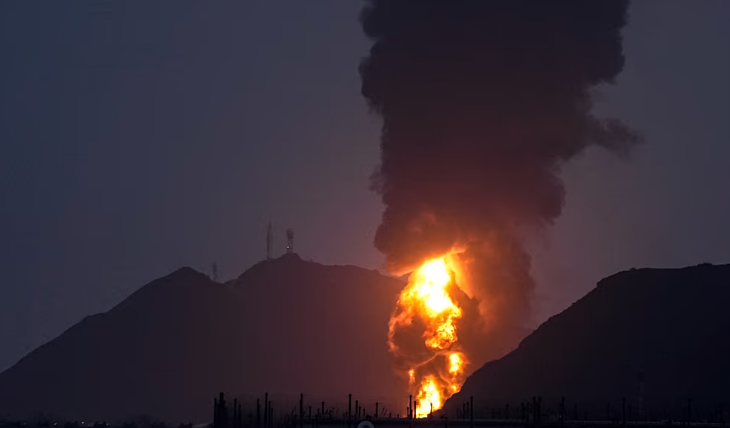
Shortly after the announcement, Iranian forces launched drone strikes targeting fuel storage tanks and silos at the Salalah Port, triggering fires that local authorities were still working to contain late Wednesday.

British maritime security firm Ambrey confirmed damage at the site, while Danish shipping company Maersk temporarily suspended port operations as a precaution.

Omani officials said the attacks had not disrupted domestic fuel supplies, though investigations into the incident were continuing. Iranian state media reported that President Masoud Pezeshkian assured Haitham bin Tariq that the events would be examined.

The security situation also worsened at sea. At least six vessels were reportedly struck in the Persian Gulf and the Strait of Hormuz, including a container ship hit by a projectile near the United Arab Emirates and two tankers damaged in waters near Iraq. Monitoring groups such as UK Maritime Trade Operations attributed the incidents to Iranian forces or allied groups.

See also  Global House Prices Set to Rise Amid Supply Shortages and Growing Demand: Fitch Report

Since the start of the conflict, at least 16 ships have reportedly been struck in the region, intensifying concerns about the security of global energy supplies.

The Strait of Hormuz normally carries about one-fifth of the world’s oil shipments. However, analysts estimate that exports of crude and refined products from the region have fallen to just 10–15 percent of pre-war levels as shipping traffic declines sharply.

In response to the crisis, several countries are contributing to the IEA’s coordinated reserve release. The United States alone plans to supply 172 million barrels, while Germany, France and Italy have also confirmed they will tap emergency stockpiles. Japan said it will begin releasing oil next week.

IEA executive director Fatih Birol described the crisis as an oil market disruption “unprecedented in scale,” saying the coordinated action reflects strong cooperation among major energy-consuming nations.

Despite the intervention, analysts say the reserve release may have limited impact if the disruption to supply continues. Warren Patterson, head of commodities strategy at ING, said the release could not fully offset the roughly 15 million barrels per day currently affected by the conflict.

Economists also warn that prolonged disruptions could push oil prices significantly higher. Analysts at Oxford Economics said crude prices could approach $140 per barrel if tensions persist, a level that could trigger a mild global recession.

Kristalina Georgieva, managing director of the International Monetary Fund, has warned that sustained increases in oil prices would likely push global inflation higher and slow economic growth worldwide.

Energy markets remain focused on developments in the Strait of Hormuz, with analysts saying the restoration of normal shipping routes will be critical for stabilising oil prices in the coming weeks.

See also  Azerbaijan’s SOFAZ fund gains from rising gold prices amid global market uncertainty

Business

Spain Employment Hits Record as Social Security Enrolment Tops 22 Million

Published

on

Spain’s labour market reached a historic milestone in March, with Social Security enrolment surpassing 22 million contributors for the first time, driven by seasonal hiring linked to Easter and continued growth in the services sector.

New data released on Monday showed that the number of contributors, adjusted for seasonal variations, rose to 22,010,532 after 80,274 jobs were added during the month. In average terms, employment increased by 211,510 people, marking the largest rise ever recorded for a March period.

Unadjusted figures also reflected a record level, with more than 21.8 million people registered with Social Security. The government highlighted that the number of contributors has grown by nearly 3.4 million since 2018, pointing to sustained expansion in the labour market.

Officials said the latest gains were supported by increased activity during Easter Week, which traditionally boosts employment in tourism, hospitality and other service-related industries. Growth has also been noted in higher-skilled sectors, including information technology, science and professional services.

The data showed that female employment continues to rise, nearing 10.4 million, while permanent contracts have increased as a share of overall employment. Authorities linked these trends to labour reforms introduced in recent years aimed at improving job stability and workforce participation.

Prime Minister Pedro Sánchez acknowledged the milestone in a brief social media message before later praising workers in a video statement. He said the achievement reflected the efforts of millions of people contributing to the country’s economic progress.

The labour market report also indicated a modest improvement in unemployment. The number of jobless people fell by 0.9 percent in March to 2.42 million, the lowest level recorded for the month since 2008. Over the past year, unemployment has declined by more than 160,000.

See also  Europe’s Electricity Trade Reveals Sharp Divide Between Energy Exporters and Importers

Second Vice-President and Employment Minister Yolanda Díaz said that both female and youth unemployment have reached historic lows. She attributed the positive results to structural changes in the labour market and policies designed to support job creation and stability.

Economists note that while seasonal factors played a role in the March figures, the broader trend points to continued resilience in Spain’s economy. Strong demand in services and ongoing improvements in employment conditions have helped sustain growth despite external uncertainties.

The latest figures underline the strength of Spain’s recovery in recent years, with employment reaching new highs and unemployment continuing its gradual decline.

Continue Reading

Business

OPEC+ Agrees Modest Output Increase as Hormuz Disruptions Shake Oil Markets

Published

on

The Organization of the Petroleum Exporting Countries and its allies (OPEC+) has agreed to raise crude oil production, as the ongoing conflict in the Middle East continues to disrupt shipments through the Strait of Hormuz, a vital artery for global energy supplies.

The group announced on Sunday that it will increase output by 206,000 barrels per day in May following a virtual meeting of key producers. The countries involved in the decision include Saudi Arabia, Russia, Iraq, the United Arab Emirates, Kuwait, Kazakhstan, Algeria and Oman.

Despite the move, analysts say the increase is unlikely to significantly ease pressure on oil prices. The additional supply represents only a small fraction of the volumes affected by disruptions in the Strait of Hormuz, where shipping has been severely constrained since the conflict began in late February.

In a statement, OPEC+ said the adjustment forms part of a broader plan to unwind voluntary production cuts introduced in recent years. The group added that it remains ready to adjust output depending on market conditions, including the possibility of pausing or reversing earlier decisions if necessary.

Market observers note that even the planned increase may have limited immediate impact, as logistical challenges linked to the strait’s closure continue to restrict exports. Oil shipments from several producing countries remain delayed or rerouted, tightening global supply.

Energy analyst Osama Rizvi said the scale of disruption across the market far outweighs the planned production increase. He pointed to widespread outages affecting energy infrastructure and ongoing difficulties in maintaining normal output levels. According to Rizvi, the additional barrels are unlikely to offset the supply losses caused by the conflict.

See also  Azerbaijan’s SOFAZ fund gains from rising gold prices amid global market uncertainty

Oil prices have climbed sharply in recent weeks, with benchmark crude nearing $120 per barrel. The surge has pushed up fuel costs globally, adding strain on households and businesses already dealing with inflationary pressures.

Forecasts from major financial institutions suggest prices could rise even further if supply constraints persist. Some projections indicate that crude could approach $150 per barrel if disruptions continue into the coming weeks.

Geopolitical tensions remain a key driver of market uncertainty. US President Donald Trump has issued a deadline for Iran to reopen the Strait of Hormuz, warning of potential military action against critical infrastructure if the route remains closed.

The standoff has raised concerns about the stability of global energy markets, as the strait typically handles a significant share of the world’s oil exports.

While OPEC+ has signalled its intention to support market stability, the effectiveness of its latest move will depend largely on developments in the region and whether normal shipping operations can resume.

Continue Reading

Business

European Cocoa and Chocolate Prices Surge Ahead of Easter

Published

on

Cocoa and chocolate prices in Europe have risen sharply ahead of Easter, outpacing overall inflation and highlighting the fragility of global supply chains. According to Eurostat data, consumer prices for cocoa and powdered chocolate increased by 15.3% annually as of December 2025, while chocolate prices rose 15.6% over the same period. These increases place both items among the top five food and non-alcoholic beverage categories with the highest inflation in the European Union, where overall inflation stood at 2.3%.

Experts attribute the surge to disruptions in the cocoa supply chain, particularly due to adverse weather conditions in Africa. Joël Frei, communication officer at the Swiss Platform for Sustainable Cocoa, said global cocoa production has become increasingly volatile, with the 2023–2024 cocoa year proving particularly difficult. Revised estimates from the International Cocoa Organization indicate that global output fell from 5.016 million tonnes in 2022–2023 to 4.368 million tonnes in 2023–2024, a 12.9% decline. At the same time, the stocks-to-grindings ratio fell from 34.9% to 26.4%, reflecting a tighter market.

“Shocks on the production side have pushed inventories to historically low levels, leaving markets extremely exposed to further disruptions and driving cocoa prices to record highs,” said Emiliano Magrini, economist at the United Nations Food and Agriculture Organization (FAO).

The impact on consumers has been severe in several countries. Denmark reported the largest annual increase at 30.5%, followed by Lithuania at 30.3%. Austria, Romania, Norway, and Sweden also saw rises above 25%. Among Europe’s largest economies, Germany experienced a 21.4% increase, Italy 20.5%, while France and Spain saw smaller hikes of 14.7% and 12%, respectively. Czechia, Belgium, Serbia, and Portugal recorded relatively minor increases between 1.3% and 3.6%.

See also  Global House Prices Set to Rise Amid Supply Shortages and Growing Demand: Fitch Report

The decline in cocoa output was concentrated in the world’s two largest producers. Côte d’Ivoire saw a drop of roughly 20–25%, while Ghana experienced an even sharper decline. Magrini said the reduction was driven by prolonged dry spells and increased disease pressure, including the cocoa swollen shoot virus. Anna Lea Albright, former fellow at the Harvard Center for the Environment, noted that extreme rainfall during flowering and early pod development also contributed to significant yield losses.

Production has recovered modestly in 2024–2025 and is expected to improve further in the 2025–2026 season. Despite this, the market remains structurally thin and vulnerable, with prices sensitive to any additional shocks from weather, disease, or trade disruptions.

As Easter approaches, consumers across Europe are facing higher chocolate costs, reflecting a combination of tight global supply, climate challenges, and logistical vulnerabilities that continue to affect the cocoa industry.

Continue Reading

Trending