Connect with us

Business

Democrats Warn New Trump Tariffs Could Raise Costs for US Households

Published

on

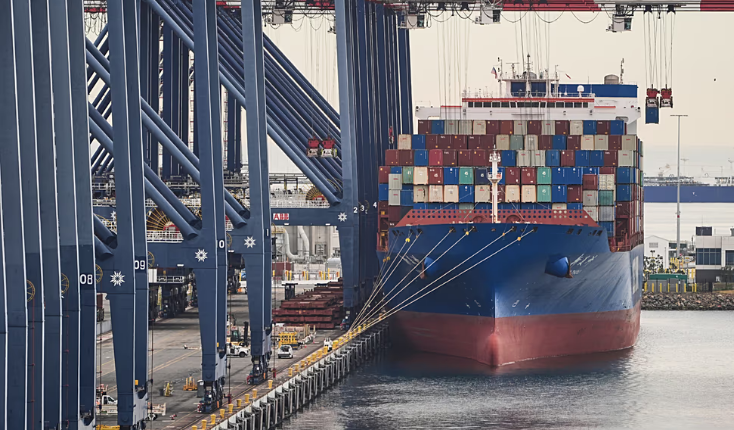
Congressional Democrats are warning that a new round of tariffs introduced by US President Donald Trump could significantly increase costs for American households, as the administration seeks to replace federal revenue lost after a recent court ruling against earlier trade measures.

A study released Friday by Democrats on the Joint Economic Committee estimates that import taxes imposed by the administration could cost US households an average of $2,512 in 2026. That figure represents a 44 per cent increase compared with last year’s estimated burden of $1,745 per household.

The report comes as many American consumers are already dealing with higher living expenses and rising fuel costs linked to tensions in the Middle East, particularly the ongoing conflict involving Iran.

Maggie Hassan, a Democratic senator from New Hampshire and the top Democrat on the committee, criticised the administration’s trade strategy. She said the government has continued introducing tariffs even after a legal setback earlier this year.

“Despite a Supreme Court ruling that much of the tariff agenda is illegal, the administration refuses to provide relief for families,” Hassan said. She added that additional tariffs could drive prices even higher for households already struggling with increased costs.

The White House dismissed the report. Spokesman Kush Desai described the analysis as inaccurate and defended the president’s trade policy, saying tariffs remain a key tool for renegotiating trade agreements, lowering certain costs and encouraging investment in the United States.

The debate follows a major decision by the Supreme Court of the United States on February 20. The court ruled that the administration did not have the authority to impose wide-ranging tariffs under the International Emergency Economic Powers Act of 1977, which had been used to justify tariffs on imports from nearly every country.

See also  EBRD Warns of Slowing Growth in Europe Amid Chinese Competition and US Tariffs

As a result of the ruling, the government is expected to refund importers who paid the tariffs. The total amount of refunds could reach about $175 billion.

In response, the administration has begun introducing new trade measures using other legal authorities. Officials have already implemented a 10 per cent tariff under the Trade Act of 1974 through Section 122, with the possibility of raising it to 15 per cent. However, tariffs under that provision can only remain in place for 150 days unless Congress approves an extension.

The administration is also turning to Section 301 of the same law, which allows tariffs on countries accused of unfair or discriminatory trade practices.

Earlier this week, US Trade Representative Jamieson Greer launched an investigation into whether 16 trading partners, including China and the European Union, are producing excess goods that harm American industries.

Democrats argue that tariffs ultimately fall on consumers. They point to analysis from the Congressional Budget Office indicating that importers often pass tariff costs on to buyers, while domestic producers may also raise prices because of reduced foreign competition.

The renewed push for tariffs comes ahead of November’s midterm elections, as economic concerns remain a central issue for voters facing higher living costs and volatile energy prices.

Business

Oil jumps above $100 after Iranian strikes on Omani energy facilities

Published

on

Global oil prices surged above $100 per barrel on Thursday after fresh attacks linked to Iran targeted oil storage facilities in Oman, offsetting the expected market relief from a record emergency oil release announced a day earlier.

Benchmark Brent crude climbed sharply during trading, briefly moving above the $100 mark before easing slightly. Prices still remained significantly higher than earlier in the week, reflecting continued volatility in global energy markets.

The spike came despite an unprecedented move by the International Energy Agency, which on Wednesday announced a coordinated release of 400 million barrels from emergency stockpiles held by its 32 member countries. The measure is the largest such release in the agency’s history and more than twice the volume deployed after the Russian invasion of Ukraine in 2022.

Shortly after the announcement, Iranian forces launched drone strikes targeting fuel storage tanks and silos at the Salalah Port, triggering fires that local authorities were still working to contain late Wednesday.

British maritime security firm Ambrey confirmed damage at the site, while Danish shipping company Maersk temporarily suspended port operations as a precaution.

Omani officials said the attacks had not disrupted domestic fuel supplies, though investigations into the incident were continuing. Iranian state media reported that President Masoud Pezeshkian assured Haitham bin Tariq that the events would be examined.

The security situation also worsened at sea. At least six vessels were reportedly struck in the Persian Gulf and the Strait of Hormuz, including a container ship hit by a projectile near the United Arab Emirates and two tankers damaged in waters near Iraq. Monitoring groups such as UK Maritime Trade Operations attributed the incidents to Iranian forces or allied groups.

See also  UK Job Market Trails European Peers as Spain and Italy Lead Vacancy Growth

Since the start of the conflict, at least 16 ships have reportedly been struck in the region, intensifying concerns about the security of global energy supplies.

The Strait of Hormuz normally carries about one-fifth of the world’s oil shipments. However, analysts estimate that exports of crude and refined products from the region have fallen to just 10–15 percent of pre-war levels as shipping traffic declines sharply.

In response to the crisis, several countries are contributing to the IEA’s coordinated reserve release. The United States alone plans to supply 172 million barrels, while Germany, France and Italy have also confirmed they will tap emergency stockpiles. Japan said it will begin releasing oil next week.

IEA executive director Fatih Birol described the crisis as an oil market disruption “unprecedented in scale,” saying the coordinated action reflects strong cooperation among major energy-consuming nations.

Despite the intervention, analysts say the reserve release may have limited impact if the disruption to supply continues. Warren Patterson, head of commodities strategy at ING, said the release could not fully offset the roughly 15 million barrels per day currently affected by the conflict.

Economists also warn that prolonged disruptions could push oil prices significantly higher. Analysts at Oxford Economics said crude prices could approach $140 per barrel if tensions persist, a level that could trigger a mild global recession.

Kristalina Georgieva, managing director of the International Monetary Fund, has warned that sustained increases in oil prices would likely push global inflation higher and slow economic growth worldwide.

Energy markets remain focused on developments in the Strait of Hormuz, with analysts saying the restoration of normal shipping routes will be critical for stabilising oil prices in the coming weeks.

See also  Markets Inch Higher as Iran-Israel Ceasefire Holds, Oil Prices Edge Up
Continue Reading

Business

Rising Energy Costs From Iran Conflict Raise Eurozone Inflation Concerns

Published

on

Economists say the surge in global energy prices linked to the conflict with Iran could push inflation higher across the eurozone, increasing the possibility that the European Central Bank may be forced to raise interest rates in 2026.

Oil markets experienced one of their sharpest reversals on record this week after comments from Donald Trump suggested the US-led military campaign against Iran might soon wind down. The statement briefly eased fears of a prolonged disruption to energy supplies moving through the Strait of Hormuz, a critical shipping route for global oil.

Speaking during a press conference, Trump said the United States and Israel had made rapid progress in military operations against Iran and insisted Washington would act to keep international energy routes open.

“Oil supplies will be dramatically more secure,” Trump said, adding that the US could escort oil tankers through the Strait of Hormuz if necessary. When asked whether the conflict might end soon, he responded that it could be resolved within days.

Energy markets reacted quickly to the remarks. West Texas Intermediate crude, which had climbed to about $119 per barrel during heightened concerns over potential shipping disruptions, fell to below $90 by the end of the trading session, representing a drop of more than $30 in less than a day.

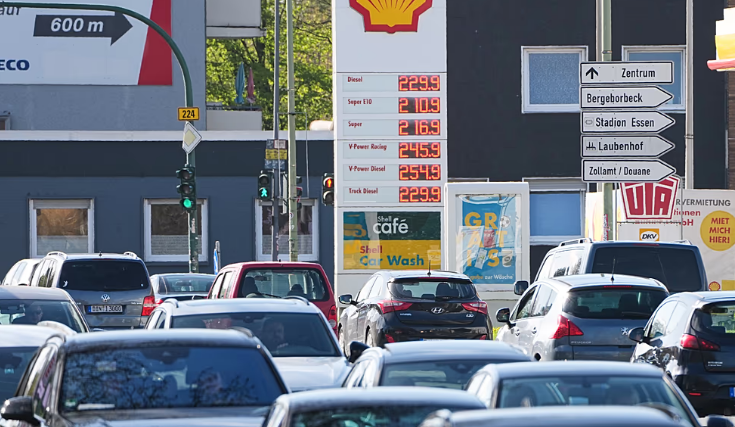
Despite the dramatic fall in crude prices, economists warn that retail fuel costs in Europe have not yet reflected the change. Fuel prices across several major cities remain elevated, highlighting the delay between movements in wholesale oil markets and prices paid by consumers.

See also  Markets Inch Higher as Iran-Israel Ceasefire Holds, Oil Prices Edge Up

According to data from fuel tracking platform Fuelo, petrol prices remain high across major European cities. In Milan, unleaded fuel is selling for around €1.89 per litre while diesel has climbed to €2.10. In Paris petrol costs about €1.92 per litre and diesel roughly €2.06. Frankfurt currently records the highest prices among the three, with petrol reaching €2.12 per litre and diesel at €2.19.

Economists say the biggest economic channel through which the conflict affects Europe is energy. Sven Jari Stehn, chief European economist at Goldman Sachs, said most European economies rely heavily on imported oil and gas, making them particularly sensitive to price shocks.

The bank estimates that a 10 percent increase in oil prices typically raises eurozone inflation by around 0.3 percent. Analysts caution that the effect could be stronger if natural gas prices also rise, as gas markets often react differently from oil.

Analysts at Bank of America outlined several potential scenarios depending on how long energy prices remain elevated. In a moderate scenario, crude stabilises near $80 per barrel while European gas prices remain elevated for several months. Under that outcome, eurozone inflation could briefly climb to about 2.5 percent before gradually declining later in the year.

A stronger energy shock would have more serious consequences. Economists warn that inflation could exceed 3 percent during the second quarter while economic growth slows.

Michael Saunders, an adviser at Oxford Economics, said central banks can no longer ignore energy-driven inflation in the way they sometimes did in the past. He argued that policymakers are increasingly concerned that rising energy costs could feed into broader inflation expectations across the economy.

See also  Revolut to Maintain Hybrid Work Policy Despite New London Headquarters

Financial markets are already adjusting their expectations. Data from prediction platform Polymarket suggests investors now see a significantly higher chance that the European Central Bank may raise interest rates in 2026 if energy prices remain elevated.

Continue Reading

Business

Iran War Sends Shockwaves Through Global Economy, Raising Energy and Food Security Concerns

Published

on

The ongoing conflict involving Iran is sending economic shockwaves across global markets, pushing up energy and fertiliser prices and raising fears of food shortages in vulnerable countries. Economists warn that the disruption is also complicating efforts by central banks to control inflation.

At the center of the crisis is the Strait of Hormuz, a strategic shipping corridor through which roughly one-fifth of the world’s oil supply normally passes. The route has effectively been shut since military strikes by the United States and Israel against Iran began 11 days ago, triggering widespread concern in global energy markets.

Oil prices have surged sharply since the conflict escalated. Crude traded below $70 per barrel in February but climbed to nearly $120 earlier this week before easing to around $90. The rise in crude prices has pushed gasoline costs higher as well. According to the American Automobile Association, the average price of gasoline in the United States jumped to $3.48 per gallon from just under $3 only a week earlier.

Economists say the impact could be even greater in regions that rely heavily on Middle Eastern energy supplies. Countries in Europe and Asia depend more on imported oil and gas from the Gulf than the United States, making them particularly vulnerable to supply disruptions.

Kristalina Georgieva, managing director of the International Monetary Fund, warned that sustained increases in oil prices could have broader economic consequences. She said every 10 percent rise in oil prices that lasts most of the year could push global inflation up by 0.4 percent while reducing worldwide economic output by up to 0.2 percent.

See also  Trump Cuts Putin's Deadline on Ukraine Peace Deal as Oil Prices Surge on US-EU Trade Pact

Economists stress that reopening the Strait of Hormuz is essential to restoring stability. Simon Johnson of the Massachusetts Institute of Technology said about 20 million barrels of oil pass through the waterway each day. He noted that global producers have little spare capacity to replace that volume if shipments remain blocked.

Despite the shock, some analysts believe the global economy may still manage to absorb the disruption if the conflict proves short-lived. Eswar Prasad, a trade policy professor at Cornell University, said the world economy has previously shown resilience after major shocks such as the Russian invasion of Ukraine and sweeping tariff measures introduced in 2025.

The war is already creating uneven economic effects across countries. Major energy importers including Japan, India, China and several European economies face higher costs as oil prices climb. Oil producers outside the conflict zone such as Norway, Russia and Canada could benefit from higher export revenues.

Some nations face particularly severe challenges. Pakistan imports about 40 percent of its energy and relies heavily on liquefied natural gas shipments from Qatar, supplies that have been disrupted by the conflict.

The crisis is also affecting global agriculture. Researchers at the International Food Policy Research Institute estimate that up to 30 percent of the world’s fertiliser exports pass through the Strait of Hormuz. Disruptions to shipments of products such as urea, ammonia and phosphates are already pushing costs higher for farmers.

Experts warn that higher fertiliser prices may eventually translate into rising food costs worldwide. Low-income countries with fragile agricultural systems are expected to face the greatest risk of shortages if the disruption continues. Central banks are now confronting a difficult choice between raising interest rates to curb inflation or easing policy to support economic growth as the crisis unfolds.

See also  Prolonged Iran Conflict Could Weaken Euro and Trigger Recession, Economists Warn
Continue Reading

Trending