
Business
Chinese Automakers Ramp Up Hybrid Exports to Europe Amid Higher EU EV Tariffs

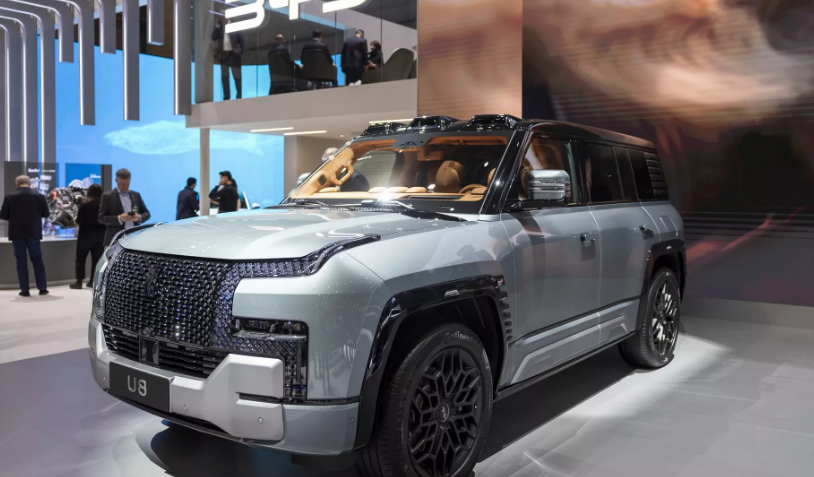
Chinese car manufacturers, including BYD, Geely, and SAIC, are increasing their hybrid vehicle exports to Europe to circumvent higher tariffs on electric vehicles (EVs) imposed by the European Union. This strategic pivot allows Chinese automakers to maintain and expand their market presence while avoiding the full impact of the new duties.
Hybrid vehicles, which combine electric batteries with internal combustion engines, are exempt from the EU’s recent tariff hikes targeting EVs. As a result, exports of Chinese hybrids to Europe have surged, with 65,800 units shipped between July and October 2024, more than triple the number exported in the same period last year, according to the China Passenger Car Association (CPCA).
Impact on Market Dynamics
The influx of Chinese hybrids is intensifying competition with established Japanese and European automakers, including Toyota, Honda, Nissan, and Volkswagen. Many of these brands are experiencing declining sales as Chinese manufacturers offer cost-competitive alternatives with advanced features.
BYD has introduced models like the SEAL U DM-i and Song Plus DM-i, while Geely offers plug-in hybrids such as the Galaxy Starship 7 and mild hybrids like the Azkarra. SAIC’s hybrid lineup includes the MG6 PHEV, Roewe Erx5 Super Hybrid Edition SUV, and MG EHS Plug-in Hybrid. These models are attracting European consumers with their modern designs, enhanced reliability, and innovative technology.
Tariff Evasion Strategies
In addition to exporting hybrids, some Chinese automakers are relocating assembly and production facilities to Europe to reduce costs and bypass tariffs. The EU imposed the higher duties amid allegations that the Chinese government subsidized EV manufacturers, enabling them to sell vehicles at below-market prices. Current tariffs range from 17% for BYD to 35.3% for SAIC and 18.8% for Geely.
While the hybrid strategy offers a temporary reprieve, analysts warn it could prompt the EU to impose tariffs on hybrids if their popularity significantly disrupts the domestic automotive market.
Growing Popularity of Chinese Hybrids
Chinese hybrids are gaining traction in Europe due to their affordability, a critical factor for consumers grappling with the cost-of-living crisis and higher interest rates. These vehicles often come equipped with cutting-edge features, sleek designs, and strong safety ratings, appealing to European buyers.
Hybrids also serve as a transitional option for consumers hesitant to fully commit to EVs, offering the familiarity of a traditional engine alongside electric capabilities. Many countries provide tax incentives for hybrid purchases, further bolstering their appeal.
The Chinese automakers’ shift towards hybrids highlights their adaptability in navigating trade barriers while continuing to challenge established players in the European market. However, this strategy’s long-term viability remains uncertain amid potential regulatory changes.




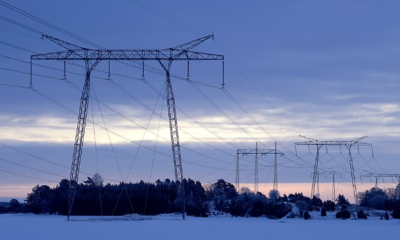



Around 46 million people aged 16 and over across the European Union cannot afford to take part regularly in leisure activities, with Greece recording the highest proportion and Croatia the lowest, according to figures published by Eurostat.
In 2025, an average of 12.1 per cent of people across the EU said financial constraints prevented them from regularly enjoying activities such as sports, cinema visits and concerts. The proportion ranged from 3.9 per cent in Croatia to 27.3 per cent in Greece.
The figures highlight significant differences in access to leisure across Europe, including between countries with comparable income levels. Researchers have linked participation in social and leisure activities to better mental well-being and fewer symptoms of depression and anxiety.
Greece had the highest rate of people unable to afford regular leisure activities, followed by Romania at 23.3 per cent. Lithuania recorded 17.9 per cent, Latvia 16.2 per cent, North Macedonia 15.9 per cent and Hungary 15.8 per cent.
France and Spain were also above the EU average, with 13.9 per cent and 13.4 per cent respectively reporting that costs prevented regular participation. Switzerland recorded 13 per cent.
Germany was slightly below the EU average at 11.7 per cent, while Italy recorded 10.7 per cent. Other countries with relatively low rates included Czechia at 4.1 per cent, Luxembourg at 5.4 per cent, Norway and Slovakia at 5.7 per cent each.
The figures stood at 6.7 per cent in the Netherlands, 8.7 per cent in Portugal and Turkey, 9.2 per cent in Ireland and 9.7 per cent in Belgium.
Women face greater financial barriers
Women were generally more likely than men to report that they could not afford regular leisure activities. Across the EU, the figure was 13 per cent for women, compared with 11.1 per cent for men. Malta was the only exception, with a difference of just 0.1 percentage point.
The gender gap was particularly pronounced in Lithuania, where the difference reached 5.1 percentage points. Romania recorded a gap of 4.7 points, followed by Denmark at 3.9 points and France at 3.7 points.
Income does not explain the whole gap
An analysis by Euronews Business covering 33 European countries found a moderate relationship between median income and the affordability of leisure. Income differences accounted for less than one-fifth of the variation between countries.
Czechia, Estonia, Latvia and Lithuania had similar median incomes, ranging from 17,097 to 17,190 purchasing power standards. However, the share unable to afford regular leisure activities varied substantially, from 4.1 per cent in Czechia to 17.9 per cent in Lithuania.
France and Cyprus also had almost identical median incomes, yet France’s rate of financial exclusion from leisure activities was more than twice Cyprus’s 6.3 per cent.
Greece recorded a rate of 27.3 per cent despite a median income of 13,612 purchasing power standards. Croatia, Czechia and Slovakia had some of the lowest rates even though their incomes were below the EU median of 22,638.
Eurostat also found that people living below the poverty line were more than three times as likely to miss out on regular leisure activities as those above it, with 29 per cent unable to afford participation.
The figures suggest that access to leisure depends on more than national income alone. Eurostat defines these activities as pursuits outside the home, including sports, cinema visits and concerts, which may involve entrance fees, travel expenses, equipment or membership costs.
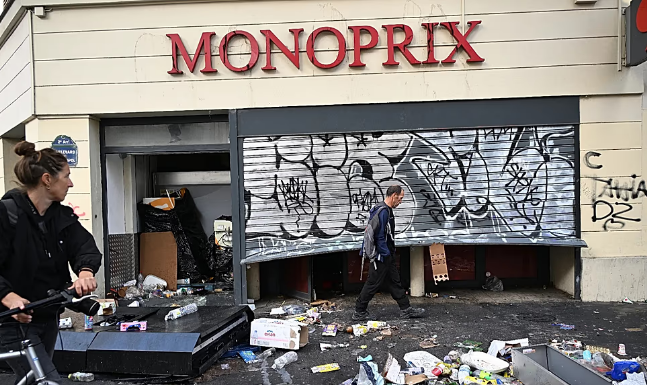
French businesses began assessing extensive damage on Sunday after cost-of-living protests descended into violence and widespread looting across the country, leaving shops vandalised, streets littered with broken glass and hundreds of workers facing disruption.
Authorities reported looting in major cities including Paris, Lyon, Marseille, Bordeaux, Rennes, Strasbourg, Grenoble, Nice and Limoges. Targets included supermarket chains Carrefour, Franprix and Monoprix, as well as luxury boutiques, bars and vape shops.
Groups of masked individuals, many dressed in black, smashed shop windows and forced open metal shutters before taking goods from shelves. In Paris, residents emerging from their homes on Sunday encountered debris and damaged storefronts following Saturday’s unrest.
Alexandre Bompard, chairman and chief executive of Carrefour Group, said 50 of the company’s stores had been targeted, including 19 Carrefour convenience stores and supermarkets. The affected premises included locations in Paris, Rennes, Lille and Bordeaux.
Bompard also expressed solidarity with retailers across the country, saying around 1,500 shops belonging to other chains and independent businesses had suffered similar violence.
He warned that the destruction would have serious economic and human consequences. Repair costs for Carrefour’s affected premises alone were expected to exceed €10 million, while dozens of employees working for franchise partners could be placed on reduced working hours.
For independent shopkeepers, the damage threatened livelihoods built over years of work. One business owner near Place de la République in Paris told the French media outlet Brut that he had invested all his savings in his shop and feared he had lost everything.
“I don’t know how I’ll get by or how I’ll live with my family,” he said. A neighbour subsequently organised a fundraising effort to help him rebuild his business.
Paris Mayor Emmanuel Grégoire pledged support for businesses affected in the capital and requested an emergency task force to assist shopkeepers whose premises had been vandalised.
The proposed team will assess damage, help businesses navigate administrative procedures and provide assistance with insurance claims, Grégoire said.
The unrest also affected journalists covering the demonstrations. A Euronews reporting crew was assaulted near Place de la République on Saturday while documenting the looting of an Intermarché Express supermarket.
Paris correspondent Estelle Nilsson-Julien said masked individuals confronted the crew after noticing they were filming. The attackers allegedly punched the cameraman, pushed him against a wall and attempted to seize his microphone. Nilsson-Julien said she was also struck during the incident.
Elsewhere in Paris, a separate march along Boulevard de Clichy towards Place de Clichy remained peaceful, according to another Euronews journalist.
French Interior Minister Laurent Nuñez said on Sunday that more than 600 police officers, gendarmes and firefighters had been injured during Saturday’s unrest. Authorities had arrested more than 2,000 people as officials faced mounting pressure to restore order and support affected businesses.
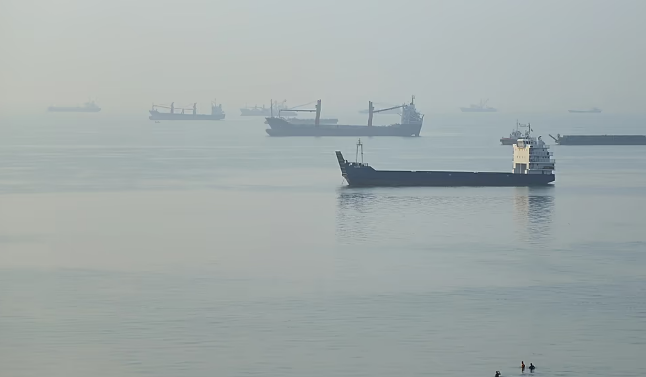
An oil super tanker carrying more than two million barrels of crude caught fire after striking a sea mine in the Strait of Hormuz, Iran’s Islamic Revolutionary Guard Corps (IRGC) said on Saturday, escalating tensions around one of the world’s most important energy shipping routes.
In a statement carried by Iranian state media, the IRGC navy said the vessel hit a mine while attempting to navigate what it described as an unauthorised route through the strait. The impact triggered a massive explosion and a fierce fire, according to the statement.
The exact location of the incident, the identity of the tanker and the extent of any damage or casualties were not immediately clear.
Iran’s Fars news agency published video footage that appeared to show the vessel engulfed in flames. The IRGC navy accused the tanker of switching off its positioning and radar systems in an attempt to avoid detection while passing through the waterway.
“The Strait of Hormuz is closed, and the consequence of defying Iranian regulations in the Strait of Hormuz is burning in the fire of trust in the terrorist US army,” the IRGC navy said in its statement.
The claim could not be independently verified from the information immediately available.
The Strait of Hormuz, located between Iran and Oman, is a vital passage for global energy supplies. Before the current conflict, it carried around a quarter of the world’s seaborne oil trade, alongside substantial volumes of liquefied natural gas.
The waterway has become a major flashpoint since the war involving Iran, the United States and Israel began in late February. Iran effectively restricted passage through the strait following US and Israeli strikes, disrupting shipping and raising concerns about the security of international energy supplies.
Washington subsequently imposed a naval blockade on Iranian ports, adding another layer of pressure to the confrontation between the two countries.
The US military has repeatedly rejected Iranian claims of control over the strait, maintaining that commercial vessels have continued to operate in the area despite what it describes as aggression by the IRGC.
Admiral Brad Cooper, commander of US Central Command (CENTCOM), said on Friday that American forces were coordinating with regional allies and shipping industry partners to help protect vessels travelling through the waterway.
“Let me be clear, the Strait of Hormuz is controlled by the United States and our regional partners, not Iran,” Cooper said. “It remains open for business.”
The reported tanker fire highlights the continuing risks to commercial shipping as Washington and Tehran maintain opposing positions over access to the strait. Any sustained disruption could have significant consequences for oil transport, energy prices and international trade.

Around 46 Million EU Residents Cannot Afford Regular Leisure Activities

Looting Across France Leaves Shops Damaged as More Than 2,000 Arrested

Uber Plans European Robotaxi Expansion After Driverless Taxi Trials in Zagreb

Iran Says Oil Super Tanker Catches Fire After Hitting Mine in Strait of Hormuz

European Trade Unions Push for Menopause Protections in EU Workplace Law

Ukraine War Strikes Raise Questions Over Security of Europe’s AI Data Centres

Europe Develops 348-Satellite Network to Reduce Dependence on Starlink

US Military Builds Up Forces in Arabian Sea as Iran Warns of Possible War

OpenAI Donates $5 Million to Mathematics Foundation After Research Dispute

AI Speeds Up Ebola Response in Congo, but Experts Warn of Healthcare Risks

Meta Acquires Tilda Swinton VR Doc ‘Impulse: Playing With Reality’

China’s Historic Olympic Victory Sparks National Pride Amid Controversy

Saudi Arabia’s Model for Sustainable Aviation Practices

Recent Developments in Small Business Taxes

Effective Drain Cleaning: A Key to a Healthy Plumbing System

Who was Ebrahim Raisi and his status in Iranian Politics?

Keely Hodgkinson Wins Britain’s First Athletics Gold at Paris Olympics in 800m

Carrectly: Revolutionizing Car Care in Chicago

Nobel Laureate Muhammad Yunus Proposed as Head of Bangladesh’s Interim Government Following Hasina’s Resignation

Chinese Hackers Infiltrate Major U.S. Telecom Firms in Possible National Security Breach

Sony WF-10XM4: Headphones Are Our Absolute Favorite

10 Places You Can’t Miss If It’s Your First Time in European

New Census Data Will Shake Up Alabama Politics

16 Top of Our Favorite Outdoor Clothing Brands

Fashionable Summer Accessories to Dress Up Your Travel Look

How Sleeping Less than 7 Hours a Night Can Lead to Weight Gain
-
 Entertainment2 years ago
Meta Acquires Tilda Swinton VR Doc ‘Impulse: Playing With Reality’
-
 Sports2 years ago
China’s Historic Olympic Victory Sparks National Pride Amid Controversy
-
 Business2 years ago
Saudi Arabia’s Model for Sustainable Aviation Practices
-
 Business2 years ago
Recent Developments in Small Business Taxes
-
 Home Improvement2 years ago
Effective Drain Cleaning: A Key to a Healthy Plumbing System
-
 Politics2 years ago
Who was Ebrahim Raisi and his status in Iranian Politics?
-
 Sports2 years ago
Keely Hodgkinson Wins Britain’s First Athletics Gold at Paris Olympics in 800m
-
 Business2 years ago
Carrectly: Revolutionizing Car Care in Chicago