Connect with us

News

White House Unveils “Media Hall of Shame” Portal as Attacks on Press Intensify

Published

on

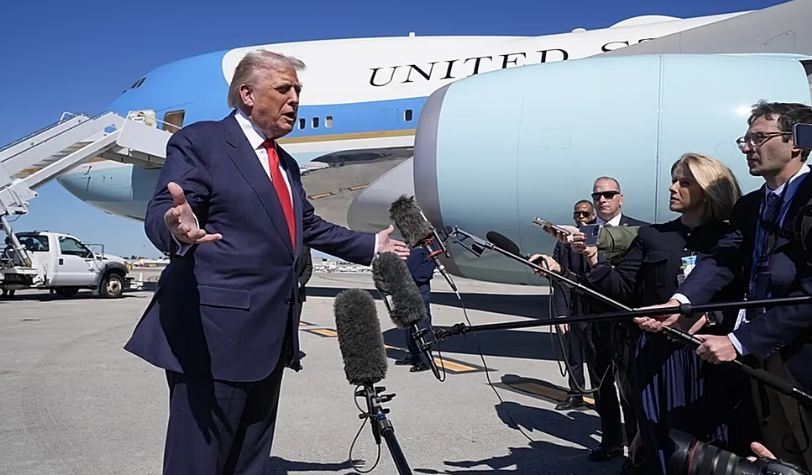
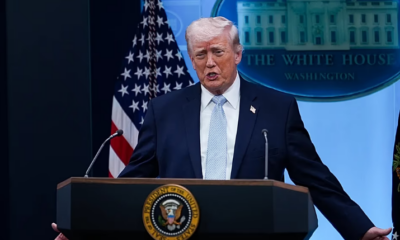
The White House has launched an online “Media Hall of Shame,” a federally hosted portal that lists news outlets and individual journalists it accuses of publishing false or misleading information. The move marks a sharp escalation in President Donald Trump’s long-running campaign against what he frequently labels “fake news,” and comes amid rising condemnation over his public attacks on reporters.

The new portal, published on an official government website, claims to offer a fully sortable and regularly updated record of what the administration describes as inaccurate reporting. “It ensures no hoax, no anonymously ‘sourced’ fan fiction, and no partisan smear gets memory-holed again,” the White House said in its announcement.

Among its features, the site names The Washington Post as “Offender of the Week,” while also spotlighting The New York Times, CNN, CBS News and The Independent. Accredited international wire services including the Associated Press and Reuters are also listed, with the administration accusing the AP of “bias” and “omission of context” and labeling a Reuters report as a “lie.”

Stories are placed into categories such as “false claim,” “misrepresentation,” “failure to report,” “malpractice,” “mischaracterisation,” and “circular reporting.” Another section titled “left-wing lunacy” aims at content the White House asserts reflects ideological slant. Notably, no conservative-leaning outlets appear anywhere on the site.

The move has drawn significant backlash from journalism advocates and major newsrooms. Matt Murray, executive editor of The Washington Post, condemned the website as an attack on constitutionally protected reporting. “Let’s be clear what’s happening here: the wrongful and intentional targeting of journalists by government officials for exercising a constitutionally protected right,” Murray said. “The Washington Post will not be dissuaded and will continue to report rigorously and accurately in service to all of America.”

See also  Britain and Norway Step Up Naval Patrols to Protect Undersea Infrastructure from Russia

While conservative media watchdogs have welcomed the launch, critics warn that the portal represents an unprecedented government effort to single out journalists. The Media Research Centre, which often accuses national news networks of liberal bias, praised the initiative. “It’s a stronger effort than Republican presidents have done before,” said MRC director of media analysis Tim Graham. “I think all Republicans realize today that the media is on the other side and need to be identified as on the other side.”

Press freedom experts interviewed by German broadcaster DW said the White House’s new approach poses a direct risk to journalists and undermines democratic norms by framing independent reporting as an adversarial act. They warned that such rhetoric fuels hostility toward the press and contributes to a climate in which reporters may face harassment or threats.

The launch of the portal comes at a time when Trump has intensified his criticism of the media, frequently singling out reporters—often women—with personal insults, calling them “stupid,” “piggy,” and “ugly inside and out.” The growing pressure on journalists has raised alarms among advocates who argue that a free and independent press is vital to the country’s democratic institutions.

The White House has not responded to questions about how the portal will be maintained or which officials will determine what qualifies as an “offense.”

News

Britain and Norway Step Up Naval Patrols to Protect Undersea Infrastructure from Russia

Published

on

Britain and Norway have launched new joint naval patrols aimed at protecting undersea cables from Russia, with a combined fleet of at least 13 warships safeguarding critical infrastructure in the North Atlantic, officials said. The announcement follows discussions in December between UK Prime Minister Keir Starmer and Norwegian Prime Minister Jonas Gahr Støre on defense cooperation.

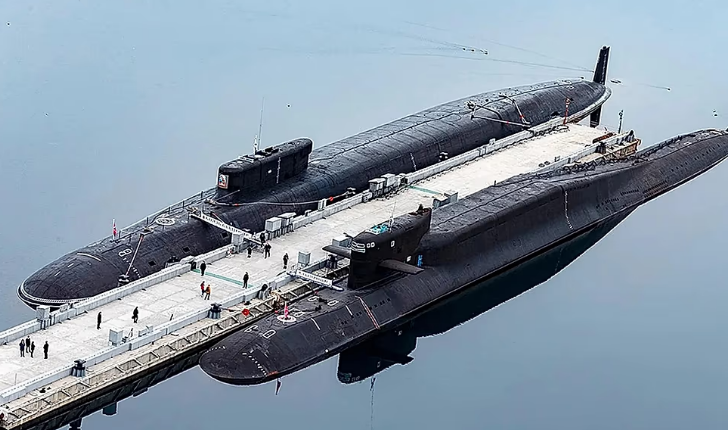
British Defence Secretary John Healey said on Thursday that the operation was designed to deter Russian submarines suspected of “malign activity” near undersea infrastructure north of the UK. A frigate, aircraft, and hundreds of personnel monitored a Russian attack submarine and two spy vessels during an operation lasting more than a month. Healey said the Russian ships eventually left the area.

His message to Moscow was clear: “We see your activity over our cables and our pipelines, and you should know that any attempt to damage them will not be tolerated and will have serious consequences.” Healey emphasized that while global attention is focused on conflicts in the Middle East, Russia remains the main threat to the UK and its allies.

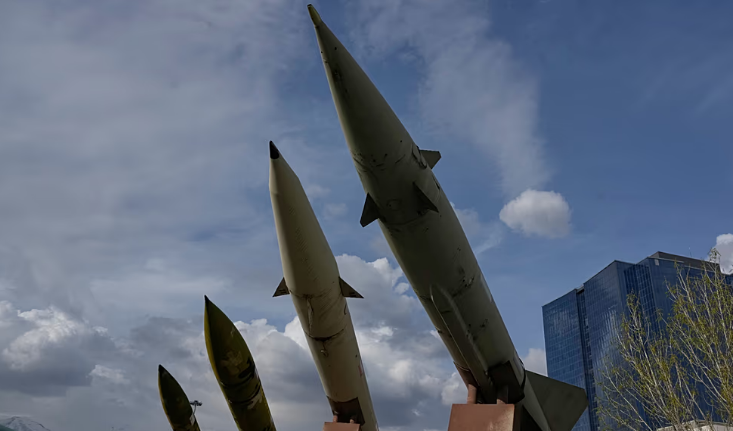
British officials have highlighted the overlap between Russia’s support for Iran and its ongoing war in Ukraine. Tehran has provided Moscow with Shahed drones, which are now also manufactured in Russia under the designation Geran. Healey said, “Putin would want us to be distracted by the Middle East. We will not take our eyes off Putin.”

The UK has also prepared to seize ships suspected of being part of Russia’s “shadow fleet,” a flotilla of old oil tankers of unclear ownership designed to bypass international sanctions imposed over Moscow’s 2022 invasion of Ukraine. Previously, the UK only assisted France and the US in monitoring such vessels. Healey said, “We are ready to take action” against these ships.

See also  Voter Fraud in the US is Extremely Rare, Despite False Claims by Trump and Allies

Norwegian Defence Minister Tore O. Sandvik, who signed the joint naval agreement with Healey, said the patrols allow both countries to “defend themselves together.” The deployment builds on a £10 billion (€11 billion) deal for Norway to purchase at least five British-made frigates, which, together with eight British ships, will operate along NATO’s northern flank.

Russian naval activity near UK waters has reportedly risen by 30 percent over the past two years. NATO officials have also warned that attacks on undersea cables are among the “most active threats” to Western infrastructure. Acting Assistant Secretary General for Innovation, Hybrid, and Cyber, James Appathurai, said recent incidents in the Baltic Sea and elsewhere reflect Russia’s long-term undersea program, which includes research ships, submarines, unmanned vehicles, divers, and explosives targeting communications and energy pipelines.

The new UK-Norway patrols signal a heightened focus on securing vital maritime infrastructure amid rising geopolitical tensions and increasing Russian naval operations in European waters.
Continue Reading

News

Fresh Attacks Reported Across Gulf Despite US-Iran Ceasefire Announcement

Published

on

Reports of new attacks across the الخليج on Wednesday have shaken early optimism following the announcement of a two-week ceasefire between the United States and Iran, raising doubts about how quickly the agreement can take hold.

The ceasefire, announced late الثلاثاء, had been welcomed across the region as tensions between واشنطن and طهران escalated. However, neither side specified when the truce would come into effect, and events on Wednesday suggested hostilities had not fully subsided.

In the United Arab Emirates, authorities reported a fresh Iranian attack targeting the Habshan gas complex. The strike disrupted operations and prompted officials to suspend production at the facility after falling debris from intercepted projectiles caused multiple fires. According to the Abu Dhabi media office, two Emirati nationals and one Indian worker suffered minor injuries.

Journalists in Dubai reported receiving air raid alerts early in the morning and observed continued air defence activity, including fighter jets operating overhead. The developments marked a sharp end to the brief sense of relief that had followed the ceasefire announcement.

In Qatar, residents in Doha also received early morning alerts after a night of heightened tension. Reports indicated a prolonged Iranian raid on Tuesday evening, with at least eight interception blasts heard across the city. The incident disrupted air traffic, with inbound flights diverted for about an hour before normal operations resumed.

Bahrain experienced similar unrest. Sirens sounded again on Wednesday morning, warning residents to seek shelter as new explosions were heard. The renewed activity followed overnight strikes that damaged homes in the Sitra area and left two people injured by falling debris after an Iranian drone was intercepted.

See also  Hezbollah Weighs US-Israeli Ceasefire Proposal Amid Escalating Conflict

Meanwhile, in Tehran, residents reported hearing air defence systems in operation late Wednesday morning. Initial reports suggested the activity may have been part of a drill, though details remained limited.

The renewed attacks come despite an agreement announced by US President Donald Trump and Iranian officials for a two-week ceasefire that includes reopening the Strait of Hormuz, a critical route for global energy supplies. Trump had earlier described a 10-point proposal from Iran as a possible basis for negotiations, though he later questioned its credibility.

Israel signalled support for the temporary pause in strikes against Iran but clarified that it would continue its military operations against Hezbollah in Lebanon, highlighting ongoing tensions beyond the immediate US-Iran conflict.

The situation underscores the fragile nature of the ceasefire, with continued military activity casting uncertainty over its implementation. As diplomatic efforts continue, the coming days are likely to determine whether the agreement can hold or whether the region will see further escalation.

Continue Reading

News

Sweden Accuses Iran of Using Criminal Gangs to Target Dissidents as Teenagers Face Trial

Published

on

Sweden’s security service, Sapo, has accused Iran of increasing its targeting of dissidents since the start of the Iran war, alleging that it has recruited organised crime networks to carry out acts of violence داخل the country. The warning comes as five teenagers are due to appear in court on Wednesday over the alleged attempted murder of an Iranian dissident researcher in southern Sweden.

Prosecutors say the group targeted Arvin Khoshnood, a researcher and commentator on Iranian affairs, at his home in the city of Malmö on September 2 last year. According to the charge sheet, one of the suspects, aged 16 at the time, rang the doorbell armed with a knife and asked Khoshnood’s wife if he was at home. Khoshnood, who was present, remained out of sight and contacted police immediately.

Authorities allege the teenager had been recruited through encrypted messaging apps and promised payment to carry out the attack. Prosecutors say three of the accused, along with a fourth individual believed to be the mastermind, provided instructions, supplied the weapon, and negotiated the terms before the attempt was made. Three of the teenagers face charges of attempted murder, while the others are accused of complicity.

“These are acts that fall under so-called crime as a service, where young perpetrators in Sweden take on assignments from individuals connected to organised crime,” prosecutor Per-Erik Rinsell said in a statement.

Khoshnood has suggested the plot may be linked to the Foxtrot network, one of Sweden’s most prominent criminal gangs. Its leader, Rawa Majid, has been reported to have connections to Iran, although such claims remain contested. The group has been associated with a series of shootings, bombings, and other violent incidents in recent years, often recruiting young people through online platforms.

See also  Ukraine Accuses Russia of Deploying North Korean Troops Amid Conflicting Reports

The case has drawn attention to what Swedish authorities describe as a growing security threat. Sapo has identified Iran as one of the main risks to national security, accusing it of using criminal gangs to target Israeli interests and Iranian opposition figures within Sweden. Tehran has denied these allegations.

Khoshnood, who frequently appears in Swedish media as an expert on Iran, has openly expressed support for exiled opposition figure Reza Pahlavi, the son of Iran’s last shah. Investigators believe his public stance may have made him a target.

Several of the accused teenagers are also facing charges related to a separate attempted murder in Uddevalla, which occurred a week after the incident in Malmö. Authorities have not confirmed whether that case involved another Iranian dissident.

The trial is expected to shed light on the alleged links between foreign actors and domestic criminal networks, as Sweden grapples with rising concerns over organised crime and national security.

Continue Reading

Trending