Connect with us

News

Russia Launches Largest Aerial Assault of War on Ukraine, Killing 12 Amid Prisoner Swap

Published

on

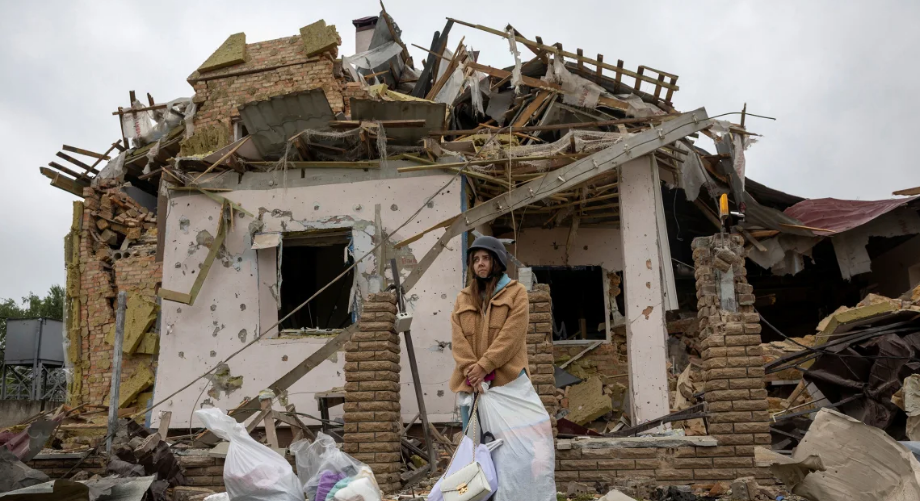
Russia launched its most extensive aerial assault of the war on Ukraine overnight, unleashing a barrage of missiles and drones that killed at least 12 people, including three children, and injured dozens more. The attacks, which struck Kyiv and 21 other locations, marked a second consecutive night of intense bombardment even as both nations completed a major prisoner exchange.

According to Ukraine’s Air Force, Russian forces launched 367 aerial weapons in total — 69 missiles and 298 drones. Ukrainian defenses intercepted 47 missiles and 266 drones, but many still hit civilian areas, causing widespread destruction. Ukrainian Foreign Minister Andrii Sybiha described the assault as “the most massive Russian air attack in many weeks.”

In the Zhytomyr region west of Kyiv, three children from the same family were killed. Their parents remain hospitalized, with the mother in serious condition, according to Interior Minister Ihor Klymenko. The children’s school expressed condolences on Facebook, stating, “We are in pain… We bow our heads in sorrow.”

The capital Kyiv was placed under lengthy air raid alerts overnight, with local officials reporting significant damage to civilian infrastructure from rocket and drone strikes. Similar attacks the previous day had killed at least 13 people.

The assault occurred despite a rare moment of cooperation: the conclusion of a large-scale prisoner swap between the two nations. On Sunday, each side released 303 prisoners, wrapping up the final phase of a 1,000-for-1,000 exchange agreed upon during last week’s Istanbul meeting. Videos posted by Ukrainian President Volodymyr Zelensky and other officials showed newly released Ukrainian servicemen calling loved ones and celebrating their return.

See also  80th Anniversary of Thiaroye Massacre Revives Calls for Justice and Historical Clarity

“This exchange was possible thanks to the tireless efforts of our team,” Zelensky said. “I am grateful to all who made it happen.”

While Ukraine endured heavy bombardment, Russia reported its own wave of drone attacks from Ukraine. The Russian defense ministry said about 100 drones were intercepted, including 13 over Moscow and Tver. A day earlier, another 94 Ukrainian drones were reportedly downed, mainly over Belgorod and Bryansk regions.

The Istanbul meeting, proposed by Russian President Vladimir Putin amid growing international pressure for a ceasefire, was seen by many as a stalling tactic. Since the talks, Moscow has intensified its military campaign.

“Without strong pressure on Russia’s leadership, this brutality will not end,” Zelensky said, urging Western allies to impose new sanctions.

The latest escalation threatens to undermine diplomatic efforts and raises concerns of a prolonged and bloodier phase in the conflict.

News

New Tashkent Aims to Redefine Urban Living with Sustainability and Smart Infrastructure

Published

on

Uzbekistan is moving forward with an ambitious plan to reshape its capital with the “New Tashkent” project, a purpose-built city designed to meet the demands of rapid population growth while promoting sustainability and modern urban living. Launched in March 2023 under Tashkent’s Master Plan through 2045, New Tashkent is planned to cover 20,000 hectares between the Chirchik and Korasuv rivers, positioning it as a major new urban hub rather than a suburban extension.

The city is expected to accommodate around 2 million residents and generate 200,000 high-income jobs driven by technology and innovation. It will feature smart-city innovations, modern amenities, and buildings built to international green standards, ensuring energy efficiency, climate resilience, and healthy living environments.

Urbanization pressures in Uzbekistan are mounting. By mid-2025, more than 19.3 million people, roughly 51 percent of the population, are projected to live in urban areas, compared with 18.6 million in rural regions. Tashkent itself officially has 3.1 million residents, but daily numbers may be 30–35 percent higher when including students and internal migrants. The concentration of 98 universities in the city continues to draw young people, intensifying demand for housing, transport, and social services.

Sustainability is central to New Tashkent’s design. Buildings will adhere to internationally recognised standards such as LEED, BREEAM, and EDGE, promoting energy efficiency, water conservation, and the use of sustainable materials. Green roof technology, rainwater collection systems, and other measures aim to reduce energy demand and improve resilience to climate extremes. The city’s energy infrastructure includes existing hydropower, a 400-megawatt solar farm, a new 100-megawatt solar installation, and a tri-generation facility converting waste into electricity and heat. Experts estimate that even modest efficiency gains could save over 900 million kilowatt-hours annually.

See also  Russia Accused of Over 2,900 Ceasefire Violations During Easter Truce, Says Zelenskyy

Transport planning is integral to the project. A 21-kilometre metro line will connect New Tashkent to the capital, while tram lines and eight multimodal transfer hubs will allow seamless switching between metro, tram, buses, bicycles, and scooters. The city is being designed around the 15-minute city concept, making walking, cycling, and public transport convenient for residents.

Urban planners are using a radial city model to prioritize walkability and access to services. Green infrastructure, parks, riverfronts, and cycling lanes will be integrated to create a connected, pedestrian-friendly environment. A cultural island at the intersection of artificial canals will serve as a social and recreational focal point, while the city’s waterways and green spaces will foster a comfortable microclimate.

By the end of 2025, construction had reached 3 million square metres. Several ministries have started operations from temporary facilities, and infrastructure projects include a €86 million underground parking facility with automated systems, bicycle rentals, and EV charging stations. Residential development includes the 95-hectare Sharq Bahori complex for 15,000 households, while New Uzbekistan University is being built to serve 10,000 students. A 55,000-seat FIFA-standard stadium is under construction ahead of the 2027 U-20 World Championship, which Uzbekistan will co-host with Azerbaijan.

New Tashkent is positioned as a blueprint for sustainable urban development in Central Asia, combining technology, green infrastructure, and strategic planning to support Uzbekistan’s rapidly growing urban population.

Continue Reading

News

EU Faces Urgent Defence and Economic Challenges Amid US Power Imbalance

Published

on

“In recent months, the EU has suffered the most serious diplomatic defeats. This will only change in the future if the member states possess greater military power, Karl-Heinz Paqué writes in an opinion article for Euronews.”

Europe is confronting a period of strategic vulnerability, as recent diplomatic setbacks highlight its limited ability to counter unilateral US actions. The July 2025 outcome of tariff talks in Scotland between European Commission President Ursula von der Leyen and then-US President Donald Trump has become a symbol of the EU’s weakened negotiating position. Under the agreement, the US maintained 15% tariffs on European goods, while Europe committed to major US investments in exchange for a pledge that higher duties would not be imposed. Analysts and critics have described the deal as amounting to little more than economic coercion.

The so-called “Greenland affair” serves as another example of Europe’s limited influence. Trump publicly suggested annexing the island, purchasing it, or offering financial incentives to Greenlanders that Denmark could not match. While EU leaders protested, the continent lacks the military power to credibly prevent such unilateral actions. Even NATO’s formal obligations would likely not compel European countries to challenge a decisive US move.

The core challenge stems from decades of underinvestment in European defence capabilities. While reliance on the US was once considered stable, Trump’s policies and rhetoric disrupted that trust, signaling the end of the post-World War II security paradigm. Analysts note that Europe now faces a structural imbalance: the EU’s combined military strength is far smaller than that of the United States, leaving it vulnerable to both economic and security-related coercion.

See also  Trump Urges Israel to Halt Gaza Bombing as Hamas Signals Partial Acceptance of Peace Plan

In response, NATO members have agreed to raise defence spending to 5% of GDP by 2025, a significant but insufficient step. Paqué notes that Europe faces a long-term gap with the US that will persist for decades. Integration of the European defence market remains incomplete, limiting efficiencies and innovation in weapons production. Compounding the challenge is Europe’s slower economic growth relative to the US, which constrains the resources available for military expansion. Diverting 5% of a stagnant GDP to defence would impose far greater social and political strain than in a more dynamic economy.

Paqué argues that achieving meaningful military capabilities will require not only higher defence budgets but also radical economic reforms, particularly in Germany. Without stronger economic and industrial foundations, Europe risks remaining dependent on external security guarantees, limiting its ability to act independently on global issues.

The EU now faces its most serious political and security tests in decades. Analysts say the lessons of recent US-European interactions are clear: Europe must strengthen both its military capacity and economic resilience to avoid repeated diplomatic defeats. The next critical phase in this effort begins in 2026, when the effectiveness of NATO commitments and national reform plans will be tested on both strategic and economic fronts.

Continue Reading

News

Venezuelan Opposition Leader María Corina Machado Presents Nobel Medal to Trump at White House

Published

on

In a rare move, Venezuelan opposition leader María Corina Machado presented her 2025 Nobel Peace Prize medal to former US President Donald Trump at the White House on Thursday, describing the gesture as “recognition for his unique commitment to our freedom.”

Machado was awarded the Nobel Peace Prize for her leadership of Venezuela’s opposition during a crackdown by President Nicolás Maduro, particularly surrounding the controversial 2023 presidential election. Her visit to Washington came shortly after a US military operation on 3 January resulted in Maduro’s capture. The former Venezuelan leader and his spouse now face drug trafficking charges in New York.

“I presented the president of the United States the medal, the Nobel Peace Prize,” Machado told reporters as she left the White House. Trump confirmed the meeting on social media, calling Machado “a wonderful woman who has been through so much” and saying the presentation was “a wonderful gesture of mutual respect.”

Although Machado’s action is unusual for a living laureate to part with her medal shortly after receiving it, it is not without precedent. The Nobel Foundation’s statutes allow winners to give away their physical medal or diploma, but the title itself remains solely with the recipient and cannot be legally transferred.

Several previous laureates have donated, sold, or auctioned their medals under extraordinary circumstances. Russian journalist Dmitry Muratov, who shared the 2021 Peace Prize with Maria Ressa, sold his medal in 2022 for $103.5 million (€89.1 million), donating all proceeds to UNICEF for Ukrainian child refugees after Russia’s invasion of Ukraine.

Historical examples include Nobel medals used for humanitarian purposes during wartime. Danish physicists Niels Bohr and August Krogh saw their medals auctioned to aid Finnish civilians during the Winter War of 1939-40. German physicists Max von Laue and James Franck entrusted their medals to Bohr to prevent them from falling into Nazi hands; the medals were later recovered and recast by the Nobel Foundation.

See also  Hungarian Prime Minister Viktor Orban Meets Chinese Leader Xi Jinping in Beijing Amid Rising Tensions

Not all medal gestures were humanitarian. Norwegian author Knut Hamsun, Nobel laureate in Literature in 1920, reportedly gave his medal to Nazi propaganda minister Joseph Goebbels during World War II, damaging his reputation permanently.

More recently, Nobel medals have been sold at auction for philanthropic or personal reasons. James D. Watson, co-discoverer of DNA’s structure and a 1962 laureate, sold his medal in 2014 for $4.8 million (€4.13 million) to support scientific research. Russian billionaire Alisher Usmanov later returned it to Watson in 2015. Other sales include Norman Angell’s Peace Prize medal, now held at London’s Imperial War Museum, and Aage Bohr’s 1975 Physics medal, sold at auction in 2011 and 2019.

Some laureates instead donate their prize money. Albert Einstein’s 1921 Nobel earnings went to his family under a pre-arranged divorce settlement. Mother Teresa directed her 1979 Peace Prize funds to the poor, and Paul Greengard used his 2000 Nobel prize money to establish an award supporting women scientists.

Machado’s presentation of her medal to Trump adds a contemporary chapter to the complex history of Nobel laureates parting with their physical awards, highlighting both symbolic gestures and humanitarian or political intentions.

Continue Reading

Trending