Connect with us

Business

Xi Jinping Begins Southeast Asia Tour, Slams Trade War with US

Published

on

Chinese President Xi Jinping has kicked off a diplomatic tour of Southeast Asia, reiterating his country’s commitment to global trade and emphasizing the importance of multilateral cooperation. In his remarks, Xi took aim at the ongoing trade tensions between China and the United States, stressing that “no one wins in a trade war.”

Xi’s comments came as he embarked on a two-day visit to Vietnam, where he wrote an editorial jointly published in Vietnamese and Chinese media, denouncing the latest tariff moves by US President Donald Trump. Although Trump has paused most of his reciprocal tariffs, 145% duties on Chinese imports remain in place.

“There are no winners in a trade war, or a tariff war,” Xi stated, adding that both China and the US should work together to safeguard a stable global trading system, as well as global industrial and supply chains. He further emphasized the importance of fostering an open and cooperative international environment.

Xi’s diplomatic tour through Southeast Asia, which includes stops in Vietnam, Malaysia, and Cambodia, is being seen as an effort by China to strengthen its relationships in the region amidst escalating trade tensions with the US. According to Nguyen Khac Giang, a visiting fellow at Singapore’s ISEAS–Yusof Ishak Institute, the visit signals China’s attempt to portray itself as a “responsible superpower” in contrast to the policies of the Trump administration.

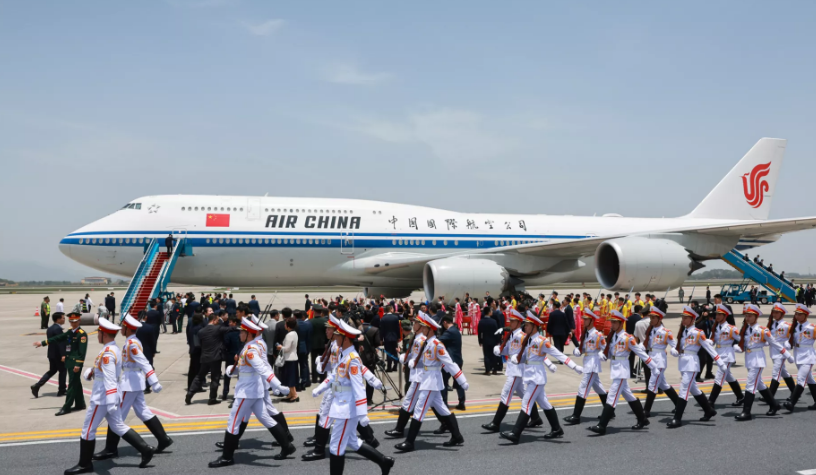
Upon arrival in Vietnam, Xi was warmly greeted by President Luong Cuong, who welcomed him at the airport – a rare honor, signaling the significance of the visit. A ceremonial drum performance and the waving of Chinese flags further marked the occasion.

See also  Germany’s Inflation Rate Hits 2.6% in December Amid Economic Struggles

The visit has gained added relevance due to the ongoing trade dispute between China and the US, which has placed heavy tariffs on Chinese goods. Xi’s stop in Vietnam is seen as an opportunity for Beijing to strengthen its economic alliances in Southeast Asia and to seek solutions for the high trade barriers the US has imposed on Chinese exports.

In Vietnam, Xi is set to meet with key political figures, including Communist Party General Secretary To Lam and Prime Minister Pham Minh Chinh. This marks the third time Xi has visited Vietnam since becoming president in 2013, highlighting the growing importance of bilateral relations.

Vietnam, which has managed to maintain a balanced relationship with both the US and China, faces challenges as the US intensifies its tariff policies. In 2023, the country upgraded its diplomatic ties with both the US and China, signaling its importance in global trade. Yet, the trade war has placed Vietnam in a precarious situation, as the US views the country as a potential backdoor for Chinese exports.

Following his visit to Vietnam, Xi will travel to Malaysia and Cambodia. The tour comes at a time when Southeast Asia is increasingly anxious about the impact of US trade policies on the region’s economic development. With the ongoing US-China trade war, the diplomatic visit aims to shore up China’s standing in Southeast Asia and foster stronger economic ties in the region.
Business

Consortium Agrees to All-Cash Deal to Acquire Polish Parcel Company InPost

Published

on

A consortium of investors has reached an agreement to acquire all shares of Polish-founded parcel locker company InPost, betting on the growth of self-service delivery across Europe. The deal is structured as an all-cash public offer valued at €15.6 per share.

The consortium includes funds managed or advised by Advent International, FCWB LLC—a wholly owned subsidiary of FedEx Corporation—A&R Investments Ltd., and PPF Group, together with InPost itself. The agreement is conditional and recommended by the InPost board.

InPost is best known for its proprietary Paczkomat parcel machines, widely used across Poland. These white self-service lockers, often located in subway stations or local shops, allow customers to send and receive small and medium parcels independently, bypassing traditional courier methods.

“Together, we will strengthen our network and reach more consumers with enhanced fast and flexible delivery options as we continue our objective of redefining the European e-commerce sector,” said Rafał Brzoska, CEO and founder of InPost. Brzoska confirmed he will remain as chief executive, and the company’s headquarters, management team, and key innovation operations will continue to be based in Poland.

“Importantly, I remain fully committed to leading the InPost Group. Our headquarters, management team and key innovation capabilities will remain in Poland, which will continue to be the centre for implementing the group’s successful strategy,” Brzoska added.

InPost has been expanding its footprint internationally. In the UK, the company acquired a 95.5% stake in competitor Yodel last year. It also operates in Italy, France, Belgium, the Netherlands, Luxembourg, Spain, and Portugal, managing parcel deliveries for online vendors across multiple European markets.

See also  Qatar Airways Group Reports Record $2.15 Billion Profit Amid Surging Passenger Demand

Following the completion of the transaction, FedEx will become a shareholder in InPost, joining the other investors to guide the company’s growth strategy. Prior to the deal, InPost was owned by PPF Group, A&R Investments—funds controlled by Brzoska—and Advent International, with just over half of the shares held by other investors.

Analysts say the acquisition reflects the rising demand for self-service parcel solutions, particularly in Europe’s growing e-commerce sector. The all-cash nature of the deal underscores confidence in InPost’s operational model and its ability to scale across multiple countries.

InPost has built a reputation for innovation in last-mile delivery, offering convenient alternatives to home delivery and enabling retailers to meet the increasing expectations of online shoppers. The company’s continued expansion and strong market position in Poland and abroad make it a strategic target for investors seeking to capitalize on the shift toward automated parcel services.

With Brzoska remaining at the helm and the company’s operational base secure in Poland, InPost looks set to maintain its leadership in self-service delivery while leveraging the backing of global investors to expand further across Europe.

Continue Reading

Business

Scandinavian Airlines Looks to AI and Consolidation for Growth Amid Industry Challenges

Published

on

The airline’s chief says artificial intelligence will help rebuild schedules during storms and improve efficiency in an industry that faces constant uncertainty. Scandinavian Airlines (SAS) is preparing for a new phase of growth while awaiting regulatory approval for its integration into the Air France-KLM group, according to President and CEO Anko van der Werff.

Speaking at the World Governments Summit in Dubai, van der Werff acknowledged the delay in the regulatory process. “We expect to get regulatory approval in the second half of the year,” he said. “I’m always a bit impatient… it’s a slow process.” He emphasized that many initiatives are effectively on hold, including joint ventures and partnerships that could unlock the benefits of a larger global network.

Despite industry consolidation, van der Werff is confident the SAS brand will remain strong. He sees the airline’s Scandinavian hubs, particularly Copenhagen, as a natural engine for growth amid capacity constraints elsewhere in the Air France-KLM network. “There will be real, real growth potential,” he said, predicting that travellers will “see more of SAS in the future than what you’re seeing today.”

The airline is also exploring the practical applications of artificial intelligence across operations. Van der Werff said SAS spent much of last year identifying “five big bets” for AI, with a focus on improving customer experience and operational efficiency. Handling disruptions during harsh Nordic winters is a key priority. “Occasionally we get hit by real snowstorms,” he said, describing days with “100 cancellations a day” and aircraft, crew, and passengers scattered across the network. AI, he noted, could rebuild schedules faster and more accurately than human teams alone.

See also  Qatar Airways Group Reports Record $2.15 Billion Profit Amid Surging Passenger Demand

Van der Werff stressed that the aviation industry is moving beyond experimentation with AI toward tangible applications. While fully autonomous passenger aircraft remain a distant prospect, he highlighted smaller improvements such as optimising onboard supplies, reducing fuel use, and automating administrative tasks.

Disruption management, he said, is the most urgent area for AI implementation. “Tens of thousands, hundreds of thousands of passengers” may need rerouting during large-scale cancellations, and faster decision-making could reduce hotel stays, reposition aircraft and crews, and limit the ripple effects of delays. “How do you put that puzzle back together more quickly, more efficiently?” van der Werff asked.

Reflecting on the broader industry, he noted that uncertainty is constant, from health crises and financial shocks to geopolitical disruptions and fluctuating demand. “Something will always happen,” he said, citing events such as SARS, the financial crisis, and COVID-19.

Van der Werff called for faster decision-making in Europe to maintain competitiveness. “Europe needs to move faster,” he said, urging reduced bureaucracy and a clearer strategic vision to support innovation. Despite challenges, he remains optimistic about consolidation and technological advances, while highlighting the potential for Europe to embrace entrepreneurship and risk-taking once more.

Continue Reading

Business

Azerbaijan’s SOFAZ fund gains from rising gold prices amid global market uncertainty

Published

on

Azerbaijan’s State Oil Fund (SOFAZ) is seeing strong gains from its gold holdings, benefiting from the ongoing rise in global gold prices and generating substantial revenue for the country. The fund’s strategy reflects a wider trend among sovereign investors, who are increasing gold allocations to shield assets from global instability.

SOFAZ, the country’s sovereign wealth fund, was established to manage revenues from oil and gas exports and support long-term economic stability. The fund also plays a key role in financing the state budget and strategic national projects. As of January 1, 2026, gold accounted for 38.2 percent of SOFAZ’s investment portfolio, up from the previous year.

“Gold holdings are managed within the Fund’s approved investment framework, taking into account target allocations and allowable deviation bands,” SOFAZ said in a statement to Euronews. The fund uses gold as a hedge against external shocks, inflation, and broader market stress, aiming to protect capital and reduce exposure to volatility.

Gold prices recently reached record levels, surpassing $5,500 (€4,660) per ounce before falling sharply following the announcement of Kevin Warsh as the next chair of the US Federal Reserve. By Wednesday, prices rebounded to $5,000 (€4,230) per ounce. SOFAZ noted that its decisions on gold investments are guided by the fund’s overall risk-return strategy rather than short-term price movements.

“Gold plays a stabilising role within the Fund’s overall portfolio, and increasing gold holdings reduces sensitivity to adverse market developments, supporting a more balanced strategic asset allocation,” the fund said. Expanding its gold reserves is intended to safeguard Azerbaijan’s strategic financial assets and strengthen resilience amid global economic uncertainty.

See also  Microsoft Lays Off 6,000 Employees Amid Strategic Shift and AI Investment Drive

SOFAZ began adding gold to its portfolio in 2012, gradually increasing allocations over time. In 2025, the fund purchased 53.4 tonnes of gold, raising total reserves to 200 tonnes. Over the past five years, SOFAZ generated $22.7 billion (€18.95 billion) in investment returns, including the benefits of gold price appreciation and exchange-rate effects.

The fund attributes its ability to navigate market downturns and recoveries to a diversified and resilient portfolio. The equity sub-portfolio, covering both public and private equities, has been a major driver of growth. Since the diversification strategy was launched in 2012, the equity portfolio has increased more than fourfold, delivering a 305 percent return and nearly $10 billion (€8.35 billion) in investment gains.

By combining oil revenues with a diversified investment approach and growing gold reserves, SOFAZ continues to strengthen Azerbaijan’s financial stability, preparing the country for both domestic and global economic challenges.

Continue Reading

Trending