
Business
Global Stocks Plunge as Trump Defends Tariff Stance Amid Escalating Trade War

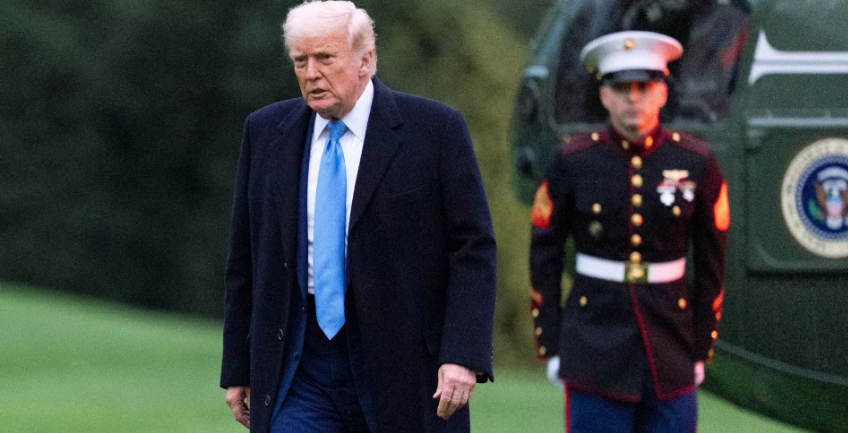
Global markets reeled Monday as escalating trade tensions between the United States and its key partners deepened investor anxiety, with U.S. President Donald Trump reaffirming his commitment to eliminating trade deficits—particularly with China—despite mounting financial turmoil.
Speaking aboard Air Force One over the weekend, Trump denied any intention to stoke market chaos but reiterated that fixing the U.S. trade imbalance with China remains a top priority. “I don’t want anything to go down, but sometimes you have to take medicine to fix something,” he said, adding that the U.S. loses “hundreds of billions of dollars a year” to China and that no deal would be made until the deficit is addressed.
His comments followed a dramatic escalation in the global trade war last week, when the White House announced unexpectedly high reciprocal tariffs. In retaliation, China imposed 34% tariffs on all U.S. imports, marking one of the most severe responses in the ongoing standoff.
Trump also took aim at Europe, demanding not just annual payments but also financial reparations for past trade imbalances. “We put a big tariff on Europe. They are coming to the table, they want to talk—but there’s no talk unless they pay us a lot of money on a yearly basis,” Trump said.
The intensifying rhetoric sent shockwaves through global equity markets during Monday’s Asian session. Hong Kong’s Hang Seng Index opened nearly 10% lower following a holiday break, erasing most of its 2025 gains. Earlier optimism around Beijing’s stimulus pledges and AI-related growth had pushed the index up 24% year-to-date before tumbling post-tariff announcement. As of Monday, the Hang Seng was up just 3.2% for the year.
Japan’s Nikkei 225 fell 6% in early trading, hitting an 18-month low and entering bear market territory after falling over 20% from January highs. South Korea’s Kospi shed more than 4%, and Australia’s ASX 200 dropped nearly 4% before partially recovering.
“There could be big rallies this week on positive headlines. But there won’t be a sustained recovery until Trump signals he won’t escalate tariffs further,” said Kyle Rodda, senior market analyst at Capital.com.
U.S. stock futures also extended losses, with S&P 500 futures down 3.5%, Nasdaq off 4.5%, and Dow futures slipping 2.9% by early morning European time. The CBOE Volatility Index (VIX), often referred to as Wall Street’s “fear gauge,” surged 51% last week to above 45—a level not seen since the 2020 pandemic crash.
European markets braced for impact, with major indices already reeling from last week’s declines. The Euro Stoxx 600 fell 7.4%, Germany’s DAX dropped 6.9%, and France’s CAC 40 slipped 7.1%.
“This morning’s note is going to be a depressing one,” wrote Michael Brown, senior analyst at Pepperstone London. “I’m quickly running out of adjectives to describe how gloomy sentiment is becoming, and how grim the economic outlook now appears.”








Business
US States Outpace EU Economies in Wealth Per Capita While Europe Remains Competitive in Total GDP

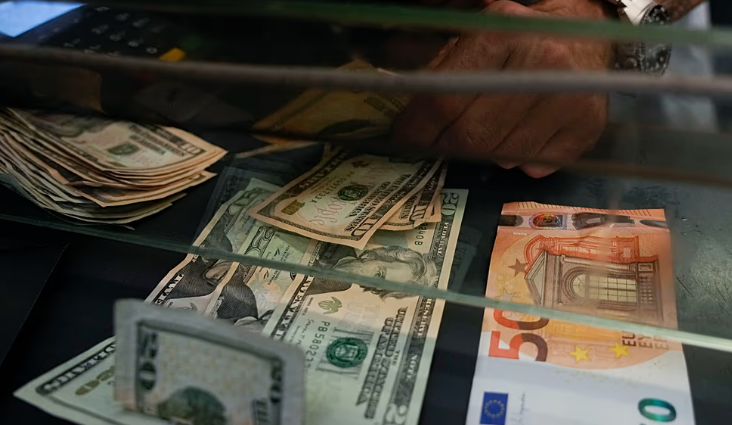
A fresh comparison of economic performance between Europe and the United States highlights a widening divide in wealth creation and living standards, with US states consistently outperforming major European economies in GDP per capita, even as Europe remains competitive in overall output.
Data drawn from Eurostat, the US Bureau of Economic Analysis and the International Monetary Fund show that Germany leads all selected economies with a GDP of €4.47 trillion in 2025. California follows closely at €3.76 trillion, reinforcing its position as the largest US state economy and one of the biggest economic units globally.
France ranks third with €2.98 trillion, ahead of Texas at €2.57 trillion. Italy records €2.26 trillion, while New York stands at €2.18 trillion. Spain comes next with €1.69 trillion, followed by Florida at €1.62 trillion. The Netherlands posts €1.18 trillion, and Illinois closes the list at €1.06 trillion.
The ranking shows a striking pattern: European countries and US states alternate throughout the table rather than clustering by region, underscoring how closely matched the two economic systems are in total output.
The picture shifts sharply when measured by GDP per capita. New York leads at €108,444, followed by California at €96,887. Illinois records €83,490, while Texas stands at €82,058, all above the US national average of €79,587. Florida ranks lowest among the US group at €69,706.
By comparison, the Netherlands tops the European group at €62,537. Germany follows at €51,817, then France at €42,671, Italy at €37,162, and Spain at €32,475. The EU average stands at €39,970, significantly below all major US states in the comparison.
When adjusted for purchasing power standards, the gap remains visible. New York again leads at 108,500 international dollars, followed by California at 90,300. Illinois and Texas remain strong at 89,300 and 87,600 respectively, while the US average stands at 89,599.
In Europe, the Netherlands posts 84,035, Germany 73,553, France 66,061, and Spain again ranks lowest among the group. Italy also falls below the EU average of 64,870.
However, the comparison is not one-sided. Research also shows that severe poverty is more pronounced in the United States than in Western Europe. A University of Oxford researcher noted that it takes about 63 minutes of work in the US to earn the equivalent of one international dollar, roughly double the time required in Germany, France and the United Kingdom.
The findings underline a dual reality: while US states generate higher income per person, European economies maintain stronger relative outcomes in certain measures of social welfare and income distribution.



Title: From Private Jets to Spaceflights: Ultra-Luxury Travel Redefines Exclusive Exploration

US States Outpace EU Economies in Wealth Per Capita While Europe Remains Competitive in Total GDP

Record Turnout Reported as Hungary’s Parliamentary Election Draws Millions to the Polls

Hungary Votes in High-Stakes Election as Orbán Faces Strongest Challenge in Years

Genetic Differences May Shape Effectiveness of Popular Weight-Loss Drugs, Study Finds

Seven-Day Meditation Retreat Linked to Measurable Changes in Brain and Body, Study Finds

Fuel Prices Surge Across Europe as Middle East Crisis Pushes Oil Above $100

Oil Prices Surge as Strait of Hormuz Closure Shakes Markets

Britain and Norway Step Up Naval Patrols to Protect Undersea Infrastructure from Russia

Meta Launches Muse Spark, Its First Major AI Model in Nine Months

Meta Acquires Tilda Swinton VR Doc ‘Impulse: Playing With Reality’

Saudi Arabia’s Model for Sustainable Aviation Practices

Recent Developments in Small Business Taxes

Effective Drain Cleaning: A Key to a Healthy Plumbing System

Who was Ebrahim Raisi and his status in Iranian Politics?

China’s Historic Olympic Victory Sparks National Pride Amid Controversy

Carrectly: Revolutionizing Car Care in Chicago

Keely Hodgkinson Wins Britain’s First Athletics Gold at Paris Olympics in 800m

Saudi Arabia: Foreign Direct Investment Rises by 5.6% in Q1

Chinese Hackers Infiltrate Major U.S. Telecom Firms in Possible National Security Breach

Sony WF-10XM4: Headphones Are Our Absolute Favorite

10 Places You Can’t Miss If It’s Your First Time in European

New Census Data Will Shake Up Alabama Politics

16 Top of Our Favorite Outdoor Clothing Brands

Fashionable Summer Accessories to Dress Up Your Travel Look

How Sleeping Less than 7 Hours a Night Can Lead to Weight Gain
-
 Entertainment2 years ago
Meta Acquires Tilda Swinton VR Doc ‘Impulse: Playing With Reality’
-
 Business2 years ago
Saudi Arabia’s Model for Sustainable Aviation Practices
-
 Business2 years ago
Recent Developments in Small Business Taxes
-
 Home Improvement1 year ago
Effective Drain Cleaning: A Key to a Healthy Plumbing System
-
 Politics2 years ago
Who was Ebrahim Raisi and his status in Iranian Politics?
-
 Sports2 years ago
China’s Historic Olympic Victory Sparks National Pride Amid Controversy
-
 Business2 years ago
Carrectly: Revolutionizing Car Care in Chicago
-
 Sports2 years ago
Keely Hodgkinson Wins Britain’s First Athletics Gold at Paris Olympics in 800m