Connect with us

News

Oil Spill Prompts Regional Emergency in Sevastopol as Cleanup Efforts Continue

Published

on

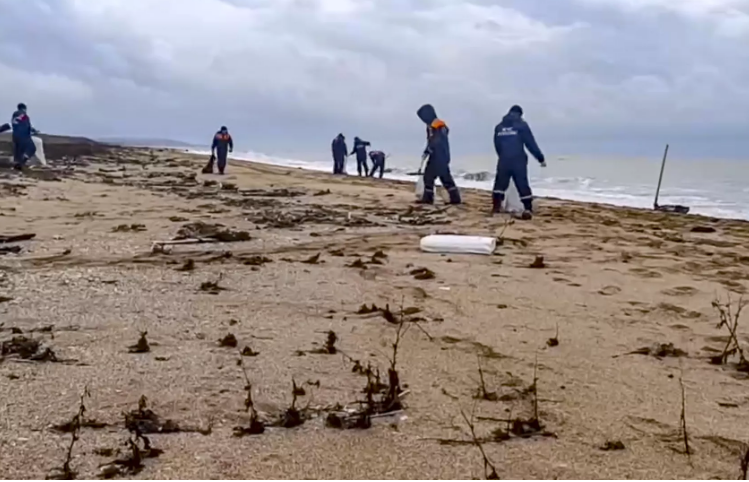
Russia-appointed officials in occupied Crimea have declared a regional emergency in Sevastopol after oil contamination was detected on the shores of the peninsula’s largest city.

The oil, believed to have originated from two tankers damaged in the Kerch Strait nearly three weeks ago, has affected four beaches in the region, according to Governor Mikhail Razvozhaev. The spill has prompted a large-scale cleanup operation involving local authorities and volunteers.

“Today a regional emergency regime has been declared in Sevastopol,” Razvozhaev announced on Telegram. He assured residents that the contamination was swiftly addressed, adding, “Let me emphasise: there is no mass pollution of the coastline in Sevastopol.”

The spill stems from an incident in the Kerch Strait, approximately 250 kilometers from Sevastopol. One tanker ran aground, and another was left adrift and damaged, leading to the discharge of fuel oil into the waters.

Authorities in Russia’s Krasnodar region had already declared a region-wide emergency last week as oil continued washing ashore along the coastline. Krasnodar Governor Veniamin Kondratyev reported on Saturday that nearly 7,000 people were engaged in cleanup efforts.

More than 96,000 tons of contaminated sand and soil have been removed since the spill, and estimates suggest up to 200,000 tons of material may have been affected, according to a December 23 report from the Ministry of Natural Resources.

Russian President Vladimir Putin described the spill as an “ecological disaster,” underscoring the severity of the situation.

The Kerch Strait, which links the Sea of Azov to the Black Sea, is a vital shipping route and has been a flashpoint of conflict between Russia and Ukraine since Moscow’s annexation of Crimea in 2014.

See also  Far-Right Leaders Rally in Rural France as National Rally Marks “Victory Day”

Ukraine has criticized the environmental impact of the spill, with Mykhailo Podolyak, an adviser to President Volodymyr Zelenskyy’s office, describing it as a “large-scale environmental disaster.” Podolyak has called for increased sanctions on Russian tankers in response.

The ongoing cleanup highlights the environmental risks associated with maritime transport in the politically sensitive region. While authorities have declared progress in addressing the spill, its broader ecological consequences remain a concern for both local communities and international observers.

As efforts continue, the incident has reignited tensions over the disputed waters, emphasizing the geopolitical and environmental challenges of the region.

News

US Coast Guard Pursuit of Sanctioned Tanker Complicated by Russian Flag

Published

on

The US Coast Guard’s operation to seize the sanctioned oil tanker Bella 1 has grown more complex after the vessel’s crew painted a Russian flag on its hull, claiming Moscow’s protection during a 10-day pursuit in the Atlantic. Officials said the ship, linked to the Iranian oil trade, is now reportedly empty.

Washington obtained a court order authorizing the seizure based on Bella 1’s history of transporting Iranian crude. However, the crew’s display of the Russian tricolour complicates enforcement under maritime law. US authorities have been tracking the tanker at roughly 800 meters distance while determining its legal status through diplomatic channels.

The Bella 1 initially resisted interception near Venezuela on December 21. Instead of stopping, it reversed course and entered open waters. Maritime tracking data show that the tanker had loaded Iranian crude at Kharg Island in September before disabling its location transponder near the Strait of Hormuz. After two months of being untracked, the ship resumed signals while empty, suggesting an at-sea cargo transfer.

Initially, Bella 1 declared Curaçao as its destination but abruptly changed course after US forces seized another tanker on December 10. Since December 17, the vessel’s transponder has been off, and officials estimate it may be heading toward Iceland or Greenland.

The US Treasury sanctioned Bella 1 in 2024 for allegedly transporting Iranian oil on behalf of Hezbollah, Yemen’s Houthis, and Iran’s Revolutionary Guard Corps. The vessel is owned by Turkey-based Louis Marine Shipholding Enterprises, and its crew primarily comes from Russia, India, and Ukraine.

The pursuit marks the third US interception operation this month. The Coast Guard successfully seized two other tankers carrying Venezuelan crude, escorting both to Texas. President Donald Trump said authorities will capture Bella 1, stating, “We’ll end up getting it.”

See also  Israel’s Right to Act: Global Stakes Rise as Iran Nears Nuclear Capability

The US has deployed its largest military presence in the Caribbean and eastern Pacific in decades, targeting both sanctioned tankers and suspected narcotics vessels. On December 17, Trump ordered a blockade of tankers trading with Venezuela to cut off President Nicolás Maduro’s primary revenue source. Maduro’s government called the operations acts of piracy, with Vice President Delcy Rodríguez saying Caracas would report the seizures to the UN Security Council.

Russia has increasingly relied on a shadow fleet of vessels with opaque ownership, flags of convenience, and irregular shipping practices to transport oil while circumventing Western sanctions imposed after its full-scale invasion of Ukraine in 2022. The fleet, composed of hundreds of aging ships, has been essential for maintaining oil exports and funding Russia’s war effort.

Experts note that if Russia formally registers Bella 1, forcibly boarding the tanker could trigger diplomatic tensions, even under the UN Convention on the Law of the Sea, which allows authorities to act against vessels flying false flags or operating without valid registration. For now, the Bella 1 continues to evade capture while US officials monitor its movements.

Continue Reading

News

US Conducts Strike on Alleged Drug-Smuggling Facility, Marks Escalation in Operations

Published

on

US President Donald Trump said Monday that the United States conducted a strike on a shore facility used for loading boats with drugs, marking an escalation beyond previous operations targeting vessels in international waters. The president declined to specify the location or which agency carried out the strike.

“There was a major explosion in the dock area where they load the boats up with drugs,” Trump said while meeting Israeli Prime Minister Benjamin Netanyahu in Florida. “They load the boats up with drugs, so we hit all the boats and now we hit the area. It’s the implementation area. There’s where they implement. And that is no longer around.”

Trump offered few details about the strike, including whether it was conducted by the US military or the CIA. “I know exactly who it was, but I don’t want to say who it was. But you know it was along the shore,” he added.

The operation represents a shift in Trump administration tactics, which have previously focused on striking suspected drug-smuggling boats in international waters of the Caribbean and eastern Pacific. According to administration figures, at least 107 people have been killed across 30 strikes since early September. On Monday, the US conducted another strike against an alleged narcoboat in the eastern Pacific, resulting in two fatalities.

Trump initially referenced the strike during a call with WABC radio host John Catsimatidis on Friday. “I don’t know if you read or saw, they have a big plant or a big facility where they send the, you know, where the ships come from,” he said. “Two nights ago, we knocked that out. So, we hit them very hard.”

See also  Ukraine Claims Missile Strike Sinks Russian Submarine in Sevastopol

Unlike previous maritime operations, which were often announced by US Defence Secretary Pete Hegseth or military social media accounts, no formal announcement was made regarding the facility strike. The Pentagon referred questions to the White House, which did not immediately provide additional information. Venezuela’s government also declined to comment.

Trump has long indicated that US operations could move beyond boat strikes to land-based missions in South America, including Venezuela. Recent weeks have seen the deployment of US warships to the region, increased military presence, and the seizure of two oil tankers, with a third vessel pursued. The administration has characterized the campaign as part of an “armed conflict” against drug cartels to stop narcotics flowing into the United States.

Venezuelan President Nicolás Maduro has dismissed the US actions, insisting that the real aim of American operations is to pressure him from office rather than target drug trafficking.

The facility strike signals a new phase in US operations in the region, demonstrating a willingness to extend military actions onto land, raising questions about potential further escalation in South America.

Continue Reading

News

One Dead, Three Missing After Migrant Boat Sinks Off Samos

Published

on

One person has died and three remain missing after a migrant boat sank near the Greek island of Samos early Monday, Greek coast guard authorities reported. Twenty-six migrants reached the shore in the Petalides area and alerted authorities that others were still at sea.

The incident occurred during the early morning hours, prompting an immediate search and rescue operation. Coast guard vessels, a helicopter, a private boat, and ground teams joined the efforts. During the operation, the body of a woman was recovered, while crews continued searching for the three missing migrants. The nationalities of those involved have not been disclosed.

Greece has served as a major entry point for migrants and refugees into the European Union since 2015. Over one million arrivals have been recorded through Greek territory, though hundreds have died attempting the often perilous sea crossing.

Data from Frontex, the European Border and Coast Guard Agency, shows that irregular migration flows through the eastern Mediterranean fell by 30 percent in the first 11 months of 2025 compared with the same period in 2024. Around 46,200 migrants arrived in Greek waters this year. However, Frontex noted a sharp increase in activity along the Libya-Crete route, with detections rising by 272 percent year-on-year.

The sinking off Samos is part of a series of recent migrant tragedies in Greek waters. On 6 December, Greek authorities recovered 17 bodies and rescued two migrants from a vessel off Crete. Two days later, a 12-year-old boy died after being struck by a boat propeller when smugglers forced migrants to jump from a speedboat near Samos.

See also  Far-Right Leaders Rally in Rural France as National Rally Marks “Victory Day”

A week later, another vessel carrying 31 migrants crashed into rocks off Samos. Twenty-eight people were rescued, while three remained unaccounted for.

The Eastern Mediterranean continues to be a dangerous route for migrants seeking entry into Europe. Authorities have repeatedly warned of the risks posed by overcrowded and unseaworthy vessels operated by smugglers. Local coast guard officials have emphasized the need for vigilance, particularly in areas near islands like Samos and Crete, which lie close to key migrant corridors from Turkey and Libya.

Search and rescue teams remain on alert, patrolling the waters around Samos to locate the three missing migrants and prevent further casualties.

Continue Reading

Trending