Connect with us

News

Ethiopia’s Grand Renaissance Dam Opens Amid Fierce Dispute With Egypt and Sudan

Published

on

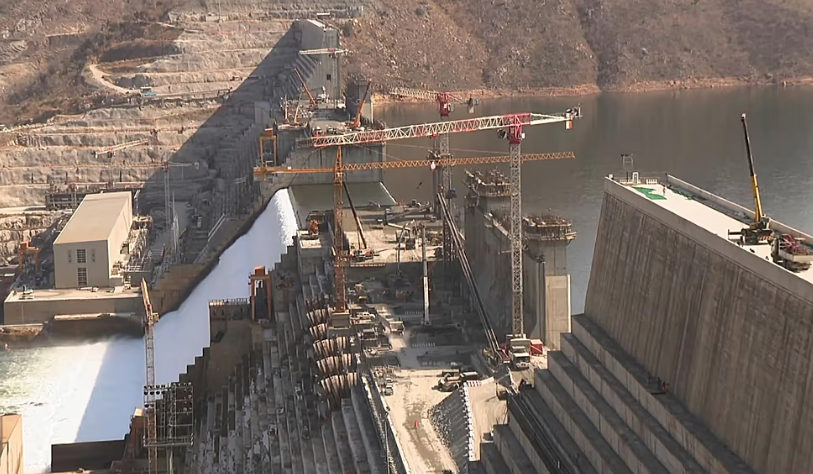
Ethiopia’s long-awaited Grand Ethiopian Renaissance Dam (GERD) was officially inaugurated in September, marking what Prime Minister Abiy Ahmed described as “a generational victory.” But while the ceremony was hailed as a triumph in Addis Ababa, leaders in Egypt and Sudan called it an “existential threat,” deepening long-standing tensions over control of the Nile’s waters.

Speaking at the inauguration on 9 September, Abiy praised the dam as a symbol of national pride and self-reliance. “This lake has brought with it a wealth greater than Ethiopia’s GDP. The era of begging has ended,” he declared to gathered officials and regional leaders. Behind him, torrents of water cascaded from the 74-billion-cubic-metre reservoir — a body of water roughly the size of Greater London.

The dam, located on the Blue Nile in western Ethiopia, is expected to generate between 5,000 and 6,000 megawatts of electricity, potentially transforming the country into a regional energy hub. Abiy described it as a “shared opportunity” for neighbouring nations. Yet no representatives from Egypt or Sudan attended the ceremony, underlining their deep opposition to the project.

Just weeks later, Egyptian President Abdel Fattah al-Sisi warned that his country “will not stand idly by” in response to what he called Ethiopia’s “irresponsible” actions. Cairo and Khartoum have long feared that the dam will restrict the flow of water downstream, threatening their agriculture and livelihoods.

The Nile dispute predates the GERD by decades. Egypt’s water rights are anchored in colonial-era agreements — including treaties from 1902, 1929, and 1959 — that heavily favoured Cairo, granting it roughly two-thirds of the Nile’s flow. Ethiopia, which contributes about 85% of the river’s water through the Blue Nile, argues those accords were unfairly imposed and outdated.

See also  Northvolt Files for Bankruptcy Amid Mounting Debt, Aims to Restructure Operations

“The construction of the GERD was the first time these old treaties were truly challenged,” said Ahmed Morsey, an Egyptian analyst with the Middle East Council on Global Affairs. Ethiopian scholar Tsedenya Girmay added that a 2015 declaration of principles was meant to ease tensions, ensuring the dam would operate without harming downstream nations. “But domestic political crises derailed those efforts,” she said.

In Ethiopia, the dam has become a symbol of unity in a nation often divided by internal strife. “The GERD is the one thing that unites Ethiopians,” Tsedenya noted, pointing out that it even features in school curricula. With nearly 60 million Ethiopians lacking electricity, the project is seen as crucial for national development.

Egypt, meanwhile, sees the dam as a direct threat to its survival. Ninety-five percent of its 115 million citizens live along the Nile, which remains the country’s primary water source. Al-Sisi has insisted Egypt will pursue diplomacy, though past U.S.-brokered negotiations have collapsed amid mutual distrust.

Analysts suggest that regional instability has only hardened positions. Sudan’s civil war has drawn its leaders closer to Egypt’s stance, while Ethiopia accuses Cairo of meddling in its internal affairs. At the same time, the European Union has tilted toward Egypt, recently reaffirming its “support for Egypt’s water security” during a summit in Brussels.

According to Corrado Čok of the European Council on Foreign Relations, the EU’s shift stems from its growing reliance on Egypt for regional stability, energy cooperation, and migration control. “Cairo has become an indispensable partner,” he said, noting that this alignment has weakened Europe’s once-neutral role in the Nile dispute.

See also  Israeli Minister Resignations Shake Coalition Amid Gaza Ceasefire Debate

As the GERD begins operations, its promise of prosperity for Ethiopia contrasts sharply with fears of crisis in Egypt and Sudan — a reminder that the Nile, the river that sustains life across the region, continues to divide as much as it unites.

News

Investigation Underway After Goa Nightclub Fire Kills at Least 25

Published

on

Authorities in the Indian state of Goa have opened an investigation into a nightclub fire that killed at least 25 people, including several tourists, in one of the region’s most popular party districts. Six others were injured in the blaze, which broke out shortly after midnight in Arpora, a nightlife hub about 25 kilometres from the state capital, Panaji.

Goa Chief Minister Pramod Sawant confirmed the death toll in a statement posted on X, saying the victims included many of the club’s kitchen staff and a small number of visiting tourists. He added that all the injured were in stable condition and receiving medical treatment. Rescue teams recovered all bodies from the site.

Early reports from local police, cited by the Press Trust of India, indicated that a gas cylinder explosion triggered the fire. Witnesses, however, told the agency that the blaze appeared to start on the club’s first floor, where nearly 100 tourists were dancing at the time. As smoke and flames swept through the building, many people ran toward the lower floor, where they became trapped along with staff members.

Sawant said a formal inquiry would determine the exact cause and whether the club complied with fire safety regulations. He pledged strict action against anyone found responsible, writing on X that any negligence uncovered by investigators would be “dealt with firmly”.

Eyewitnesses described scenes of panic as patrons attempted to flee the burning building. “We rushed out of the club only to see that the entire structure was up in flames,” said Fatima Shaikh, who was inside when the fire began.

See also  Europe Faces Security Crisis After Trump-Zelenskyy Clash, London Summit Set to Address Fallout

Prime Minister Narendra Modi offered condolences in a message on X, calling the incident “deeply saddening” and wishing the injured a swift recovery.

Local media reported that the club’s location along the Arpora River backwaters posed challenges for emergency crews. A narrow approach road forced fire engines to park about 400 metres from the entrance, slowing their response. Reports also revealed that the building had previously received a demolition notice after officials found it lacked a construction permit. That order was later withdrawn by senior state authorities, according to Arpora councillor Roshan Redkar.

Incidents involving gas cylinders and electrical faults are not unusual in India and often lead to heavy casualties, prompting renewed calls for stronger enforcement of safety standards. Opposition leader Rahul Gandhi criticised the tragedy as a “criminal failure of safety and governance” and urged a transparent investigation to establish accountability and prevent future disasters.

The probe into the fire is expected to assess structural safety, emergency exits and compliance with existing regulations as authorities work to piece together how the late-night gathering turned into one of the deadliest incidents in the state in recent years.

Continue Reading

News

White House Unveils “Media Hall of Shame” Portal as Attacks on Press Intensify

Published

on

The White House has launched an online “Media Hall of Shame,” a federally hosted portal that lists news outlets and individual journalists it accuses of publishing false or misleading information. The move marks a sharp escalation in President Donald Trump’s long-running campaign against what he frequently labels “fake news,” and comes amid rising condemnation over his public attacks on reporters.

The new portal, published on an official government website, claims to offer a fully sortable and regularly updated record of what the administration describes as inaccurate reporting. “It ensures no hoax, no anonymously ‘sourced’ fan fiction, and no partisan smear gets memory-holed again,” the White House said in its announcement.

Among its features, the site names The Washington Post as “Offender of the Week,” while also spotlighting The New York Times, CNN, CBS News and The Independent. Accredited international wire services including the Associated Press and Reuters are also listed, with the administration accusing the AP of “bias” and “omission of context” and labeling a Reuters report as a “lie.”

Stories are placed into categories such as “false claim,” “misrepresentation,” “failure to report,” “malpractice,” “mischaracterisation,” and “circular reporting.” Another section titled “left-wing lunacy” aims at content the White House asserts reflects ideological slant. Notably, no conservative-leaning outlets appear anywhere on the site.

The move has drawn significant backlash from journalism advocates and major newsrooms. Matt Murray, executive editor of The Washington Post, condemned the website as an attack on constitutionally protected reporting. “Let’s be clear what’s happening here: the wrongful and intentional targeting of journalists by government officials for exercising a constitutionally protected right,” Murray said. “The Washington Post will not be dissuaded and will continue to report rigorously and accurately in service to all of America.”

See also  Majority of Europeans Support Increased Defence Spending, but Doubt Autonomy from U.S., Survey Finds

While conservative media watchdogs have welcomed the launch, critics warn that the portal represents an unprecedented government effort to single out journalists. The Media Research Centre, which often accuses national news networks of liberal bias, praised the initiative. “It’s a stronger effort than Republican presidents have done before,” said MRC director of media analysis Tim Graham. “I think all Republicans realize today that the media is on the other side and need to be identified as on the other side.”

Press freedom experts interviewed by German broadcaster DW said the White House’s new approach poses a direct risk to journalists and undermines democratic norms by framing independent reporting as an adversarial act. They warned that such rhetoric fuels hostility toward the press and contributes to a climate in which reporters may face harassment or threats.

The launch of the portal comes at a time when Trump has intensified his criticism of the media, frequently singling out reporters—often women—with personal insults, calling them “stupid,” “piggy,” and “ugly inside and out.” The growing pressure on journalists has raised alarms among advocates who argue that a free and independent press is vital to the country’s democratic institutions.

The White House has not responded to questions about how the portal will be maintained or which officials will determine what qualifies as an “offense.”

Continue Reading

News

Russia Launches Massive Overnight Barrage on Ukraine as Peace Talks With U.S. Continue

Published

on

Ukraine was hit by one of the largest overnight assaults of the war as Russia launched 653 drones and 51 missiles across the country early Saturday, triggering nationwide air raid alerts and striking multiple regions. At least eight people were wounded, including three in Kyiv, according to Ukrainian officials.

Ukraine’s air force reported that its defenses intercepted 585 of the drones and 30 of the missiles, but 29 locations were still hit during the hours-long attack. Strikes were recorded in the Kyiv region, where industrial facilities and residential buildings sustained damage.

President Volodymyr Zelenskyy said on X that energy sites were the primary targets, adding that the attack also hit the main railway station building in Fastiv. He described the strike as “meaningless from a military point of view,” arguing that Moscow “could not have been unaware” that it was a civilian facility.

Several other regions felt the impact, including Dnipro, Chernihiv, Zaporizhzhia, Odesa, Lviv, Volyn, and Mykolaiv. Emergency services worked through the morning to contain fires, restore power and assess damage at multiple sites.

The latest assault came as Ukraine continues to brace for Russia’s winter strategy of targeting infrastructure, aimed at cutting off heat, electricity and water during the coldest months. Ukrainian officials have warned repeatedly that Moscow is renewing efforts to cripple the country’s energy grid.

In Russia, the Ministry of Defence reported that its air defenses intercepted 116 Ukrainian drones overnight across several regions. A Russian Telegram news channel, Astra, reported that Ukraine hit the Ryazan Oil Refinery, one of the country’s key energy facilities. Regional governor Pavel Malkov confirmed that drone debris fell at an industrial site and damaged a nearby residential building, but did not mention the refinery.

See also  Germany’s CDU-CSU and SPD Reach Coalition Deal, Paving Way for Friedrich Merz to Become Chancellor

Ukraine has increasingly focused its own attacks on Russia’s energy infrastructure, arguing that oil revenues remain central to financing Moscow’s full-scale invasion. Kyiv says these strikes are aimed at pressuring the Kremlin to scale back its military campaign and engage seriously in diplomatic efforts.

The escalation on both sides came as Ukrainian and U.S. officials prepared for a third day of meetings aimed at advancing discussions over a potential path to peace. Washington has been acting as an intermediary between Kyiv and Moscow, though progress has been limited.

Ukrainian officials and several European governments have accused Russian President Vladimir Putin of showing interest in negotiations only for political advantage. Recent exchanges between U.S. and Russian representatives have produced no major breakthroughs, and Kyiv remains skeptical of Moscow’s intentions.

Saturday’s bombardment underscored the deep instability surrounding the talks, as both countries continue to push for leverage on the battlefield while diplomats seek even the smallest opening to halt the conflict.

Continue Reading

Trending