Connect with us

Business

UK Bank Shares Slide Amid Talk of New Sector Tax

Published

on

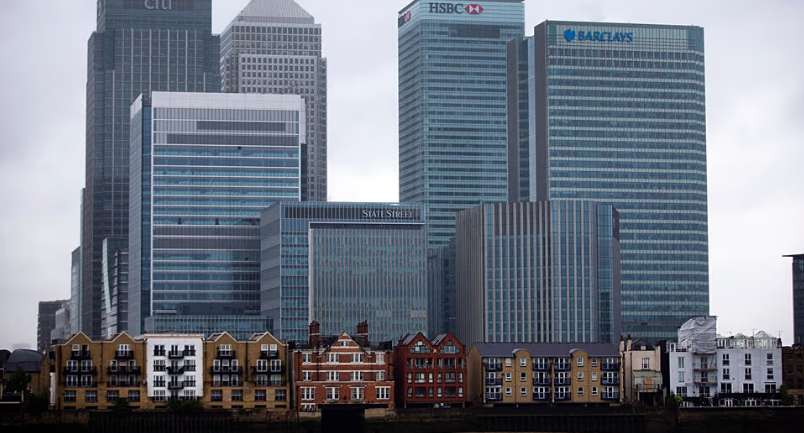
Shares in Britain’s leading banks fell sharply on Friday following reports that the government is considering new taxes on the sector to help plug a widening hole in the public budget.

NatWest Group led the decline, with shares down 4.7% by midday in European trading. Lloyds Banking Group dropped 4.5%, while Barclays fell 3.7%. The sell-off weighed on London’s benchmark FTSE 100 index, which slipped nearly 0.4%.

“NatWest, Lloyds and Barclays were the FTSE 100’s biggest fallers on Friday morning as investors wondered if the era of bumper profits, dividends and buybacks is now under threat,” said Russ Mould, investment director at AJ Bell.

The trigger for the slump was a proposal by the Institute for Public Policy Research (IPPR), a centre-left think tank, which suggested that commercial banks should shoulder part of the financial burden created by the Bank of England’s bond-buying programme, known as quantitative easing (QE).

The Bank of England’s QE programme, introduced during the financial crisis and expanded during the pandemic, once generated significant profits. However, with interest rates climbing from near zero to 5.25% since late 2021, the scheme has produced steep losses. According to the IPPR, these losses now cost taxpayers £22 billion (€25.4bn) annually across the current parliamentary term.

To offset the cost, the think tank proposed a new “QE reserves income levy” on commercial banks. Such a measure, it argued, would be a fair way to redistribute part of the banking sector’s strong profits back into public finances.

The government has not yet signalled whether it will adopt the recommendation, but analysts warn that higher levies could risk dampening credit growth. “The issue is whether taxing the banks more will end up stifling the very growth the government is keen to foster, by crimping lending to businesses and households alike,” said Mould.

See also  Experts Warn of Potentially Harsh Flu Season in Europe Amid Low Vaccination Rates

Still, political appetite for the proposal may grow given the scale of bank profits. HSBC, Barclays, NatWest and Lloyds are projected to earn about £44 billion (€50.7bn) worldwide in 2025, their third-best year on record after 2023 and 2024.

While banks have benefited from higher interest rates boosting their net interest margins, they have also faced criticism over perceived underinvestment in customer service and overcharging borrowers. For the government, a tax could present both fiscal relief and political gain.

Mould noted that while banks have played an important role in financing households and businesses, the debate will hinge on whether their profitability justifies additional taxation. “These companies have enjoyed a strong run on the stock market in recent years,” he said, “but investors now face uncertainty about whether that momentum can continue.”


Business

Silver Surges Past $60 as Supply Strains, Rate Expectations and Tariff Concerns Drive Rally

Published

on

Silver prices have surged to levels not seen before, rising above $60 an ounce this week after months of rapid gains driven by tightening supply, shifting Federal Reserve expectations and uncertainty around potential US trade actions. The metal hovered near $62 on Wednesday, extending a rally that began early this year when prices averaged around $30.

The latest jump came ahead of the Federal Reserve’s meeting, where investors expect another cut to the benchmark interest rate. The timing of the central bank’s leadership transition has added another layer of speculation. The US administration is reviewing finalists to replace Jerome Powell as chair, with Kevin Hassett, a senior economic adviser during Donald Trump’s presidency, reported to be the leading contender.

Market analysts say the candidates under consideration favour sharper rate reductions than those overseen by Powell. Since September, the Fed has trimmed rates twice by a quarter point each time. The gentler pace of easing has already pressured returns on cash and fixed-income assets, prompting many investors to shift into precious metals, which typically attract interest when rates fall. Silver, which does not generate yield, becomes more appealing in such an environment. Its performance has even outpaced gold, which has risen about 60 percent this year to reach record highs.

At the same time, traders are monitoring signals from Washington about whether silver could be targeted with tariffs. The metal was added in early November to the US government’s 2025 Critical Minerals List, a classification usually applied to resources seen as essential for national economic security. The designation places silver within the range of potential Section 232 investigations, the mechanism used in past years to justify tariffs on imported steel and aluminium.

See also  German Aerospace Industry Backs Targeted EU Tariffs on U.S. Aircraft, Warns Against Disrupting Global Supply Chain

Section 232 allows restrictions on imports deemed to put the country at risk through heavy dependence on overseas supply. No investigation has been launched, and officials have not indicated that tariffs are imminent. Still, the possibility has unsettled markets. Any duties on imported silver could reshape trade patterns and raise costs for domestic manufacturers, leading some buyers to boost inventories as a precaution.

Industrial use is also adding upward pressure. Demand from electric vehicle and solar panel manufacturers continues to rise, with these sectors relying on silver for components essential to production. Industrial consumption represents more than half of global silver use, and the combination of tight supply and strong manufacturing needs has intensified the rally.

Analysts say the market remains highly sensitive to signals from the Fed and the White House, with both interest-rate policy and trade decisions poised to shape the direction of prices in the months ahead.

Continue Reading

Business

US Allows Nvidia to Sell H200 Chips to Approved Chinese Customers With 25% Surcharge

Published

on

The United States has granted Nvidia permission to sell its H200 semiconductor chips to selected customers in China, provided the company pays a 25% surcharge to the US government. President Donald Trump announced the decision on Monday, marking a shift in Washington’s export policy after months of lobbying from Nvidia chief executive Jensen Huang.

The approval, which will also extend to other American chipmakers such as Intel and AMD, follows earlier restrictions imposed over concerns that advanced US-made chips could strengthen China’s military and cyber capabilities. The agreement does not cover Nvidia’s more powerful Blackwell chips or the upcoming Rubin series, which remain prohibited for export.

Trump said in a post on Truth Social that he had personally informed Chinese President Xi Jinping of the decision and that the move would maintain strong national security protections. He described Xi’s response as “positive”.

The H200 chip is used in a wide range of high-performance computing applications, from medical technology to artificial intelligence systems. While not as powerful as the Blackwell line—considered the current benchmark in AI processing—the H200 remains significantly more advanced than chips produced by Chinese manufacturers.

Restrictions on China’s access to American semiconductors have been a central component of Washington’s technology policy. In April, the US barred sales of Nvidia’s H20 chip to China on national security grounds, even though the chip had been specifically designed to comply with existing export rules. That decision was later softened in July after Nvidia agreed to return 15% of its China revenue to the US government. AMD accepted a similar arrangement.

See also  Nvidia Shares Drop Amid Escalating US-China Trade War and Antitrust Probe

Critics of the export controls argue that limiting access to foreign technology pushes China to accelerate its domestic semiconductor development. Beijing has already discouraged state-linked firms from buying Nvidia products, warning that reliance on US hardware could leave companies vulnerable to abrupt policy changes.

Nvidia said in a statement that allowing the sale of H200 chips to vetted commercial customers “strikes a thoughtful balance that is great for America”, adding that the arrangement would support well-paid US jobs and strengthen domestic production.

Despite the added safeguards, several Democratic senators have opposed the approval. They warned that giving China access to more capable chips could assist its military and expand its ability to carry out cyberattacks on American infrastructure. Their concerns were amplified by a recent admission from Chinese AI firm DeepSeek, which said its biggest competitive obstacle was the lack of access to cutting-edge semiconductors designed in the United States.

The decision opens one of Nvidia’s most important markets at a time when demand for advanced chips continues to surge globally, setting another stage in the ongoing technological and geopolitical rivalry between Washington and Beijing.

Continue Reading

Business

Gold Looks to 2026 After a Record-Breaking Year Marked by Geopolitical Tension and Strong Central Bank Demand

Published

on

Gold enters 2026 after one of the strongest years in its modern history, rising more than 60% in 2025 and setting over 50 record highs. The surge placed the metal ahead of all major asset classes and delivered its best performance since 1979. Now, investors are assessing whether gold can extend its momentum over the next year or whether the market is nearing a turning point.

Analysts say the 2025 rally was the product of several overlapping global forces. Persistent geopolitical risks, trade uncertainty, a softening US dollar, and expectations of lower interest rates all helped drive demand. Central banks also played a decisive role by continuing to absorb large volumes of gold, keeping official-sector buying well above pre-pandemic levels.

Data from the World Gold Council (WGC) highlights how these factors contributed to the metal’s rise. Geopolitical tensions alone added roughly 12 percentage points to year-to-date performance, while a weaker dollar and modestly lower rates provided another 10 points. Economic expansion and investor positioning also offered meaningful support.

Looking ahead, the WGC expects many of the same pressures to influence the market in 2026. But it cautions that gold begins the year from a very different starting point. Prices have already factored in broad expectations of steady global growth, moderate rate cuts, and a stable dollar. With real interest rates no longer falling sharply and momentum cooling, the Council describes gold as fairly valued at current levels.

In its central outlook, the WGC projects gold trading in a narrow band next year, with returns likely ranging between a 5% decline and a 5% gain. The group notes that investor sentiment is balanced rather than defensive, reducing the likelihood of outsized moves unless economic conditions shift significantly.

See also  European Car Market Shows Mixed Results in 2024, Spain Outperforms Amid Challenges

Three alternative scenarios could force a deviation from this baseline. In a mild economic slowdown marked by extra US rate cuts, gold could rise 5% to 15% as investors position more cautiously. A deeper recession could push gains even higher, with the WGC estimating a potential 15% to 30% jump driven by aggressive policy easing and renewed safe-haven flows. On the other hand, if pro-growth policies from the Trump administration lift yields and strengthen the dollar, gold could fall 5% to 20% as opportunity costs rise.

Despite the WGC’s measured tone, major Wall Street institutions remain bullish. J.P. Morgan Private Bank expects prices to climb to between $5,200 and $5,300 per ounce, while Goldman Sachs forecasts around $4,900. Deutsche Bank and Morgan Stanley also see room for appreciation, though both acknowledge possible volatility in the coming months.

Much of this optimism is tied to ongoing demand from central banks, especially in emerging markets, and the belief that many global investors remain underexposed to gold. Softening real yields and persistent geopolitical uncertainty are also seen as supportive.

At the same time, risks could hinder further gains. A stronger US economy, renewed inflation pressures, or reduced central bank buying could weigh on the market. Rising supply from recycled gold, particularly in India where the metal is widely used as collateral, may also place pressure on prices.

While a repeat of 2025’s dramatic rise appears unlikely, analysts agree that gold enters the new year from a position of strength. Its reputation as a hedge during unpredictable times remains firmly intact, keeping it central to many investors’ long-term strategies.

See also  eBay UK Scraps Seller Fees in Major Policy Shift to Boost Listings
Continue Reading

Trending