Business
Italy and Saudi Arabia Push Trade Ties Forward at First Joint Business Forum
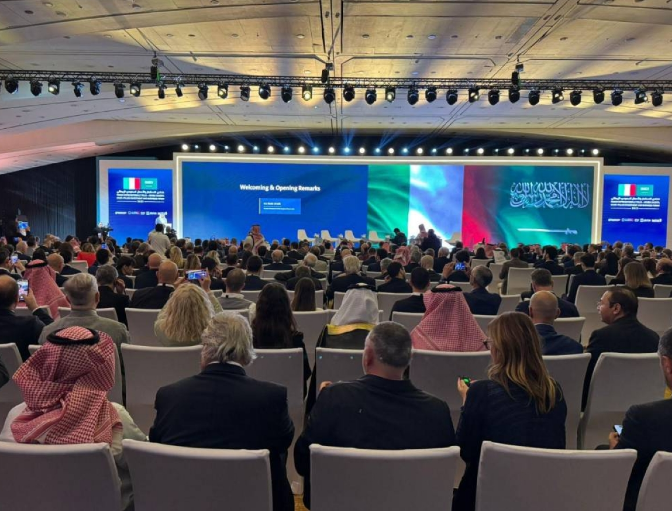
Italy and Saudi Arabia have taken a major step toward deepening economic cooperation with the launch of the first Italy–Saudi Arabia Business Forum in Riyadh, an event aimed at strengthening commercial partnerships and supporting Italy’s ambition to reach €700 billion in exports under its national Export Action Plan.
Held at the Mandarin Oriental Al Faisaliah in the Saudi capital, the forum was organised by the Italian Trade Agency (ITA) and the Italian Embassy, in collaboration with Saudi institutional partners. The gathering brought together senior officials from both countries, including Saudi Minister of Investment Khalid bin Abdulaziz Al-Falih and Italy’s Deputy Prime Minister and Foreign Minister Antonio Tajani. Leading representatives from Italian institutions such as SACE, Confindustria and Simest also attended.
The event was structured around five key sectors: infrastructure and mobility; construction and furniture; pharmaceuticals and life sciences; advanced technology; agritech and agro-industry; and cultural and sports-related industries. More than 430 Italian companies and over 600 Saudi companies took part, marking the highest level of bilateral business engagement between the two nations.
Matteo Zoppas, President of the Italian Trade Agency, said the forum builds on strengthened political ties following Prime Minister Giorgia Meloni’s recent visit to Saudi Arabia. He highlighted the alignment of Italian industrial capabilities with opportunities emerging from Saudi Arabia’s Vision 2030 agenda, which is opening pathways for foreign investment and raising demand for high-quality global expertise.
According to Zoppas, the B2B platform activated for the forum generated significant activity, receiving more than 337 meeting requests and facilitating nearly 4,300 exchanges between participating companies. He noted that 20 agreements were signed across sectors such as sustainable mobility, medical technology, digital innovation, agribusiness, and cultural industries—areas that Saudi policymakers have prioritised for expansion.
Trade data reflects the momentum behind the relationship. Italian exports to Saudi Arabia reached €4.4 billion in the first nine months of 2025, a 4.3% increase compared to the same period last year. Total exports for 2024 stood at €6.2 billion, up 27.8% from 2023. Italy has now moved from eighth to seventh place among the Kingdom’s top suppliers.
The Italian Trade Agency has played a central role in nurturing these ties. In 2024, its Riyadh office delivered 43 promotional initiatives, ranging from supporting Saudi delegations at Italian trade fairs to organising events across multiple sectors. For 2025, 50 initiatives are planned, including participation in Agrilevante, Marmomac, Euroflora and Italian Design Days, as well as a visit to Jeddah by the training ship Amerigo Vespucci.
With a total of 93 initiatives scheduled across 2024 and 2025, Italian officials say the expanding programme reflects a sustained commitment to developing long-term commercial ties with Saudi Arabia amid rapid economic transformation in the region.
Business
Oil Tanker Attacked in Strait of Hormuz, Crew Evacuated
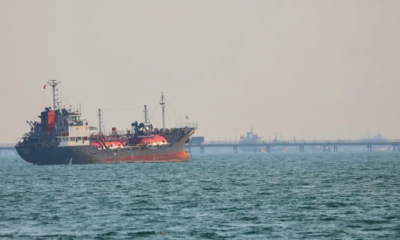
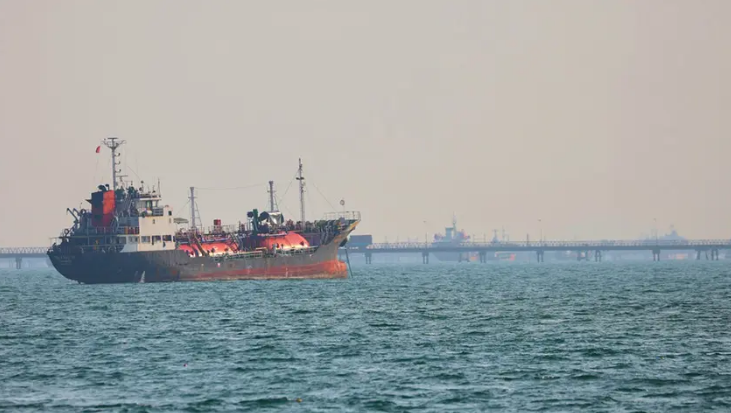
An oil tanker was attacked off the coast of Musandam in the Strait of Hormuz on Sunday, leaving four people injured and prompting the evacuation of all 20 crew members, according to Oman’s Maritime Security Centre.
The vessel, named Skylight and flying the flag of the Republic of Palau, was targeted around five nautical miles (9.26 km) north of Khasab Port, Oman authorities said. The incident marked the first reported attack on a ship in the strategic Strait of Hormuz on Sunday morning.
Oman’s Maritime Security Centre confirmed that the tanker’s crew included 15 Indian nationals and five Iranian nationals, all of whom were safely evacuated. The four injured crew members were transferred for medical treatment. Authorities did not immediately provide details on the cause of the attack or the identities of the attackers.
The incident has heightened concerns about shipping safety in one of the world’s most important oil transit routes. The Strait of Hormuz handles a significant portion of global crude oil exports, and any disruption to its operations can have major implications for energy markets.
In response to the attack, major shipping companies have suspended operations through the Strait of Hormuz. Danish shipping and logistics giant Maersk announced on Sunday afternoon that it had halted all future transits through the waterway until further notice. Other operators are reportedly reviewing their shipping schedules and implementing additional safety measures.
The attack comes amid ongoing regional tensions, with the Strait of Hormuz often at the center of geopolitical disputes. Analysts say the incident could lead to further disruptions in global oil supplies and push energy prices higher if shipping companies continue to avoid the area.
Maritime security experts emphasize the need for close monitoring of shipping traffic and coordinated responses to ensure the safety of vessels and crews in the region. The rapid evacuation of Skylight’s crew has been described as a positive example of emergency preparedness, but the attack underscores the continuing risks faced by commercial shipping in the Gulf.
Authorities are continuing to investigate the circumstances of the attack and are coordinating with international maritime agencies to prevent further incidents. The situation remains fluid, and the potential impact on shipping and regional security is likely to unfold in the coming days.
Business
EU Household Energy Prices Remain Above Pre-War Levels Despite Stabilisation
Residential electricity and natural gas prices across the European Union remain higher than before Russia’s invasion of Ukraine, even though markets have steadied in recent years.
The war, which began in February 2022 and has now entered its fifth year, reshaped Europe’s energy landscape. According to the European Council, Russia’s share of EU pipeline gas imports fell sharply from around 40 per cent in 2021 to about 6 per cent in 2025, following sanctions, embargoes and efforts to diversify supplies.
New data from Eurostat show that between the first half of 2021 and the first half of 2025, household electricity prices in the EU rose 30 per cent, from 22 cents per kilowatt-hour to 28.7 cents. Over the same period, natural gas prices climbed 79 per cent, from 6.4 cents to 11.4 cents per kilowatt-hour.
The Household Energy Price Index (HEPI), compiled by Energie-Control Austria, MEKH and VaasaETT, tracks monthly end-user prices in European capital cities. Its January 2026 figures indicate that electricity prices across EU capitals were 5 per cent higher than in January 2022. However, compared with January 2021, prices were up 38 per cent.
Some cities experienced particularly sharp increases over the five-year period. Electricity prices more than doubled in Vilnius, rising 102 per cent. Other large jumps were recorded in Bucharest (88 per cent), Bern (86 per cent), Kyiv (77 per cent), Amsterdam (75 per cent), Riga (74 per cent), Brussels (67 per cent) and London (64 per cent).
Only Copenhagen and Budapest posted declines over that period, at minus 16 per cent and minus 8 per cent respectively.
Among the capitals of Europe’s five largest economies, London and Rome saw notable increases, while Madrid and Berlin recorded relatively modest rises. Paris remained below the EU average increase.
Energy analysts at the European Energy and Climate Policy (IEECP) say the electricity mix has been a decisive factor. Countries such as Spain benefit from a higher share of wind, solar and hydropower, while Nordic nations rely heavily on hydropower, geothermal and wind energy, reducing exposure to fossil fuel price swings.
Looking only at the period from January 2022 to January 2026 presents a different trend. Copenhagen recorded a 44 per cent fall in electricity prices, while London, Madrid, Berlin and Rome also saw declines. Paris, by contrast, registered a 21 per cent increase. Vilnius showed the largest EU rise at 70 per cent, while Kyiv topped the overall list at 87 per cent.
Natural gas prices across EU capitals edged down by 1 per cent between January 2022 and January 2026. Berlin, Brussels and Athens recorded declines of around 40 per cent, while Riga, Warsaw and Lisbon saw strong increases.
Despite the recent stabilisation, household energy bills across much of Europe remain well above pre-invasion levels, reflecting the lasting impact of the energy crisis.
Business
Transatlantic Tensions on Digital Rules Highlight Need for Cooperation
Discussions between Europe and the United States over digital regulation continue to be marked by miscommunication and frustration, even as competitors observe from the sidelines. Europeans and Americans talk past each other while rivals watch. The European Union can set its own standards, but in an interconnected economy, decoupling fantasies and grandstanding won’t help.
The debate often centres on “free speech” concerns voiced by U.S. tech companies and policymakers in response to the EU’s legislative framework for digital platforms. In Europe, such narratives typically prompt defensive reactions. Some Europeans respond with a blunt message: “This is our land, our Union, our laws, follow them, or leave the EU—we’ll find alternative products to use!” Public awareness of American constitutional amendments is low across Europe, just as Americans pay little attention to European digital acts and regulations.
The transatlantic dialogue is further complicated by the global nature of social media platforms. Any EU legislation affecting user experience inevitably influences the functioning of these platforms worldwide, touching on what Americans see as free speech rights. The EU also seeks to extend its influence through the “Brussels effect,” ensuring that European rules shape global standards, while the U.S. maintains a large trade surplus in services and competes technologically with China. This mix of economic, political, and regulatory factors explains why U.S. attention is sharply focused on Europe’s digital policies.
Europeans argue that their 450-million-consumer market has the right to set rules that reflect local principles and values. Attempts to adjust or simplify regulations are difficult, with efforts often met with political resistance and scrutiny. The regulatory ecosystem in Europe supports industries of lawyers, consultants, and experts whose work depends on maintaining complex rules, making reform a sensitive topic.
On the American side, anti-EU rhetoric by public figures has sometimes compounded the problem, drowning out moderates and reinforcing defensive European responses. Analysts note that both regions have seen productive voices sidelined as grandstanding and negative statements dominate public discourse.
Observers argue that long-term thinking is necessary. By evaluating the EU-U.S. tech partnership in the broader context of global alliances, including China and Russia, policymakers can better assess priorities and avoid unnecessary disruption. Blank-slate decoupling between Europe and the United States is unrealistic, and delaying constructive dialogue risks broader economic consequences.
Experts warn that continued transatlantic infighting benefits other global powers and weakens the ability of both regions to set coherent standards in emerging technologies. The message from analysts is clear: cooperation, not confrontation, will determine whether the EU and U.S. can maintain leadership in digital regulation while safeguarding economic and technological interests.
-
Entertainment2 years agoMeta Acquires Tilda Swinton VR Doc ‘Impulse: Playing With Reality’
-
Business2 years agoSaudi Arabia’s Model for Sustainable Aviation Practices
-
Business2 years agoRecent Developments in Small Business Taxes
-
Home Improvement1 year agoEffective Drain Cleaning: A Key to a Healthy Plumbing System
-
Politics2 years agoWho was Ebrahim Raisi and his status in Iranian Politics?
-
Business2 years agoCarrectly: Revolutionizing Car Care in Chicago
-
Sports2 years agoKeely Hodgkinson Wins Britain’s First Athletics Gold at Paris Olympics in 800m
-
Business2 years agoSaudi Arabia: Foreign Direct Investment Rises by 5.6% in Q1