
Business
Amazon Expands Job Creation in Europe’s High-Unemployment Regions, Invests Billions in Cloud and Infrastructure

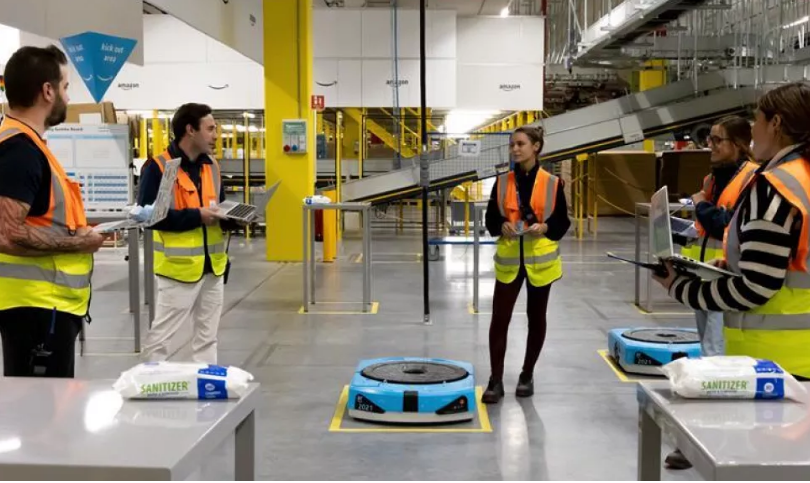
Amazon has announced significant investments aimed at driving job growth across Europe’s high-unemployment regions, as part of its broader economic impact strategy. The announcement coincides with the release of the company’s 2024 Europe Impact Report, which revealed Amazon contributed over €41 billion to Europe’s GDP, including €29 billion to the EU27 alone.
The figure is comparable to the entire GDP of Latvia, underscoring Amazon’s growing footprint across the continent. “Our economic impact in Europe goes far beyond the numbers,” said Mariangela Marseglia, Vice President of Amazon Stores EU. “We’re creating opportunities where they’re needed most, supporting local economies, and helping to revitalize communities across the continent.”
Amazon currently employs over 150,000 people across the EU, with more than 90,000 jobs located in areas suffering from above-average unemployment, according to Eurostat. One of the most striking examples is in France’s Hauts-de-France region, where unemployment is 8.7%. There, Amazon has created over 6,000 jobs in the past decade, including 2,600 permanent roles at its Lauwin-Planque fulfillment center.
A recent survey revealed 71% of locals view Amazon’s presence positively, and 94% highlight job creation as a key benefit. Research by Ipsos further supports this trend, showing that 81% of residents near Amazon logistics centers have seen job opportunities increase. More than half report financial improvements that influence long-term life decisions like homeownership or starting a family.
Amazon has also confirmed it does not use zero-hour contracts in any European countries where they are legally permitted, maintaining consistent employment standards across the region.
In terms of long-term investments, Amazon poured over €55 billion into infrastructure and workforce development across Europe in 2024 alone, with €38 billion going to EU member states. Since 2010, total investment has surpassed €320 billion.
Future plans heavily involve Amazon Web Services (AWS), which continues to expand across major European tech hubs. In Germany, Amazon plans to invest €8.8 billion in Frankfurt through 2026, supporting 15,200 jobs and contributing €15.4 billion to the country’s GDP. In the UK, an £8 billion (€9.5 billion) investment will support 14,000 jobs annually through 2028. France is set to benefit from €6 billion in cloud infrastructure investment by 2031, projected to generate €16.8 billion in GDP and support over 5,200 jobs annually.
As Amazon diversifies its European operations, these strategic investments aim to foster employment, boost regional economies, and solidify its presence as a key driver of growth and innovation across the continent.







French lawmakers have backed proposals to tax unrealised cryptocurrency gains when wealthy investors leave the country, alongside fines of up to €10,000 for failing to declare certain self-custody wallets.
The measures were approved by the National Assembly’s finance committee last week as part of discussions on the government’s 2027 budget. However, the proposals must be submitted again for votes in the full Assembly after the committee rejected the budget bill’s revenue section.
The proposed exit tax would extend France’s existing rules for shares and other securities to digital assets, including Bitcoin. It is scheduled to take effect on January 1, 2027, if approved.
Under current rules, people who have lived in France for at least six of the previous 10 years can be taxed on unrealised gains when they move abroad, provided their shares and other securities exceed €800,000 in total value.
The amendment, introduced by Communist MP Nicolas Sansu and 16 left-wing colleagues, would apply the same threshold to household cryptocurrency holdings, including assets held on foreign exchanges or in wallets controlled directly by their owners.
Tax payments would be deferred for moves within the European Union and certain other countries. The tax could also be cancelled if the assets were retained for between two and five years.
The proposal does not specify a tax rate for crypto-assets or explain how social charges would apply, leaving the potential bill for departing investors unclear.
Supporters argue that cryptocurrency should not receive more favourable treatment than conventional investments of equivalent value.
Proposed reporting rules for crypto wallets
The committee also backed a proposal by centrist MP Charles de Courson requiring taxpayers to declare self-custody wallets worth a combined €100,000 or more at the end of the year. Failure to comply could attract fines of up to €10,000. Existing rules generally require the declaration of cryptocurrency accounts held abroad, rather than self-custody wallets.
Supporters cited concerns about tax compliance and fraud, while cryptocurrency advocates warned that creating a register of holdings could expose investors to security risks if the information were leaked.
The concerns come amid a rise in crypto-related kidnappings in France. Police recorded more than 40 such cases between January and mid-April, following around 30 during all of 2025.
Lawmakers also backed a separate amendment to tax exchanges of cryptocurrencies for stablecoins, which are digital tokens pegged to currencies such as the US dollar. Under current rules, tax generally applies when cryptocurrency is converted into conventional money or used for purchases.
Other measures approved by the committee would allow investors to offset cryptocurrency losses against gains for 10 years and increase a proposed fine for failing to provide documents requested by tax authorities from €10,000 to €50,000 per request.
The committee rejected proposals for a broader wealth tax covering crypto-assets and a plan to exempt up to €1,000 a year in cryptocurrency payments from tax.
Budget faces parliamentary hurdles
The committee rejected the revenue section of the 2027 budget on Friday by 31 votes to three. As a result, its amendments must be resubmitted when the full National Assembly begins considering the original bill.
Lawmakers are due to vote again on the revenue section on October 20 and on the complete bill on November 17, before it moves to the Senate. Parliament must pass the budget by December 10, after which the government can enact it by ordinance.
The minority government faces a difficult parliamentary process amid political uncertainty and rising borrowing costs, with France’s 10-year government bond yield briefly exceeding 5% this month for the first time since 2002.

French President Emmanuel Macron will visit the Paris Motor Show on Monday for the final time during his presidency, using the event to renew calls for European public support to favour vehicles and components manufactured within the European Union.
The biennial exhibition, one of the world’s oldest and most popular motor shows, provides Macron with an opportunity to review his government’s record in the automotive sector and promote his ambition to strengthen European manufacturing against growing competition from China.
The French presidency considers the automotive industry central to the country’s manufacturing base, supporting around 400,000 direct jobs. Officials point to progress in electric vehicle production and the development of a domestic battery industry since Macron took office in 2017.
At the beginning of his presidency, France had no battery factories and electric car production remained limited, relying heavily on the Renault Zoe. The country has since opened four battery plants in the north, although domestic production still falls short of demand.
According to France’s national statistics agency Insee, 331,000 new electric passenger cars were registered in the country in 2025, compared with 216,000 produced domestically. Around 60% of electric vehicles manufactured in France are exported, particularly to the United Kingdom and other European markets. As a result, only 26% of new electric cars purchased in France are made within the country.
The government has set a target of producing two million electric vehicles annually by 2030, a goal that remains distant.
Macron’s visit will follow a dinner at the Élysée Palace on Sunday evening, attended by around 60 representatives from the automotive industry, including manufacturers, suppliers, battery producers and rare-earth companies. The presidency said Chinese manufacturers would not be represented at the dinner, although several Chinese brands are expected to exhibit at the motor show.
On Monday, Macron is scheduled to visit the stands of Stellantis, Renault and automotive supplier Valeo before taking part in a roundtable discussion on autonomous vehicles.
France wants the EU to make public subsidies more dependent on production within the bloc’s 27 member states, covering the entire supply chain from batteries to spare parts. Paris argues that Europe must strengthen its position as China expands its export capacity.
The French government remains open to Chinese investment that brings advanced technology and transfers expertise to Europe. However, it opposes factories that carry out only final assembly in Europe while sourcing most components elsewhere.
Winning German support remains a challenge. Germany exports substantially more vehicles than France and has major commercial interests in China, leaving Berlin concerned that tougher European restrictions could trigger retaliation against its manufacturers.
Reports that France and Germany had reached a deal linking stricter European production rules to changes in the EU’s 2035 emissions targets were rejected by the Élysée, which said discussions were continuing.
After a press day featuring Macron’s visit, the Paris Motor Show will open to the public from October 13 to 18 at the Porte de Versailles exhibition centre.
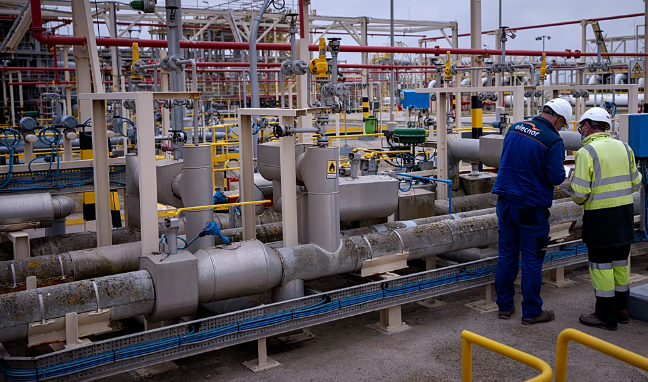
The European Union may need to reduce gas consumption by 7% this winter as storage levels fall to their lowest for this time of year on record and the war involving Iran keeps energy prices elevated, according to a report by the Institute for Energy Economics and Financial Analysis (IEEFA).
The US-based energy research organisation said EU gas storage facilities were about 72.4% full on October 3, the lowest level recorded for this point in the year since 2011. The shortfall could leave the bloc with 7.3 billion cubic metres less gas available from storage between November and March than during the previous winter.
Combined with the EU’s planned complete ban on Russian liquefied natural gas imports from January 2027, the lower reserves could require member states to use about 14 billion cubic metres less gas than last winter.
IEEFA said the situation did not mean European storage facilities would run empty. However, lower reserves can reduce the rate at which gas is released, potentially creating supply difficulties during a prolonged cold spell late in winter. Lower storage levels would also leave Europe needing to purchase larger and potentially more expensive volumes of gas next summer.
The organisation estimated that replacing the storage shortfall with additional imports rather than reducing demand would cost about €3 billion, approximately 12% more than the same volume would have cost last year.
The energy market has faced additional pressure since the war involving Iran began on February 28, disrupting shipping through the Strait of Hormuz, a route responsible for about one-fifth of global liquefied natural gas trade.
Dutch Title Transfer Facility futures, Europe’s main gas price benchmark, reached €84.50 per megawatt-hour in mid-September, their highest level since 2022. Prices climbed above €80 on Thursday before easing to around €78 early on Friday.
European Commission President Ursula von der Leyen said imported fossil fuels had cost the EU an additional €100 billion since the end of February, without providing any additional energy in return.
Energy Commissioner Dan Jørgensen has urged governments to continue limiting consumption amid exceptionally low storage levels. European gas network operators also warned that a severe winter could leave the bloc facing a supply shortfall of up to 15%.
Governments have begun taking measures to secure supplies. The Netherlands approved up to €993 million in June to support reserve building by state-owned company EBN. Germany instructed state-owned importer SEFE to store eight terawatt-hours of gas by December 15, while Spain has increased the volume of liquefied natural gas held at its import terminals by more than 25%.
EU winter gas consumption fell from around 222 billion cubic metres in 2021-22 to 185 billion in 2022-23 following a surge in prices and emergency conservation measures. Consumption subsequently recovered to approximately 200 billion cubic metres in each of the past two winters.
IEEFA said this suggested that further reductions in demand could become increasingly difficult.
The organisation warned against responding primarily by expanding storage infrastructure, arguing that this could prolong dependence on fossil fuels. Instead, it recommended greater investment in renewable energy, heat pumps, industrial electrification and energy-efficiency improvements to reduce winter demand.

France Considers Exit Tax on Crypto Gains and €10,000 Fine for Undeclared Wallets

Portuguese Teenagers Report Lower Drug and Alcohol Use, but High-Risk Behaviour Persists

Lancet Study Warns AI Misuse and Nuclear War Could Threaten Humanity by 2100

Spanish Police Clear Ceuta’s Last Migrant Camp Ahead of Royal Visit

Macron to Push ‘Made in Europe’ Agenda at Final Paris Motor Show Visit

Scientists Warn of Possible Major Rockslide at Germany-Austria Border Mountain

EU May Need to Cut Gas Consumption by 7% This Winter as Reserves Hit Record Low

Russian Escalation Raises Questions Over EU’s €90 Billion Ukraine Support Plan

Teacher Salaries Across Europe: Germany Leads as Major Pay Gaps Persist

Etihad Airways and flydubai Cancel Saudi Flights After Riyadh Airport Attacks

Meta Acquires Tilda Swinton VR Doc ‘Impulse: Playing With Reality’

China’s Historic Olympic Victory Sparks National Pride Amid Controversy

Saudi Arabia’s Model for Sustainable Aviation Practices

Recent Developments in Small Business Taxes

Effective Drain Cleaning: A Key to a Healthy Plumbing System

Who was Ebrahim Raisi and his status in Iranian Politics?

Keely Hodgkinson Wins Britain’s First Athletics Gold at Paris Olympics in 800m

Carrectly: Revolutionizing Car Care in Chicago

Nobel Laureate Muhammad Yunus Proposed as Head of Bangladesh’s Interim Government Following Hasina’s Resignation

Chinese Hackers Infiltrate Major U.S. Telecom Firms in Possible National Security Breach

Sony WF-10XM4: Headphones Are Our Absolute Favorite

10 Places You Can’t Miss If It’s Your First Time in European

New Census Data Will Shake Up Alabama Politics

16 Top of Our Favorite Outdoor Clothing Brands

Fashionable Summer Accessories to Dress Up Your Travel Look

How Sleeping Less than 7 Hours a Night Can Lead to Weight Gain
-
 Entertainment2 years ago
Meta Acquires Tilda Swinton VR Doc ‘Impulse: Playing With Reality’
-
 Sports2 years ago
China’s Historic Olympic Victory Sparks National Pride Amid Controversy
-
 Business2 years ago
Saudi Arabia’s Model for Sustainable Aviation Practices
-
 Business2 years ago
Recent Developments in Small Business Taxes
-
 Home Improvement2 years ago
Effective Drain Cleaning: A Key to a Healthy Plumbing System
-
 Politics2 years ago
Who was Ebrahim Raisi and his status in Iranian Politics?
-
 Sports2 years ago
Keely Hodgkinson Wins Britain’s First Athletics Gold at Paris Olympics in 800m
-
 Business2 years ago
Carrectly: Revolutionizing Car Care in Chicago