
Tech
Spain to Ban Social Media for Children Under 16, Introduces Age Verification Rules


Spain will ban social media platforms for children under the age of 16, Prime Minister Pedro Sanchez announced on Tuesday at the World Government Summit in Dubai. Platforms will also be required to implement strict age verification systems to ensure compliance.
“Social media has become a failed state, where laws are ignored, and crimes are tolerated,” Sanchez said. “We will protect them from the digital Wild West.”
The Spanish government plans to introduce a new bill next week that will hold social media executives accountable for illegal and hateful content on their platforms. The legislation reflects growing concerns about the impact of social media on children’s mental health and safety.
Spain’s announcement follows Australia’s world-first social media ban for children under 16, which came into effect in December 2025. According to Australia’s internet regulator, companies have removed roughly 4.7 million accounts held by under-16 users to comply with the new law. Despite this, reports indicate that some children have found ways to bypass restrictions, including using facial distortion techniques to trick age verification systems.
Several other European countries are considering similar measures. The United Kingdom, Denmark, and France have all discussed potential regulations to restrict social media use among minors. Last month, French lawmakers approved a bill that would ban children under 15 from accessing social media platforms. French President Emmanuel Macron said, “Because our children’s brains are not for sale — neither to American platforms nor to Chinese networks. Because their dreams must not be dictated by algorithms.” Macron has requested that the legislation be fast-tracked, with debate in the Senate scheduled in the coming weeks.
Experts say these measures mark a growing trend in global regulation of social media, driven by concerns over privacy, mental health, and online safety. Sanchez’s comments emphasized the need for accountability among platform operators, noting that legislation will target executives who fail to address harmful content.
Digital safety advocates welcomed Spain’s announcement. “Protecting children online requires both strong regulations and enforcement,” said Maria Lopez, director of a Madrid-based children’s rights organisation. “Age verification is a critical step to ensure platforms cannot ignore their responsibilities.”
The Spanish government has not yet detailed the technical requirements for age verification, but analysts expect platforms will need to implement robust identity checks to continue operating legally in the country. Observers note that the success of such measures will depend on enforcement mechanisms and collaboration between governments and tech companies.
Spain joins a growing number of countries seeking to regulate social media use for minors. With similar initiatives underway across Europe and in Australia, lawmakers appear determined to set global standards aimed at protecting children from harmful content and giving parents more control over their online experiences.









Apple has unveiled its latest iPhone range, including the company’s first foldable smartphone, as new chief executive John Ternus made his first major product presentation since taking over from Tim Cook.
Ternus, who became Apple’s CEO on September 1, introduced the new products at the company’s headquarters in Cupertino, California. After presenting updates to the iPhone, Apple Watch and AirPods, he surprised the audience at the Steve Jobs Theater by saying, “actually there is one more thing,” echoing the famous phrase associated with Apple’s late co-founder Steve Jobs.
The announcement was the foldable iPhone Duo, which Apple says has the largest display ever fitted to an iPhone while remaining pocket-sized.
The device opens to a 7.6-inch display, about 80% larger than the screen on the new iPhone 18 Pro. It also supports the Apple Pencil, a feature previously associated with the iPad range.
Duo allows users to divide the screen between two different applications or operate two windows of the same website, which could be useful for tasks such as comparing products online. The device will start at $1,999, making it the most expensive iPhone Apple has released.
Ben Wood, chief analyst at CCS Insight, said the device was likely to dominate attention at the event because it introduces a new design to the iPhone family and takes Apple into the foldable smartphone market.
However, Wood noted that foldable devices remain a small part of the global smartphone market, accounting for less than 5% of sales.
Apple also introduced the iPhone 18 Pro and iPhone 18 Pro Max, priced from $1,199 and $1,299 respectively. Preorders will open on September 12, with the phones going on sale on September 18. The Duo will arrive later, with availability scheduled for October 23.
The new Pro models feature improved battery life, cameras and performance. Apple said the Pro Max can provide up to 45 hours of video playback and supports faster charging.
Camera upgrades include new cinematic effects, expanded manual controls and smart focus tracking, designed to keep a moving subject in focus.
Apple also highlighted new Siri capabilities powered by artificial intelligence, while stressing privacy and security as it attempts to narrow the gap with rivals in AI.
Samsung, Motorola and Google have already launched foldable smartphones, but Apple has taken a slower approach to the technology.
Forrester analyst Dipanjan Chatterjee said Apple’s strategy was to enter the category after competitors had helped establish its potential, while allowing the company to shape the market with its own product.
The launch also gave Ternus an opportunity to begin defining his leadership of Apple, following Cook’s long tenure. Analysts said the company’s established hardware, software and services business would remain central to its future as the leadership transition gets under way.
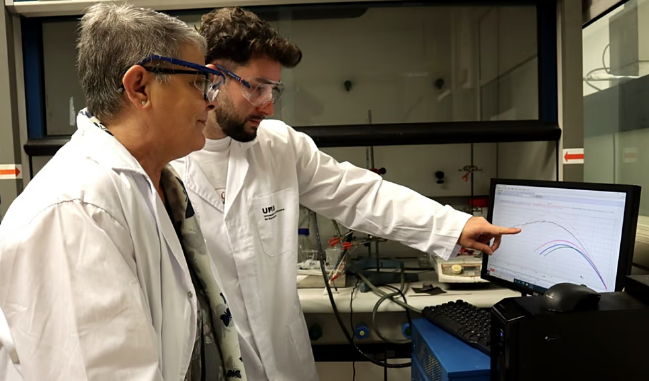
Researchers in Spain have developed a new design for zinc-air batteries that can increase their power output by up to 80% without changing the chemistry at the heart of the technology.
The work was carried out by scientists at the Institute of Materials Science of Barcelona (ICMAB-CSIC), in collaboration with the Catalan Institute of Nanoscience and Nanotechnology (ICN2) and the National University of La Plata in Argentina.
The researchers introduced conductive elements inside the battery that function as wireless bipolar electrodes. The elements are not connected to the battery’s existing electrodes or external electrical circuit, but can improve the movement of charge and reduce internal resistance.
The findings, published in the journal Energy Storage Materials, challenge conventional assumptions about how batteries should be designed.
Batteries generate electricity through the energy difference between their two electrodes, while an electrolyte allows ions to move between them. Conventional battery designs generally require the electrolyte to prevent electrons from passing directly between the electrodes in order to avoid a short circuit.
The research team, led by Nieves Casañ-Pastor of ICMAB-CSIC, found that isolated conductive metal pieces can be placed between the electrodes under specific conditions without causing a short circuit.
The researchers said the electric field created between the electrodes while the battery is operating polarises the conductive elements. Opposite charges accumulate at either end of the pieces, creating additional pathways for charge transport.
This process reduces the battery’s internal resistance and allows energy to be delivered more quickly.
“What is remarkable is that these conductors are not wired to anything: they are simply inserted into the system and they produce beneficial effects,” Casañ-Pastor said.
The research forms part of the doctoral work of Marc Mosqueda and focuses on the potential of zinc-air batteries, which use materials that are relatively abundant, inexpensive and considered safer than some alternatives.
Zinc-air batteries have attracted interest for energy storage because of these characteristics, but their performance has been constrained by the slow oxygen reaction involved in their operation.
The new architecture addresses part of this limitation by using wireless bipolar electrodes to improve charge transport and reduce internal resistance. Tests showed that the approach could raise power output by as much as 80%.
The researchers said the design principle could extend beyond zinc-air batteries and potentially be used in other energy storage technologies.
Casañ-Pastor’s group has already observed similar effects in other battery systems and plans to continue studying wireless bipolar electrodes.
The findings could offer a new approach to battery design by showing that carefully positioned conductive components do not necessarily need to be physically connected to a circuit to improve performance.

AMD has unveiled a powerful new workstation in Berlin that it describes as a personal supercomputer, designed to bring data-centre level artificial intelligence capabilities to desktop users.
The American chipmaker introduced the Threadripper Halo Station at the Internationale Funkausstellung technology event on Friday. AMD Senior Vice President Jack Huynh presented the system as part of a new generation of computing hardware built around the growing demand for AI.
The workstation is designed for demanding AI workloads and can be configured with up to two terabytes of system memory and 576 gigabytes of high-bandwidth HBM3E memory. It also features 96 Threadripper Pro CPU cores and two MI350P data-centre accelerators, with liquid cooling used to manage the system’s high performance requirements.
Huynh described the machine as the world’s most powerful workstation and said it would be capable of running artificial intelligence models containing more than one trillion parameters.
During a demonstration in Berlin, Huynh showed the system generating an entire 3D environment and flight simulator from a single prompt. The presentation was intended to demonstrate how advanced AI tasks could be performed locally without depending entirely on remote cloud infrastructure.
AMD plans to release the Threadripper Halo Station early next year, although the company has not announced a final price. Analysts expect the system could cost more than €100,000, placing it firmly in the corporate, research and institutional market rather than the consumer PC sector.
The workstation is aimed at organisations that want to operate large language models and AI agent systems on their own hardware. Running these workloads locally could reduce dependence on cloud services, particularly for businesses and institutions facing rising AI subscription and computing costs.
AMD’s closest rival in this market is Nvidia’s DGX Station, which also brings powerful AI computing capabilities into a desktop-sized system. The two machines take different approaches to local AI performance.
AMD’s system has a major advantage in memory capacity and bandwidth. Its larger memory pool is designed to allow trillion-parameter models to run locally, while Nvidia’s machine offers tighter integration between local systems and cloud-based computing environments.
Nvidia’s DGX Station is already available and sells for around €100,000, giving it an early advantage in the emerging market.
AMD’s entry could intensify competition as companies seek alternatives to cloud-based AI computing. The growing ability to run increasingly large models on local hardware could also change how businesses manage AI development and deployment.
By using standardised components while targeting data-centre class performance, AMD is betting that powerful local AI systems will become an increasingly important part of the next generation of computing.

Apple Unveils Foldable iPhone Duo as John Ternus Takes Charge

Mental Health Support Before Major Surgery May Improve Recovery, Study Finds

Spanish Researchers Develop Zinc-Air Battery Design That Raises Power Output by 80%

Google Plans €13 Billion Investment in Finland Data Centres

ECB Expected to Raise Rates as Energy-Driven Inflation Complicates Decision

Thailand Investigates Bangkok Clinic After British Influencer Dies Following Cosmetic Procedure

China Export Growth Accelerates to 25% in August on Strong Tech Demand

Italy Leads Europe in Pay Transparency as Salary Disclosure Surges

AMD Unveils Personal Supercomputer Designed to Bring AI Power to Desktops

Turkey Raises 2026 Inflation Forecast to 28.4% as Middle East War Hits Outlook

Meta Acquires Tilda Swinton VR Doc ‘Impulse: Playing With Reality’

China’s Historic Olympic Victory Sparks National Pride Amid Controversy

Saudi Arabia’s Model for Sustainable Aviation Practices

Recent Developments in Small Business Taxes

Effective Drain Cleaning: A Key to a Healthy Plumbing System

Who was Ebrahim Raisi and his status in Iranian Politics?

Keely Hodgkinson Wins Britain’s First Athletics Gold at Paris Olympics in 800m

Carrectly: Revolutionizing Car Care in Chicago

Nobel Laureate Muhammad Yunus Proposed as Head of Bangladesh’s Interim Government Following Hasina’s Resignation

Chinese Hackers Infiltrate Major U.S. Telecom Firms in Possible National Security Breach

Sony WF-10XM4: Headphones Are Our Absolute Favorite

10 Places You Can’t Miss If It’s Your First Time in European

New Census Data Will Shake Up Alabama Politics

16 Top of Our Favorite Outdoor Clothing Brands

Fashionable Summer Accessories to Dress Up Your Travel Look

How Sleeping Less than 7 Hours a Night Can Lead to Weight Gain
-
 Entertainment2 years ago
Meta Acquires Tilda Swinton VR Doc ‘Impulse: Playing With Reality’
-
 Sports2 years ago
China’s Historic Olympic Victory Sparks National Pride Amid Controversy
-
 Business2 years ago
Saudi Arabia’s Model for Sustainable Aviation Practices
-
 Business2 years ago
Recent Developments in Small Business Taxes
-
 Home Improvement2 years ago
Effective Drain Cleaning: A Key to a Healthy Plumbing System
-
 Politics2 years ago
Who was Ebrahim Raisi and his status in Iranian Politics?
-
 Sports2 years ago
Keely Hodgkinson Wins Britain’s First Athletics Gold at Paris Olympics in 800m
-
 Business2 years ago
Carrectly: Revolutionizing Car Care in Chicago