Connect with us

News

Hundreds Arrested as PSG Champions League Win Sparks Violent Clashes in Paris

Published

on

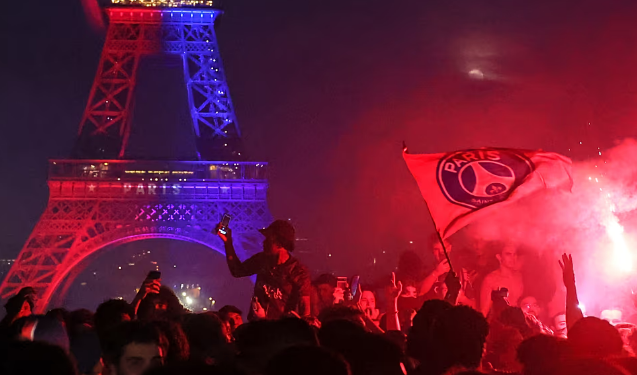
French authorities have detained hundreds of people following violent disturbances that erupted during celebrations of Paris Saint-Germain’s Champions League victory, with unrest spreading across Paris and other cities late Saturday night.

According to the French interior ministry, police questioned around 780 people nationwide and detained 457 individuals after celebrations turned disorderly following PSG’s dramatic penalty shootout win over Arsenal in Budapest. The victory marked the club’s second consecutive Champions League title, prompting large-scale public celebrations across France.

In Paris alone, 283 people were detained as thousands of fans gathered in key locations including the Champs-Élysées and areas near the Arc de Triomphe. Officials estimated that around 20,000 supporters converged on the famous boulevard, where many set off flares, sounded car horns and filled the streets in celebration.

While much of the crowd remained festive, authorities said smaller groups caused significant disruptions. The Paris police prefecture reported incidents of vandalism, arson and property damage in several districts. Vehicles were set on fire, and both a bakery and a restaurant were damaged during the unrest. One police officer was reported injured during the clashes.

Tensions escalated in parts of the capital as some groups attempted to storm a police station in the upscale 8th arrondissement. Police intervened and dispersed the crowd, making several arrests during the incident. By around 10 p.m., authorities said 45 people had already been taken into custody as security operations intensified across the city.

Disruptions were also reported on the main ring road encircling Paris, where crowds briefly blocked traffic before being cleared by police. In the 16th arrondissement near the PSG stadium, officers moved in to break up a gathering of around 1,000 people and dismantled barricades that had been constructed using bicycles.

See also  Trump Hints at Regime Change in Iran After U.S. Strikes on Nuclear Sites

The interior ministry confirmed that nationwide arrests included individuals involved in public disorder, vandalism and attempted attacks on police facilities. Security forces were deployed in large numbers across Paris to contain the situation and prevent further escalation.

The unrest comes a year after similar scenes followed PSG’s earlier Champions League success, when heightened security measures were in place across the capital. During those celebrations, more than 500 arrests were made nationwide and 201 people were injured in Paris amid widespread clashes.

This year’s victory places PSG among a small group of clubs in modern Champions League history to retain the title in consecutive seasons. However, the celebrations were again overshadowed by episodes of violence, prompting renewed scrutiny of crowd control measures during major sporting events in the French capital.

News

Eastern Germany Faces Growing Economic Gap as Poland Pulls Ahead, Economists Warn

Published

on

Eastern Germany is at risk of losing momentum in its long-running effort to close the economic gap with the western part of the country, while neighbouring Poland continues to record strong growth and attract rising investment, according to economists and a new competitiveness report.

The 2026 Competitiveness Report for Eastern Germany warns that the convergence process between east and west is “in jeopardy,” with the region facing weaker investment, persistent labour shortages and mounting demographic pressures. Researchers say the gap that narrowed for decades could begin widening again unless urgent action is taken.

Joachim Ragnitz, deputy head of the ifo Institute in Dresden and author of the study underpinning the report, said the situation has reached a turning point. He cautioned that eastern Germany’s economic catch-up can no longer be assumed and may stall without decisive policy and business intervention.

The report highlights that private investment in eastern Germany remains significantly below western levels. Between 2019 and 2023, investment per resident reached only about three-quarters of western Germany’s level. Excluding housing and public infrastructure, it fell to roughly two-thirds.

Demographic change is adding further pressure. The working-age population is expected to decline by around 7 percent by 2035, with sharper drops in some regions. Thuringia and Saxony-Anhalt could lose as much as a quarter of their labour force potential, raising concerns over production capacity and business continuity. In Thuringia alone, company closures outpaced new business formations last year.

Officials and economists argue that a shortage of skilled labour and weak private-sector investment remain central challenges. Elisabeth Kaiser, the federal government’s commissioner for eastern Germany, said targeted tax incentives and continued investment are essential to strengthening long-term growth prospects.

See also  North Korean Soldiers Seen Training in Russia for Possible Deployment to Ukraine

By contrast, Poland has recorded strong industrial expansion in recent years, attracting investment in sectors such as automotive manufacturing, logistics and battery production. Economists say Poland’s flexibility in shaping economic policy has been a key advantage.

Ragnitz noted that Poland can offer tailored incentives and regulatory conditions that are not possible within Germany’s unified legal and wage framework. He said eastern Germany’s integration into national systems limits its ability to compete on costs or design special investment zones.

After reunification, eastern Germany briefly benefited from enhanced subsidies and simplified approval processes, but many of these measures were later phased out due to policy changes and EU rules. Attempts to reintroduce similar frameworks have faced political resistance.

Despite this, several major projects have recently been secured in eastern Germany, including Tesla’s plant in Brandenburg, semiconductor investments in Dresden and battery production facilities near Erfurt. However, economists say these flagship developments have not yet translated into broad regional gains.

Wealth disparities also remain significant. Median household net worth in eastern Germany is around €35,900, compared with €143,200 in the west. Lower incomes, reduced home ownership and fewer inheritances continue to widen the gap.

While Germany’s overall economy shows signs of stabilisation, eastern states continue to lag behind in sectors such as industry, construction and retail. GDP per capita in the east remains about 85 percent of western levels.

Economists say the challenge now is not simply catching up, but redefining the region’s economic role. Attention is expected to focus on new growth strategies at upcoming policy forums, where Germany and international experts, including those studying Poland’s development model, will assess how to revive momentum in the east.

Continue Reading

News

White House Says Trump Remains in Excellent Health After Annual Medical Exam

Published

on

US President Donald Trump remains in “excellent health” and is fully capable of carrying out his presidential duties, according to a medical report released by the White House following his annual examination.

The assessment, issued Friday by Capt. Sean Barbabella, Trump’s official physician, followed a series of medical tests conducted earlier this week at Walter Reed National Military Medical Center in Maryland.

The report said Trump underwent extensive evaluations covering cardiac, respiratory and neurological health, along with other routine examinations. Barbabella concluded that the president was “fully fit to carry out all duties of the Commander-in-Chief and Head of State.”

“President Trump remains in excellent health, demonstrating strong cardiac, pulmonary, neurological, and overall physical function,” the physician wrote in the memo.

The report highlighted Trump’s active schedule as a contributing factor to his overall condition, noting that his routine includes high-level meetings, public appearances and regular physical activity.

“His demanding daily schedule, including multiple high-level meetings, public engagements, and regular physical activity, continues to support his overall well-being,” the memo stated.

Barbabella also said the president’s “cognitive and physical performance are excellent,” addressing a topic that has frequently drawn public and political attention as Trump approaches his 80th birthday this summer.

Trump underwent the examination earlier in the week and later shared his reaction on Truth Social, declaring that the medical review had gone smoothly.

“Everything checked out perfectly,” Trump wrote.

The report included details about several physical observations. Physicians noted scarring on Trump’s right ear that was described as consistent with a prior gunshot injury.

See also  Trump Declares Rift with Musk Final, Warns of "Consequences" if Tesla CEO Backs Democrats

The memo also addressed bruising that has repeatedly appeared on Trump’s right hand since his return to the White House.

According to Barbabella, examination of the hands showed bruising, medically referred to as ecchymosis, caused by “minor soft tissue irritation” linked to frequent handshaking while taking aspirin as part of cardiovascular prevention treatment.

Trump’s weight was listed at 238 pounds, or approximately 108 kilograms, representing an increase compared with his previous medical evaluation.

The physician said the president received preventative health counseling and guidance related to diet and weight management as part of the examination process.

Presidential medical reports have long drawn public scrutiny, particularly for older presidents, as they provide one of the few official glimpses into a leader’s health while serving in office.

The latest assessment comes as Trump maintains a busy political and governing schedule ahead of another active year in Washington.

Continue Reading

News

Local Elections Across Italy Mark Key Test for Giorgia Meloni’s Government

Published

on

Italy has entered a decisive phase of local elections, with mayoral and municipal council votes taking place across hundreds of cities and towns, offering a significant political test for Prime Minister Giorgia Meloni and her right-wing coalition following recent setbacks at the national level.

Voting resumed on Monday after the first round was held on Sunday, covering 749 municipalities. More than six million citizens are eligible to participate, with ballots being cast in around 700 areas, including the regional capital Venice and 15 provincial capitals such as Messina, Salerno, Reggio Calabria and Mantua.

Early figures showed turnout at approximately 46.5%, slightly below the 50.1% recorded in the previous comparable election cycle, according to local reports. Election officials noted that participation levels will be closely monitored as a gauge of public engagement ahead of Italy’s next general election, expected in 2027.

In municipalities with more than 15,000 residents, run-off votes are scheduled for 7 and 8 June, while Sardinia will also hold voting across 149 municipalities, with its own run-offs set for later in June.

The elections come at a sensitive moment for Meloni’s government, following a recent defeat in a referendum on justice reforms in March, which has raised questions about the durability of her political momentum. Analysts say the local results could either reinforce the governing coalition’s standing or signal deeper challenges ahead.

The contest is also seen as a measure of strength for the opposition “broad camp,” which remains fragmented across regions and cities. Alliances vary widely, with centrist parties such as Azione aligning with the centre-right in some municipalities while remaining divided from centre-left partners elsewhere.

See also  Ukraine Claims Missile Strike Sinks Russian Submarine in Sevastopol

Attention is focused on 118 larger municipalities where political competition is most intense. In Venice, the centre-left is attempting to regain control after a decade of centre-right administration under Mayor Luigi Brugnaro. In contrast, in Reggio Calabria, the centre-right is seeking to reclaim influence following the tenure of Democrat-backed leadership under Giuseppe Falcomatà.

Other closely watched races include Crotone and Salerno, where local dynamics and independent civic candidates are shaping unpredictable contests. The presence of former regional governor Vincenzo De Luca’s civic list has added further complexity to an already divided progressive bloc.

As campaigns draw to a close, both governing and opposition coalitions are treating the results as a barometer of national sentiment. The outcomes in key cities are expected to influence political narratives in the months ahead, potentially reshaping alliances and strategies before Italy’s next general election.

Continue Reading

Trending