Connect with us

News

Macron Calls G7 Summit in Évian “Objectively Successful” as Transatlantic Coordination Strengthens

Published

on

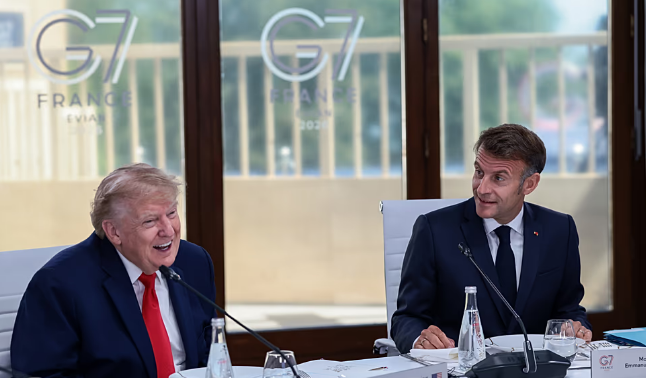
French President Emmanuel Macron declared the G7 summit in Évian-les-Bains an “objectively successful” gathering on Wednesday, highlighting rare unity among major economies on Ukraine, Iran and critical minerals, even as questions persist over the durability of transatlantic alignment under US President Donald Trump.

Speaking at the close of the three-day summit, Macron said leaders had reached a joint declaration backed by all members, including Washington, marking what he described as a turning point in cooperation after months of uncertainty over US engagement in multilateral diplomacy.

In the lead-up to the meeting, European officials had feared a repeat of last year’s fractured summit in Canada, where disagreements over trade, security and Middle East conflicts left allies divided. This time, however, diplomats pointed to coordinated language on Ukraine and renewed commitments to pressure Russia as evidence of improved alignment.

The G7 statement reaffirmed “unwavering support” for Ukraine’s sovereignty and territorial integrity while also committing to stronger sanctions on Russian energy exports. European officials described the agreement as a significant step toward closing gaps with Washington on strategy toward Moscow.

Macron said the summit reflected “a very profound shift” in US-European relations, noting that G7 members now appeared more willing to coordinate closely on security challenges. He added that Western capitals had reached similar conclusions regarding Russia’s lack of readiness for meaningful peace negotiations with Kyiv.

European sources said Trump’s administration had shown openness to reconsidering tougher measures on Russian energy exports, though no timetable was set. Ukrainian President Volodymyr Zelenskyy attended parts of the summit but did not secure a bilateral meeting with Trump, speaking only briefly on the sidelines of group discussions.

See also  Ukrainian Drone Strike Targets Russian Oil Facility, Killing Firefighters

Alongside Ukraine, leaders also welcomed progress on a US-Iran framework agreement aimed at ending the conflict and stabilising global energy flows. European officials said the deal could ease pressure on markets while reducing regional escalation risks, though concerns remain over Iran’s nuclear ambitions.

Behind the scenes, EU officials said limited diplomatic contacts were being explored with Moscow through indirect channels, although Brussels stressed it does not view itself as a mediator in the conflict.

Despite signs of coordination, uncertainty remains over the future of transatlantic diplomacy. Trump’s bilateral and often unpredictable approach to foreign policy continues to create concern among European allies, even as cooperation at the summit appeared to improve.

Macron nevertheless emphasised that Europe had secured a stronger position in shaping discussions, saying the bloc had “found its place at the table” through a combination of diplomacy and strategic engagement.

As leaders departed Évian, European diplomats described the outcome as pragmatic rather than transformative — a workable consensus shaped by shared interests rather than full alignment.

The summit concluded with Trump attending a state dinner at Versailles marking 250 years of Franco-American relations, underscoring both the symbolism and the continuing complexity of the partnership between Washington and Europe.

News

EU Green Investment Fund Faces Scrutiny Over Potential Reliance on Chinese Clean Technology

Published

on

The European Union has launched a €15–20 billion Global Green Bond Initiative aimed at financing sustainable infrastructure projects in partner countries, but concerns are mounting in Brussels that a significant portion of the funding could end up supporting Chinese clean technology suppliers.

The programme, one of the EU’s largest external climate financing tools, is intended to mobilise investment for renewable energy, water treatment and transport projects across developing regions. Planned projects include solar farms in Algeria, wastewater systems in India and light rail infrastructure in the Dominican Republic, with the European Investment Bank (EIB) acting as a key anchor investor alongside other European development institutions.

However, EU officials warn that the structure of the initiative could unintentionally strengthen Chinese dominance in the global renewable technology market. A Commission official familiar with the matter said most of the allocated funds are likely to flow toward Chinese manufacturers, particularly in sectors such as solar energy components.

Of particular concern are high-risk power inverters used in solar installations. These devices, many of which are produced by Chinese companies including Huawei-linked suppliers, are increasingly being scrutinised by Brussels due to potential cybersecurity vulnerabilities. Officials fear they could allow remote interference with energy systems, posing risks to grid stability in third countries connected to European energy networks.

The European Commission recently issued guidance calling for the gradual removal of such high-risk inverters from EU-funded renewable projects. However, the directive applies primarily to projects outside the EU from 2027 onwards, leaving a gap between policy ambition and current investment frameworks.

The Green Bond Initiative, approved before the cybersecurity guidance was finalised, contains no requirement for partner countries to avoid Chinese suppliers. This absence of procurement conditions has raised concerns that EU-backed financing may indirectly reinforce dependency on Chinese technology at a time when Brussels is trying to diversify critical supply chains.

See also  Britain and Norway Step Up Naval Patrols to Protect Undersea Infrastructure from Russia

A second EU official said projects funded under the scheme risk increasing exposure to Chinese influence in regions such as North Africa, which is expected to receive a large share of early investments. The Mediterranean is considered strategically sensitive due to its proximity to European energy infrastructure.

Efforts by the Commission to push European development banks, including the EIB, to apply stricter exclusion rules have met resistance. Financial institutions argue that project viability and cost efficiency must remain central, while Brussels insists that geopolitical risk and cybersecurity concerns can no longer be ignored.

The debate has also exposed a broader policy gap between the EU’s economic security strategy and its external investment tools, many of which were designed before recent shifts in global trade and technology competition.

The Commission is expected to press fund managers, including Amundi, to reassess procurement frameworks. However, officials acknowledge that many projects were already structured without restrictions on suppliers, limiting room for immediate changes.

With no formal exclusion mechanism in place, disagreements between EU institutions are likely to continue as the initiative moves into implementation, highlighting the tension between climate investment goals and efforts to reduce strategic dependence on China.

Continue Reading

News

Pakistan Signals Near-Completion of US-Iran Peace Deal as Negotiations Intensify

Published

on

Pakistan’s Prime Minister Shehbaz Sharif said on Saturday that a proposed peace agreement between the United States and Iran was closer than ever to being finalised, with expectations that it could be completed within 24 hours. His remarks came amid heightened diplomatic activity involving multiple regional and international actors working to bridge long-standing differences between Washington and Tehran.

Iranian state media reported on Sunday that Tehran had not yet reached a final decision on the draft agreement aimed at ending tensions between the two countries. The uncertainty followed a series of statements suggesting that progress had accelerated significantly in recent days.

US President Donald Trump also indicated on Saturday that a deal was within reach, echoing optimism from mediators involved in the process, including Pakistan. In a post on his Truth Social account, Trump stated that the agreement was scheduled for signing the following day. He added that once completed, the Strait of Hormuz would be opened for unrestricted passage.

“Hopefully, this process will all work out quickly, easily, and smoothly. If it doesn’t, we have the ultimate alternative, hopefully never to be used again,” Trump said, while also emphasizing that the arrangement would prevent nuclear escalation.

Prime Minister Shehbaz Sharif, speaking earlier on Saturday, described the situation as being at its closest point to resolution. He said Pakistan was preparing for an electronic signing ceremony once final agreement was reached. According to his statement on X, technical-level discussions would continue in the days following the signing to ensure implementation of the deal’s provisions.

Diplomatic engagement continued on Sunday when a Qatari delegation arrived in Tehran. According to Iran’s Tasnim news agency, the delegation’s purpose was to review the latest developments related to the ongoing diplomatic process and maintain momentum in negotiations.

See also  Europe’s Housing Crisis Worsens, Young Spaniards Struggle to Enter Market

Central to the proposed agreement is Iran’s commitment to fully reopen the Strait of Hormuz, a critical maritime passage for global oil and gas shipments. Another key condition involves curbing Tehran’s nuclear program, which has been a longstanding point of contention in its relations with Western powers.

While optimism has grown among mediators, Iranian authorities have not confirmed final approval, leaving the outcome uncertain. Negotiations are expected to continue as involved parties attempt to resolve outstanding issues and move toward formal agreement.

Continue Reading

News

US Orders Anthropic to Restrict Foreign Access to Advanced AI Models Amid Security Concerns

Published

on

The United States government has ordered artificial intelligence company Anthropic to suspend access to some of its most advanced AI models for foreign nationals, a move the company says it will comply with while strongly disagreeing with the reasoning behind the directive.

In a statement published on its blog late Friday, Anthropic said it received an official letter from the US government at 5:21 p.m. ET instructing it to halt access to its Fable 5 and Mythos 5 models. The decision was based on national security concerns, according to the company.

The restriction applies broadly to foreign nationals, including those located inside the United States as well as overseas, and even extends to foreign employees working at Anthropic. The company confirmed that access to other AI systems it operates will remain unaffected.

“The net effect of this order is that we must abruptly disable Fable 5 and Mythos 5 for all our customers to ensure compliance,” Anthropic said, adding that it has apologized to users and is working to restore access as quickly as possible.

The company said US authorities had raised concerns after identifying a potential “jailbreak” vulnerability in Fable 5. In AI systems, jailbreaks refer to attempts to bypass built-in safeguards and ethical restrictions, allowing users to manipulate models into performing prohibited tasks.

Anthropic described the issue as relatively limited in scope, noting that publicly available models were already able to detect similar weaknesses. The company argued that while it was complying with the directive, it did not agree that a “narrow potential jailbreak” justified withdrawing a commercial product used by hundreds of millions of users.

See also  US Says Iran Talks ‘Borderline’ as Pakistan Pushes Diplomacy Amid War Tensions

It also stressed that Fable 5 had been designed with enhanced safeguards intended to reduce misuse, particularly in areas linked to cybersecurity threats.

The decision has sparked wider debate over the geopolitical implications of artificial intelligence. Jordan Bardella, a Member of the European Parliament and leader of France’s National Rally party, said the move underscores how AI has become central to questions of national sovereignty, warning that countries without domestic AI capabilities risk increasing dependence on foreign powers.

British MP and former security minister Tom Tugendhat echoed similar concerns, saying the case highlights how technological systems are now deeply tied to national security and strategic independence.

The dispute follows earlier tensions between the US government and Anthropic. In February, President Donald Trump ordered federal agencies to stop using certain Anthropic technologies after disagreements over defense applications. At the time, Trump wrote on social media that the US would “not do business with them again,” initiating a phased withdrawal period.

Anthropic has also previously announced legal action after being labeled a “supply chain risk” by US authorities, further escalating its dispute with regulators over national security policy and AI governance.

The latest directive adds to growing global friction over how advanced AI systems should be regulated, controlled, and shared across borders.

Continue Reading

Trending