Connect with us

News

US Senate Sanctions Bill Raises European Concerns Over Expanded Presidential Tariff Powers

Published

on

A sanctions bill advancing through the US Senate is drawing growing attention in Europe, where officials and policy experts warn that legislation aimed at increasing pressure on Russia could also hand President Donald Trump sweeping new authority to impose tariffs on both allies and rivals.

The proposed legislation was originally introduced by Republican Senator Lindsey Graham and Democratic Senator Richard Blumenthal as part of an effort to tighten economic pressure on Moscow over the war in Ukraine. Following Graham’s death last month, supporters have renewed efforts to move the bill forward in what they describe as a tribute to his work. The measure, however, still faces an uncertain path in the House of Representatives after lawmakers began their summer recess.

Ukrainian President Volodymyr Zelenskyy attended Graham’s funeral in Washington and urged US lawmakers to approve the legislation, calling it an important signal of continued support for Ukraine and Europe.

The bill proposes a broad package of sanctions targeting Russia, including restrictions on financial transactions involving Russian banks, penalties against government officials and oligarchs, and measures aimed at vessels linked to Russia’s so-called shadow fleet.

Its most closely watched provision would allow the US president to impose tariffs of up to 100% on goods imported from countries identified as major buyers of Russian oil and gas or those considered to be helping circumvent sanctions on Russian energy exports. The White House would have sole authority to determine which countries fall within those categories.

Supporters of the measure have said the provision is primarily intended to discourage continued purchases of Russian energy by countries such as China and India, which remain among Moscow’s largest customers.

See also  TikTok Blackout Hits U.S. as Federal Ban Takes Effect

Policy analysts, however, argue that the language of the bill is broad enough to create uncertainty for US allies, including members of the European Union. They note that Europe continues to import Russian liquefied natural gas, although the bloc has committed to ending those purchases through a permanent ban scheduled for January 2027.

The legislation includes an exemption for countries that have taken “significant steps” to reduce Russian energy imports. Critics point out that determining whether those conditions have been met would rest entirely with the US president.

Experts also warn that references to countries “facilitating” sanctions evasion are not clearly defined, creating uncertainty over how the law could be applied. Nations including Greece, Cyprus and Malta remain involved in the lawful transport of Russian oil under the international price cap, while Hungary and Slovakia continue receiving Russian crude through existing pipeline exemptions.

A European Commission spokesperson declined to comment directly on the draft legislation but said the EU continues to coordinate sanctions policy with the United States and G7 partners while steadily reducing dependence on Russian fossil fuels.

Legal specialists say the bill contains safeguards limiting its scope compared with previous emergency trade authorities, but uncertainty remains over how future administrations could interpret and enforce its provisions. They argue that much will depend on presidential discretion, leaving allies watching developments in Washington closely as the legislation moves through Congress.

News

Iran Says Hormuz Can Reopen Within Seven Days as Oil Exports Come Under Pressure

Published

on

Iran’s military said it retained full control of the Strait of Hormuz on Monday, while Foreign Minister Abbas Araghchi said the strategic waterway could be fully reopened within seven days if Tehran’s conditions were met and hostile measures against the country were lifted.

The statements came as Iran faced growing economic pressure, with the rial falling to record lows, Oil Minister Mohsen Paknejad resigning and the United States claiming that Tehran had not loaded any crude onto tankers during September.

Brigadier General Aziz Jafari, commander of Iran’s Khatam al-Anbiya Joint Air Defence Headquarters, said all movements through the Strait remained under the control of the Iranian armed forces despite changes in US tactics.

“All movements (in Hormuz) are under the control of the armed forces of the Islamic Republic,” Jafari said.

US Treasury Secretary Scott Bessent said on Thursday that Iran had not loaded crude oil onto tankers during September, arguing that the Trump administration was targeting Tehran’s main source of revenue.

Iranian President Masoud Pezeshkian acknowledged in August that restrictions were disrupting oil exports, saying the country had previously been able to sell oil but was now unable to do so at the same level.

Paknejad’s resignation was officially attributed to family and personal matters. However, his departure came amid speculation about the impact of reduced oil exports on government finances. Before his resignation was announced, Paknejad said in a video carried by Iranian media that revenue from oil already sold would be collected and that the process would continue.

See also  Chickenpox Outbreak Spreads Through Gaza Camps as Overcrowding and Vaccine Gaps Raise Alarm

The acting oil minister has pledged to maximise production and maintain exports through new strategies.

Despite pressure on Iranian exports, oil shipments from other parts of the region remained high. Ship-tracking company Kpler estimated crude exports from the region excluding Iran at between 19.5 million and 22.5 million barrels per day during the final week of September, compared with a pre-war regional average of about 18 million barrels per day.

Iran’s currency has also come under severe pressure. The euro rose above 300,000 tomans on the informal market, while the US dollar reached 270,000 tomans, more than double its level of about 135,000 tomans at the beginning of the year. One toman is equal to 10 rials.

The UK Maritime Trade Operations agency reported at least one attack each day in the Strait of Hormuz or the Gulf of Aden since October 2.

Araghchi told foreign ambassadors in Tehran that the conflict could not be resolved militarily and called for negotiations based on fairness. He warned that any renewed military confrontation would trigger a stronger Iranian response.

Parliament Speaker Mohammad Bagher Ghalibaf said Tehran had received US proposals through intermediaries but rejected what he described as one-sided demands.

He said the Strait would remain closed until Iran’s seven conditions, based on the Islamabad memorandum, were met.
Continue Reading

News

SpaceX crew reaches International Space Station in record US transit

Published

on

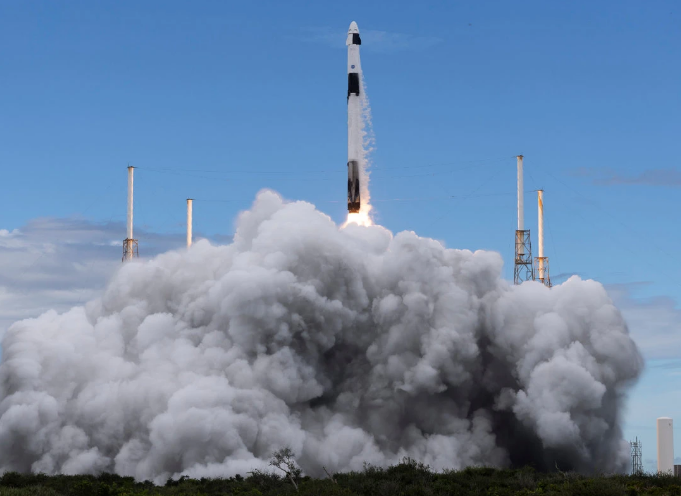
Four astronauts arrived at the International Space Station on Thursday after an eight-hour journey from Earth, completing the fastest crewed trip to the orbiting laboratory by a US spacecraft.

The astronauts launched aboard a SpaceX Dragon capsule after a three-week delay caused by repairs to a leaking fuel system. Thick clouds threatened to postpone the launch again, but weather conditions improved enough for the mission to proceed from Cape Canaveral Space Force Station in Florida.

The short journey was possible partly because of the station’s position at the time of launch. Although the astronauts are scheduled to spend about six months aboard the space station, their trip there was the quickest recorded by SpaceX or any US space programme, including NASA.

Commander Jessica Watkins became the first Black woman to lead a crew into orbit. The geologist previously worked with NASA’s Curiosity Mars rover programme and spent an extended period aboard the space station in 2022.

“Thanks for an amazing ride,” Watkins told mission control after the launch.

The other members of the crew are NASA astronaut Luke Delaney, a retired Marine, Canadian astronaut Joshua Kutryk, a Royal Canadian Air Force colonel, and Russian cosmonaut Sergey Teteryatnikov, a former submariner. All three are making their first journey into space.

The crew will replace four astronauts who have been living aboard the International Space Station since February.

The mission is SpaceX’s 13th crewed flight for NASA, excluding its crewed test flight in 2020. The astronauts have embraced the Crew-13 designation, with the mission patch featuring a reference to Apollo 13, the 1970 lunar mission that ended with its crew safely returning to Earth after a serious in-flight emergency.

See also  US Defense Secretary Hegseth Praises Poland as 'Model NATO Ally' in Warsaw Visit

The number 13 featured repeatedly during Thursday’s launch preparations. The astronauts travelled to the launch pad in black Tesla vehicles with licence plates reading “Lucky 13”. They also carried a small crocheted golden dragon called Lucky, which wore a four-leaf clover.

Watkins later joked from orbit that the crew had brought some extra luck with them, describing the four astronauts as among the “luckiest humans on or off planet Earth.”

Kutryk’s mission carries a particularly personal milestone. His wife, Heather, is expected to give birth to their third child in late November, making him the fourth man to become a father while in orbit.

The Canadian Space Agency has said it will support Kutryk and his family during the birth. NASA has previously helped astronauts remain connected with family members during major events on Earth.

SpaceX also conducted multiple launches on Thursday. Hours after the crew mission, the company launched a Falcon rocket from California carrying more than 100 small satellites. Another Falcon launch from Florida was scheduled later in the day with a classified National Reconnaissance Office satellite.

The launches came during a busy week for SpaceX, following the first orbital flight of its Starship vehicle.

Continue Reading

News

Trump, Vance begin midterm campaign push as Republicans confront economic concerns

Published

on

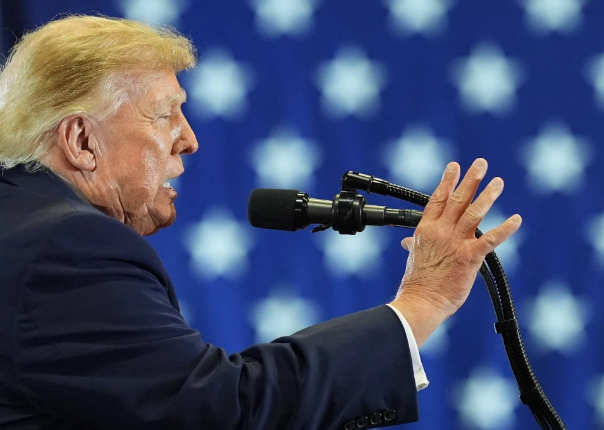
President Donald Trump and Vice President JD Vance took to the campaign trail on Thursday, opening an intensive effort to support Republican candidates ahead of the Nov. 3 US midterm elections.

Trump travelled to Texas and Oklahoma, while Vance campaigned in Florida. Their appearances were held in areas that have traditionally been strong for Republicans, as the party seeks to energise its base amid concerns about the economy and rising living costs.

Trump described his schedule as a 32-day campaign blitz. Speaking at a truck manufacturing facility in Denton, Texas, he said he remained committed to helping Republican candidates and dismissed suggestions that he was not fully engaged in the campaign.

The president also promoted Republican Texas Attorney General Ken Paxton, who is running for the US Senate against Democratic state Rep. James Talarico. Trump said Republicans needed Paxton in Washington and used his appearance in Texas to support the candidate.

Trump later travelled to Oklahoma, where he campaigned alongside Republican gubernatorial candidate Mike Mazzei. His rally in Durant took place on the Choctaw Nation of Oklahoma, making it one of the relatively few visits by a sitting US president to a tribal nation.

Vance, meanwhile, appeared in Lakeland, Florida, to support Republican Rep. Byron Donalds in his campaign for governor. He also campaigned in Texas earlier in the week for Republican congressional candidate Eric Flores.

The campaign appearances came as new polling showed dissatisfaction with the Trump administration’s handling of the economy. An Associated Press-NORC Center for Public Affairs Research poll found that 17% of US adults approved of Trump’s handling of the cost of living, while 26% approved of his handling of the economy overall, a new low in the survey. The poll was conducted Sept. 24-28 among 2,140 adults and had a margin of error of 2.9 percentage points.

See also  Chickenpox Outbreak Spreads Through Gaza Camps as Overcrowding and Vaccine Gaps Raise Alarm

Trump has continued to argue that inflation and high prices were inherited from the Biden administration and that his policies are reducing costs. The AP-NORC poll found that 65% of adults attributed persistently high costs mainly to Trump’s policies, including tariffs and the ongoing conflict with Iran.

Democratic National Committee officials criticised the Republican campaign effort, arguing that economic pressures and the Iran conflict were weighing on voters.

Republican officials are planning an extensive campaign schedule for Trump, with additional appearances expected in Alabama, Ohio and Nebraska. Party strategists have also said his rallies in strongly Republican areas can help mobilise supporters beyond the states he visits.

The midterm elections will determine control of Congress, while voters across the country will also decide numerous state and local races.

Continue Reading

Trending