
Business
Euronext’s €412.8 Million Bid for Athens Stock Exchange Marks Major Milestone for Greek Economy

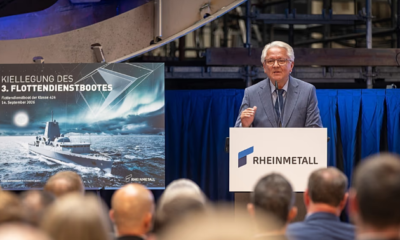



Rheinmetall Chief Executive Armin Papperger has warned that Germany’s missile stockpiles remain well below the levels needed to respond to a major security threat, saying production must increase sharply as Berlin and its European allies expand defence spending.
Papperger said shortages of rocket motors and warheads were among the main obstacles facing the European defence industry. Rheinmetall and other manufacturers are responding with major investment programmes aimed at increasing production and restoring weapons inventories across Germany, Europe and NATO.
“That is why we at Rheinmetall are launching a major investment programme,” Papperger said, adding that manufacturers needed to become “dramatically faster” to reach adequate stockpile levels.
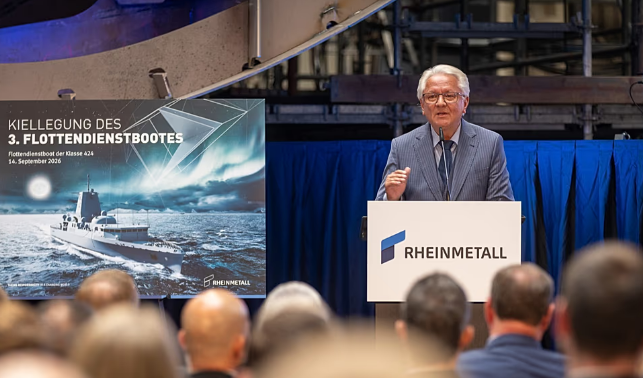
He was speaking at the keel-laying ceremony for the third Type 424 fleet service boat in Wolgast, where he discussed Germany’s military production plans, air defence systems and emerging defence technologies.
Papperger said Rheinmetall remained on track to begin series deliveries of its Skyranger air defence system in 2027, despite some delays involving the vehicle chassis, radar technology and missile integration.
The company is significantly expanding its Skyranger capacity and expects to be able to produce up to 400 systems a year from the end of 2027. Papperger said cooperation with Germany’s Federal Office of Bundeswehr Equipment, Information Technology and In-Service Support and the defence ministry would help address remaining technical issues.
Rheinmetall is also preparing to expand its long-range strike capabilities through partnerships. Papperger said a joint venture with Lockheed Martin covers artillery rockets, while a separate arrangement with Destinus focuses on cruise missiles. Both projects are in the final stages before formal signing, with the first cruise missile order expected by the end of this year or early 2027.
Papperger defended investment in advanced air defence systems alongside simpler and cheaper weapons. He said Skyranger can counter targets travelling at speeds of up to Mach 3 and can also use .50-calibre guns against smaller drones.
Rheinmetall has sharply increased ammunition production in recent years. Medium-calibre output has risen from less than one million rounds to four million, while artillery production has increased from 70,000 to 1.5 million rounds. Tank ammunition production has reached 240,000 rounds, compared with between 40,000 and 60,000 in previous years.
The company plans to invest €30 billion over six years. Papperger said Rheinmetall currently employs about 34,000 people in its defence operations and is adding around 10,000 workers a year, with a target of 70,000 employees by 2030. Its supply chain could support another 210,000 jobs.
Looking ahead, Papperger said drones would remain important, while humanoid robots and space technology would become increasingly significant. Rheinmetall has established a humanoid robotics research centre in Bremen and is investing in satellite construction and communications processing.
He said future combined-arms warfare would require a mixture of artillery, armoured vehicles, conventional ammunition, drones and missiles rather than reliance on a single weapons system.
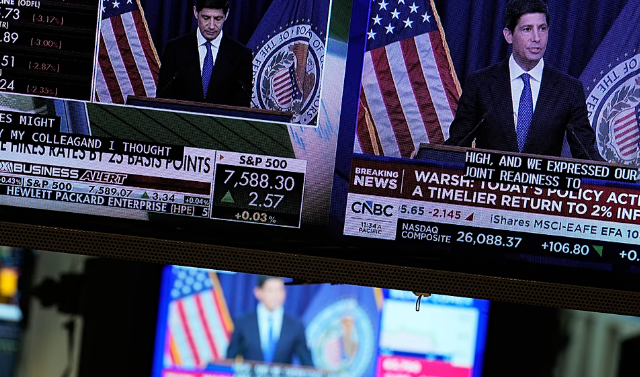
European stock markets opened higher on Thursday, showing limited reaction to Wall Street’s decline after the US Federal Reserve raised interest rates and indicated that additional increases could follow.
The Euro Stoxx 50 and broader Stoxx 600 were both trading more than 0.6% higher at the start of the session. France’s CAC 40, Germany’s DAX, Italy’s FTSE MIB, Spain’s IBEX 35, the Netherlands’ AEX and Switzerland’s CH20 were also in positive territory, with gains ranging from 0.2% to 0.7%.
The UK’s FTSE 100 was among the strongest performers, rising more than 1%.
In Paris, automakers and industrial companies led gains. Renault rose more than 2%, while Stellantis advanced 1.6% and Schneider Electric gained 1.3%. Technology stocks moved in the opposite direction, with Dassault Systèmes falling 2.4%.
The gains in Europe followed a weaker session in the United States. The Dow Jones Industrial Average fell 1.2% on Wednesday, while the S&P 500 declined 0.4%. The Nasdaq ended broadly unchanged.
Asian markets delivered mixed results overnight. Japan’s Nikkei 225 rose 0.2% and South Korea’s Kospi gained 0.9%, while Hong Kong’s Hang Seng dropped 0.7% and the Shanghai Composite fell 0.4%.
Lorraine Tan, director of equity research for Asia at Morningstar, said the market reaction was broadly in line with expectations because the interest rate increase had been anticipated. She also said the conflict in Iran was likely to continue putting pressure on inflation.
The more significant market movements were seen in currencies and government bonds.
The US dollar rose to its highest level in seven weeks against a basket of major currencies, supported by higher short-term Treasury yields following the Fed’s decision. The euro traded around $1.146, down about 0.5% from Wednesday’s opening level.
A stronger dollar can make European exports more competitive in the US, but it also increases the cost of commodities priced in dollars, including oil and gas. That could add to pressure on Europe’s energy costs.
The two-year US Treasury yield, which is particularly sensitive to expectations for interest rates, climbed to about 4.72%, compared with 4.67% before the Fed decision. The 10-year yield remained close to 5%, reflecting concerns over the energy shock caused by the conflict as well as US government borrowing.
Markets were pricing in another rate increase by December, while the possibility of an October move was around 50%. Goldman Sachs has forecast consecutive increases, changing its earlier expectation that the latest increase would be the only one.
Investors are now turning their attention to the Bank of England, which is due to announce its interest rate decision later Thursday and is expected to keep borrowing costs unchanged. The Bank of Japan is scheduled to make its decision on Friday, with markets anticipating an increase.
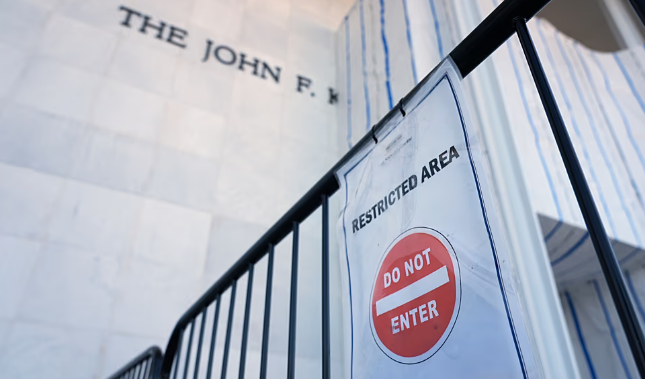
Most of Washington’s Kennedy Center will close for renovations after its board voted Tuesday to shut the landmark performing arts venue, hours after a federal judge blocked another attempt to add President Donald Trump’s name to the building.
The decision followed a ruling by US District Judge Christopher Cooper, who said the Kennedy Center board could not install a memorial to Trump or change the institution’s name without approval from Congress. The judge had previously ordered Trump’s name removed after it was added to the building’s facade.
“Simply put, Defendants cannot install memorials for President Trump or anyone or anything else at the Kennedy Center without Congress’s blessing,” Cooper wrote in his latest ruling.
Trump has said the renovation work, for which Congress has allocated $257 million, will not proceed unless the courts allow the board to move forward with plans to recognize him on the building. He said the Justice Department would appeal Cooper’s decision.
The board, which Trump chairs after replacing members with his appointees, voted to close the venue as it faces extensive repair needs and financial difficulties. Trump participated in the board’s virtual meeting, where the dispute over the institution’s future produced tense exchanges with Rep. Joyce Beatty, an Ohio Democrat and ex-officio board member who has opposed efforts to add Trump’s name.
The Kennedy Center has argued that the building requires major work. A partial ceiling collapse in a main hallway earlier this month added to concerns about the condition of the facility. Reuters reported that the closure could last as long as two years.
The dispute over the building’s name began after Trump’s return to the White House. The board first added his name to the facade, but Cooper ruled in May that the change was unlawful because Congress had established the Kennedy Center as a memorial to President John F. Kennedy. Workers removed Trump’s name in June, leaving scaffolding and a tarp covering part of the facade.
In August, the board voted to add an inscription describing the center as restored and renovated by Trump and proposed renaming the plaza outside the venue. It also considered another inscription if the Trump Kennedy Center Fund raised $100 million. Cooper’s latest ruling blocked those plans.
The court dispute has coincided with financial problems at the institution. Court filings have described declining ticket sales and contributions, while several artists and organisations have canceled performances or moved activities elsewhere. The board has argued that Trump’s involvement and fundraising are important to the center’s financial future.
The Kennedy Center, which opened in 1971, hosts major performing arts organisations and events including the annual Kennedy Center Honors. Its future now depends on the renovation process, the court appeal and decisions over how the institution will be financed and managed.

Rheinmetall Chief Warns of Low German Missile Stocks as Defence Production Expands

Frankfurt Issues Malaria Warning After Six Cases Reported Since July

European Stocks Rise Despite Wall Street Losses After Fed Rate Hike

Kennedy Center to Close for Repairs After Judge Blocks Trump Naming Plan

Weather Data Could Help Predict Cardiac Arrest Surges Days in Advance, Study Finds

Von der Leyen Says AI Should Support Doctors, Not Replace Them

US Military Faces Weapons Shortages After Iran War, Pentagon Report Says

Trump Dismisses AI Extinction Fears as Global Calls for Guardrails Grow

Microsoft Sets New AI Safety and Privacy Rules for US Schools

Brent Crude Climbs Above $108 as Hormuz Strike and Saudi Pipeline Shutdown Raise Supply Fears

Meta Acquires Tilda Swinton VR Doc ‘Impulse: Playing With Reality’

China’s Historic Olympic Victory Sparks National Pride Amid Controversy

Saudi Arabia’s Model for Sustainable Aviation Practices

Recent Developments in Small Business Taxes

Effective Drain Cleaning: A Key to a Healthy Plumbing System

Who was Ebrahim Raisi and his status in Iranian Politics?

Keely Hodgkinson Wins Britain’s First Athletics Gold at Paris Olympics in 800m

Carrectly: Revolutionizing Car Care in Chicago

Nobel Laureate Muhammad Yunus Proposed as Head of Bangladesh’s Interim Government Following Hasina’s Resignation

Chinese Hackers Infiltrate Major U.S. Telecom Firms in Possible National Security Breach

Sony WF-10XM4: Headphones Are Our Absolute Favorite

10 Places You Can’t Miss If It’s Your First Time in European

New Census Data Will Shake Up Alabama Politics

16 Top of Our Favorite Outdoor Clothing Brands

Fashionable Summer Accessories to Dress Up Your Travel Look

How Sleeping Less than 7 Hours a Night Can Lead to Weight Gain
-
 Entertainment2 years ago
Meta Acquires Tilda Swinton VR Doc ‘Impulse: Playing With Reality’
-
 Sports2 years ago
China’s Historic Olympic Victory Sparks National Pride Amid Controversy
-
 Business2 years ago
Saudi Arabia’s Model for Sustainable Aviation Practices
-
 Business2 years ago
Recent Developments in Small Business Taxes
-
 Home Improvement2 years ago
Effective Drain Cleaning: A Key to a Healthy Plumbing System
-
 Politics2 years ago
Who was Ebrahim Raisi and his status in Iranian Politics?
-
 Sports2 years ago
Keely Hodgkinson Wins Britain’s First Athletics Gold at Paris Olympics in 800m
-
 Business2 years ago
Carrectly: Revolutionizing Car Care in Chicago