Connect with us

News

Two Iraqi Nationals Arrested in Germany on Suspicion of Past Islamic State Membership

Published

on

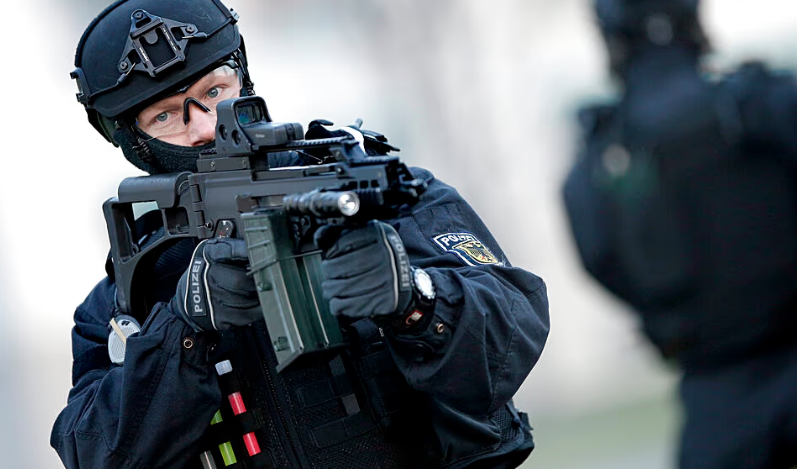
German authorities have arrested two Iraqi nationals accused of belonging to the Islamic State (IS) during the militant group’s operations in Iraq in 2016 and 2017. The Federal Public Prosecutor confirmed the detentions on Wednesday after coordinated raids were carried out across five cities.

The suspects, identified as Muthana S and Kais S J, were taken into custody on Tuesday in separate operations. Officers from the Federal Criminal Police Office detained Muthana S in Trier, located in Rhineland-Palatinate, while Kais S J was arrested in Delbrück in North Rhine-Westphalia.

According to German prosecutors, both men are suspected of being members of a foreign terrorist organisation under national security laws. Investigators allege that each man spent several months associated with IS during the group’s peak territorial control in Iraq. Court documents state that Kais S J served on an IS Sharia committee, while Muthana S is believed to have acted as a fighter.

Their arrests were authorised following warrants issued by an investigative judge at the Federal Court of Justice on 24 November. After being apprehended, both men were brought before the same judge on Tuesday, where pre-trial detention orders were issued.

Raids linked to the investigation extended beyond the two suspects. Police searched the homes of three additional individuals in Trier, Delbrück, Cologne, Chemnitz and Wittmund in Lower Saxony. Authorities have not confirmed whether these individuals are under active investigation.

The Federal Public Prosecutor did not disclose what evidence prompted the operation or whether either suspect is believed to have engaged in activities posing a risk inside Germany. The announcement follows a series of recent counterterrorism actions across the country targeting individuals whose past ties to extremist groups abroad have come under renewed scrutiny.

See also  Kosovo Accuses Serbia After Explosion Disrupts Key Water and Power Supplies

Germany has conducted dozens of similar investigations in recent years as part of its efforts to pursue suspected IS affiliates who entered the country during earlier migration waves or who later resurfaced in intelligence assessments. Authorities say such cases remain a key element of national security strategy, even as IS no longer controls territory in the Middle East.

Both suspects will remain in custody as prosecutors continue building the case, with no indication yet of when formal charges may be filed.

News

Trump Weighs Troop Cuts in Spain and Italy Amid Growing Rift Over Iran War

Published

on

President Donald Trump said on Friday that he is considering reducing the US military presence in Spain and Italy, widening a dispute with key NATO allies over their opposition to the ongoing war with Iran.

Speaking to reporters in the Oval Office, Trump suggested both countries had failed to adequately support Washington’s military campaign in the Middle East.

“Yeah, probably, I probably will. Why shouldn’t I?” Trump said when asked whether he would withdraw troops from the two countries. He added that Italy “has not been of any help” and described Spain as “absolutely horrible.”

The comments came just one day after Trump floated a similar proposal regarding Germany, following criticism from German Chancellor Friedrich Merz over the administration’s handling of the Iran conflict.

Trump has repeatedly argued that the US-led campaign against Iran serves the security interests of the entire Western alliance. He has expressed frustration that several NATO members have not provided stronger military or political backing, particularly in efforts to counter Iran and reopen the Strait of Hormuz.

According to the latest Pentagon figures, the United States has about 36,000 troops stationed in Germany, roughly 12,600 in Italy and nearly 3,800 in Spain. While Trump did not specify the scale of any potential reductions, reports in US media suggest the cuts under consideration could be substantial.

Tensions with Italy have grown in recent weeks after Prime Minister Giorgia Meloni publicly questioned the war. Trump, once a close ally of the Italian leader, accused her of lacking the courage to fully support the campaign.

See also  China Warns U.S. Against Tariff Escalation Amid Rare Earths Dispute

Relations with Spain have been strained for longer. Disagreements initially emerged over Madrid’s stance on the war in Gaza and later expanded to include defence spending and NATO commitments. Spain has resisted Trump’s push for alliance members to raise defence spending to 5 per cent of gross domestic product.

Prime Minister Pedro Sánchez has said Spain will only increase military spending when it aligns with national interests. That position has drawn repeated criticism from Washington.

The Trump administration has previously threatened trade measures against Spain and has even raised the possibility of suspending the country from NATO. Reports last week indicated that such discussions have resurfaced amid Spain’s refusal to support the Iran campaign.

The diplomatic tensions come as the war enters its third month, with no clear end in sight. The conflict has disrupted global energy markets, especially after the closure of the Strait of Hormuz. Brent crude settled at around $114 a barrel on Friday, sharply higher than the roughly $70 level seen before the conflict began.

Trump’s latest remarks are likely to deepen divisions within NATO at a time when alliance unity is already under strain.

Continue Reading

News

Trump Threatens Troop Reduction in Germany Amid Dispute With Chancellor Merz

Published

on

US President Donald Trump has suggested that the United States could reduce its military presence in Germany, escalating tensions with German Chancellor Friedrich Merz over the handling of the conflict involving Iran.

In a social media post on Wednesday, Trump said Washington was reviewing the possibility of withdrawing some American troops from Germany, with a decision expected soon. The announcement comes amid a growing public disagreement between the two leaders over US strategy in the Middle East.

“The United States is studying and reviewing the possible reduction of troops in Germany,” Trump wrote, signalling that the longstanding American military footprint in Europe’s largest economy could once again be under scrutiny.

Germany hosts some of the most important US military facilities outside the United States, including Ramstein Air Base, the headquarters of US European Command and US Africa Command, and Landstuhl Regional Medical Center, the largest American military hospital abroad.

Trump’s latest warning follows comments by Merz earlier this week, in which the German leader said Washington was being “humiliated” by Iran and questioned the effectiveness of the US approach to the conflict. Merz has repeatedly called for a clearer strategy and a diplomatic resolution to the crisis.

Despite the sharp exchange, Merz said on Wednesday that his personal relationship with Trump remained strong. He added, however, that he had harboured concerns from the outset about the military campaign against Iran.

The two leaders met at the White House in March, shortly after the United States and Israel launched strikes on Iranian targets. At the time, Merz said Germany was prepared to work closely with Washington on future regional strategy, while also warning that a prolonged conflict could inflict serious damage on the global economy.

See also  Pakistani Forces Kill 54 Militants Along Afghan Border in Major Operation

That concern has intensified as the closure of the Strait of Hormuz continues to disrupt global energy markets. The vital waterway, through which about one-fifth of the world’s oil supply normally passes, has remained effectively shut since fighting began in late February.

“We are suffering considerably in Germany and in Europe from the consequences of the closure of the Strait of Hormuz,” Merz said, urging all sides to seek a resolution.

Trump, however, has shown increasing frustration with Germany’s stance. In a post on Tuesday, he criticised Merz’s remarks on Iran and accused the chancellor of misunderstanding the threat posed by Tehran’s nuclear ambitions.

This is not the first time Trump has threatened to reduce US troop levels in Germany. During his first term, he announced plans to withdraw nearly 10,000 troops, citing Berlin’s defence spending. That proposal was later halted by the Biden administration.

Any renewed reduction would likely raise fresh questions about US commitment to NATO and European security at a time of heightened global instability.

Continue Reading

News

Unverified Videos Show Armed Women in Iran as State Projects Wartime Unity

Published

on

Videos circulating on social media appear to show armed Iranian women taking part in military-style parades in several cities, in what state-linked outlets have described as a “jihad of women” in support of Iran’s wartime mobilisation.

The footage, which has not been independently verified, reportedly shows women carrying assault rifles, riding in armoured vehicles and marching alongside members of the Islamic Revolutionary Guard Corps (IRGC). The scenes are said to have been filmed in Tehran, Mashhad, Qom, Rasht, Bushehr and Qazvin.

In the videos, women can be seen travelling in organised convoys through city streets while pro-government chants ring out. Some clips have been aired on Iranian state television, while media outlets affiliated with the IRGC have presented the displays as evidence of broad public support for the Islamic Republic amid its conflict with the United States and Israel.

The imagery marks a notable shift in Iran’s wartime propaganda. Since the 1979 Islamic Revolution, women have frequently been portrayed in official narratives as supporters of the state, often as mothers, caregivers or volunteers in auxiliary roles. During the Iran-Iraq war in the 1980s, such symbolism was widely used to bolster morale. Public displays of women bearing arms in urban military parades, however, are far less common.

Questions have emerged about the authenticity of some of the footage. Analysts and social media users have pointed to visual irregularities, suggesting that certain clips may have been digitally altered or generated using artificial intelligence. No conclusive evidence has been presented, and Iranian authorities have not commented on claims that any of the videos may be fabricated.

See also  Russia Intensifies Drone Assaults as Ukraine Faces New Threats Amidst Trump’s Reelection

One detail that has drawn particular attention is the appearance of some women without the full hijab required under Iranian law. That has prompted further scrutiny, given the government’s strict enforcement of dress regulations over many years.

The videos have surfaced at a time of intense pressure on Iran’s leadership. The country is grappling with the fallout from a prolonged conflict with the United States and Israel, while also facing deep domestic unrest.

Large-scale protests erupted late last year after the collapse of the Iranian rial, spreading to cities across the country. The demonstrations were met with a severe crackdown in January. Casualty estimates vary widely, with official figures placing the death toll in the low thousands, while human rights groups and independent observers believe the number may be significantly higher.

Iran has maintained tight restrictions on internet access since the crackdown, making independent verification of events inside the country increasingly difficult.

Against that backdrop, the emergence of these videos appears aimed at projecting an image of national unity, resilience and public support as the government confronts both external conflict and internal dissent.

Continue Reading

Trending