
Business
UK Inflation Rises to 3.6% in October as Record Diesel Prices Push Up Costs


UK inflation edged higher in October as rising petrol and diesel prices outweighed a slowdown in food costs, according to figures from the Office for National Statistics (ONS).
The annual consumer price inflation rate increased to 3.6 per cent from 3.5 per cent in September. Motor fuel prices were the main contributor to the rise, with diesel reaching a record high and petrol climbing to its highest level since August 2022.
Grant Fitzner, chief economist at the ONS, said fuel prices had again played a major role in pushing up the annual inflation rate.
Motor fuel prices increased by 33.2 per cent in the year to October, compared with 29.8 per cent in September. This was the fastest annual rise since July 2022. The increase pushed transport inflation to 7.5 per cent, up from 6.6 per cent a month earlier, making transport the largest contributor to the overall rise.
The figures also showed some relief for households buying food. Inflation for food and non-alcoholic drinks slowed to 0.9 per cent in October from 1.3 per cent in September. It was the lowest annual rate since September 2021.
Core inflation, which excludes energy, food, alcohol and tobacco, remained unchanged at 2.8 per cent. The overall Consumer Prices Index rose by 0.5 per cent between September and October.
Sanjay Raja, Deutsche Bank’s chief UK economist, said the figures were considerably softer than expected. He noted that food prices were rising slowly, although increases were anticipated during 2027.
Implications for interest rates
The latest data could give the Bank of England some room to assess its next interest rate decision. Raja said both headline and core inflation were 0.1 percentage points below the central bank’s November forecasts. Services inflation remained at 3.7 per cent, also below the level the Bank had anticipated.
The Bank raised its main interest rate by 0.25 percentage points to 4 per cent in early November, marking its first increase in more than three years as it sought to contain inflation.
However, Raja warned that further price pressures could emerge in the coming months. He expects Ofgem’s household energy price cap to rise by more than 20 per cent in January, while food inflation could accelerate again.
He also highlighted the planned expiry in July 2027 of two temporary tax reductions affecting petrol and diesel and household electricity in Great Britain.
The Bank’s November projections suggested inflation could reach around 5 per cent in mid-2027. Under a scenario involving a sharp and sustained rise in energy prices, it estimated that inflation could climb to approximately 6.2 per cent in the third quarter.
Raja expects the peak to be lower, forecasting inflation above 4 per cent early next year before gradually easing towards 3 per cent by the end of 2027. He said a sustained return to the Bank’s 2 per cent target was unlikely before late 2028.






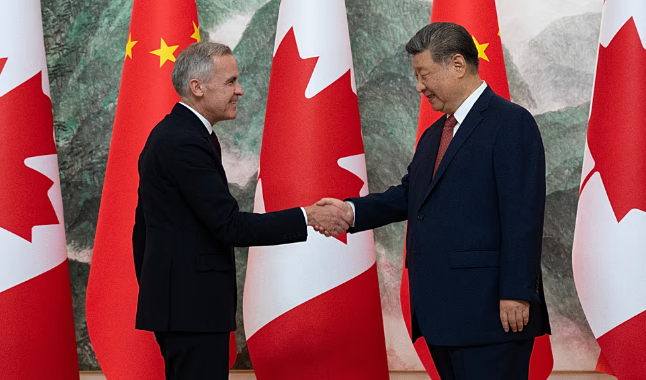
Canada and China have agreed to reduce trade barriers on several goods, offering relief to Canadian pork and seafood exporters while extending exemptions for Chinese steel and aluminium products. The agreement comes as Ottawa seeks to diversify its trading relationships amid pressure from US tariffs.
The measures were announced after Canadian Prime Minister Mark Carney met Chinese President Xi Jinping in Shenzhen on Tuesday, ahead of the Asia-Pacific Economic Cooperation summit.
China will suspend additional tariffs of 25% on most frozen pork cuts and selected seafood products from January 1, 2027, until December 31, 2028, according to the Canadian prime minister’s office.
The affected exports were worth approximately C$400 million (€254 million) in 2024, before the additional duties were introduced. Eligible seafood products include certain frozen cold-water shrimp and prawns, molluscs, sea cucumbers and Greenland halibut.
In return, Canada will maintain existing tariff exemptions for selected Chinese steel and aluminium products until the end of 2028. Ottawa will also introduce full or partial exemptions for 32 additional product categories where domestic supplies are insufficient or unavailable.
The latest agreement builds on trade measures announced earlier this month, when China extended tariff relief on Canadian canola meal, peas, lobster and crab through 2028. Canada also confirmed an extension of existing exemptions covering Chinese metals.
Ottawa seeks to diversify trade
Carney has been working to expand Canada’s overseas trade as tariffs imposed by US President Donald Trump affect industries that rely heavily on access to the American market.
Foreign Minister Anita Anand said on Wednesday that Canada was taking a gradual approach to restoring economic relations with China while reducing its dependence on a single trading partner.
Speaking in Shenzhen, Carney said Canadian exports to China had increased by more than a third this year. However, he stressed that negotiations with Washington remained a priority.
“The United States fundamentally changed its trade objectives, and we are focused on getting the right deal for Canadians,” he told reporters.
The prime minister said earlier this week that Canada could consider working with Chinese carmakers if discussions with the United States failed to protect the closely connected North American automotive industry. He maintained that securing an agreement with Washington remained his preferred option.
Previous steps towards closer trade ties
Canada and China began easing trade restrictions following an agreement reached during Carney’s visit to Beijing in January.
Under that arrangement, Ottawa agreed to initially allow up to 49,000 Chinese electric vehicles into Canada each year at a reduced tariff rate of 6.1%. Beijing, in return, agreed to lower duties on Canadian agricultural products, including canola.
Carney has also announced plans for a Canadian trade mission to China in 2027 and a joint initiative to help smaller Canadian businesses reach Chinese consumers through online shopping platforms.
The latest measures reflect efforts by both countries to restore commercial ties, while Canada continues to negotiate with its largest trading partner, the United States.

Entrepreneurs in Germany need almost 4,000 hours to complete the administrative procedures required to open a small business, making it the slowest country in a new international ranking covering 27 nations across Europe, Latin America and the Caribbean.
The Index of Bureaucracy 2026 estimates that setting up a business in Germany takes 3,942 hours, equivalent to almost 500 eight-hour working days. The figure is nearly 18 times higher than France, which ranked first with just 223 hours, or around 28 working days.
Compiled by the Adam Smith Center for Economic Freedom at Florida International University, the index measures the time required to register a company, obtain permits and complete other legal requirements, including waiting for official approvals.
The study covers 20 countries in Latin America and the Caribbean, five EU member states, Germany, France, Italy, Portugal and Spain, as well as the United Kingdom and Ukraine. It is not a ranking of all EU countries. The average across the 27 nations was 1,638 hours.
Germany, Europe’s largest economy, ranked behind every Latin American and Caribbean country included in the assessment. Venezuela required 2,738 hours, while Peru took 3,853 hours.
According to the report, municipal permits and business registration account for approximately 2,400 hours of the German total. Identification and registry procedures add another 1,440 hours.
Sary Levy-Carciente, the index’s lead author, told Euronews that Germany’s administrative burden was concentrated in complex local procedures. She pointed to the involvement of multiple municipal departments, separate paperwork requirements, mandatory notarisation for certain company structures and delays in electronic processing at local courts.
The study’s German estimate is based on three sample businesses weighted according to their contribution to the economy. A farm producing pigs and grain or a machine-tool manufacturer could require as many as 8,633 hours, partly because of environmental permitting requirements. A car dealership and repair business would need around 2,056 hours.
The findings come as Chancellor Friedrich Merz’s government seeks to reduce bureaucracy and improve conditions for businesses. Its coalition agreement pledged to introduce a digital one-stop service allowing companies to be established within 24 hours. More than 100 founders and business managers also supported a similar demand from the German Startup Association in June.
France’s 223 hours placed it first, followed by Italy at 303 hours and Brazil in third place. Portugal ranked fourth at 335 hours, while Spain required 707 hours. Ukraine recorded 603 hours, whereas the UK took 1,873 hours, above the overall average.
Levy-Carciente said the main difference between faster and slower countries was the efficiency of local registration systems. Municipal permits and registration take about one hour in France and 24 hours in Italy, compared with approximately 2,400 hours in Germany.
The report found no clear link between a country’s wealth and the time required to establish a business. It warned that excessive procedures can discourage entrepreneurship and push businesses into the informal economy.
The European Commission has proposed an optional company structure, EU Inc, designed to allow online registration across the bloc within 48 hours for up to €100.

Renault plans to create 2,000 jobs in France by 2028 while reducing its workforce by 1,000 positions, mainly in administrative functions, as the carmaker reorganises its operations to compete with growing pressure from Chinese manufacturers.
The French company presented its France Industrie FutuREady project to trade unions on Monday, outlining changes to its industrial activities over the next two years. The plan is intended to strengthen production capacity and adapt the business to changing conditions in the European automotive market.
Thierry Charvet, Renault’s head of quality, manufacturing and supply chain, said most of the new positions would be production-related roles, commonly known as blue-collar jobs.
Of the 2,000 planned hires, 1,650 will be operators and production workers at Renault’s French plants. Another 250 positions will cover indirect functions, while 100 places will be offered to young graduates.
Renault currently employs around 15,000 industrial workers in France. The additional recruitment is expected to support manufacturing operations as the company adjusts its production methods and prepares for future vehicle programmes.
Alongside the recruitment drive, Renault intends to arrange 1,000 voluntary departures among white-collar employees working mainly in administrative and indirect functions. The departure scheme has not yet been finalised and will require negotiations with trade unions.
The CFDT union criticised the timetable for implementing the changes, describing it as a “forced march schedule”. Union representatives are expected to seek further details about the proposed departures and the impact on employees affected by the restructuring.
Renault said certain areas considered essential to its future operations would be protected. These include battery engineering, electronics and software development, electric powertrains and industrial maintenance.
The decision to safeguard these skills reflects the industry’s shift towards electric vehicles and increasingly software-driven technologies. Manufacturers are under pressure to improve efficiency while developing products that can compete with lower-priced models from Chinese companies.
The restructuring comes as Europe’s automotive sector faces several challenges, including weak consumer demand, excess manufacturing capacity and intensifying competition from overseas producers.
Chinese carmakers have expanded their presence in international markets, particularly in electric vehicles, putting pressure on established European brands to reduce costs and accelerate product development.
Renault has also been expanding its manufacturing plans outside France. In September, the company announced a €600 million investment in Spain by 2030 to produce five new models.
The French workforce changes form part of a broader effort to reshape Renault’s industrial operations while maintaining production expertise in key technologies. The company is seeking to balance new recruitment in manufacturing with reductions in administrative roles as competition across the European car market continues to intensify.

Canada and China Agree to Ease Tariffs on Pork, Seafood and Metals

Germany Ranks Last in Business Start-up Bureaucracy Study, Requiring Nearly 4,000 Hours

UK Inflation Rises to 3.6% in October as Record Diesel Prices Push Up Costs

EU Accuses Temu of Failing to Prevent Illegal Products, Risking Heavy Fine

Measles Cases Decline Across Europe in 2026, but Outbreaks Persist in Several Countries

Renault Plans 2,000 New Jobs in France While Cutting 1,000 Administrative Roles

Global Stocks Slide as Nvidia Leadership Uncertainty Puts AI Trade Under Pressure

Estonia to Close Russian Border Crossings After Foiled Attack on Drone Manufacturer

Berkeley Study Reveals How Sleep and Growth Hormone Work Together to Regulate Waking

Australia Beat New Zealand 32-12 to Win Fourth Consecutive Rugby League World Cup

Meta Acquires Tilda Swinton VR Doc ‘Impulse: Playing With Reality’

China’s Historic Olympic Victory Sparks National Pride Amid Controversy

Saudi Arabia’s Model for Sustainable Aviation Practices

Recent Developments in Small Business Taxes

Effective Drain Cleaning: A Key to a Healthy Plumbing System

Who was Ebrahim Raisi and his status in Iranian Politics?

Keely Hodgkinson Wins Britain’s First Athletics Gold at Paris Olympics in 800m

Carrectly: Revolutionizing Car Care in Chicago

Nobel Laureate Muhammad Yunus Proposed as Head of Bangladesh’s Interim Government Following Hasina’s Resignation

Chinese Hackers Infiltrate Major U.S. Telecom Firms in Possible National Security Breach

Sony WF-10XM4: Headphones Are Our Absolute Favorite

10 Places You Can’t Miss If It’s Your First Time in European

New Census Data Will Shake Up Alabama Politics

16 Top of Our Favorite Outdoor Clothing Brands

Fashionable Summer Accessories to Dress Up Your Travel Look

How Sleeping Less than 7 Hours a Night Can Lead to Weight Gain
-
 Entertainment2 years ago
Meta Acquires Tilda Swinton VR Doc ‘Impulse: Playing With Reality’
-
 Sports2 years ago
China’s Historic Olympic Victory Sparks National Pride Amid Controversy
-
 Business2 years ago
Saudi Arabia’s Model for Sustainable Aviation Practices
-
 Business2 years ago
Recent Developments in Small Business Taxes
-
 Home Improvement2 years ago
Effective Drain Cleaning: A Key to a Healthy Plumbing System
-
 Politics2 years ago
Who was Ebrahim Raisi and his status in Iranian Politics?
-
 Sports2 years ago
Keely Hodgkinson Wins Britain’s First Athletics Gold at Paris Olympics in 800m
-
 Business2 years ago
Carrectly: Revolutionizing Car Care in Chicago
You must be logged in to post a comment Login